
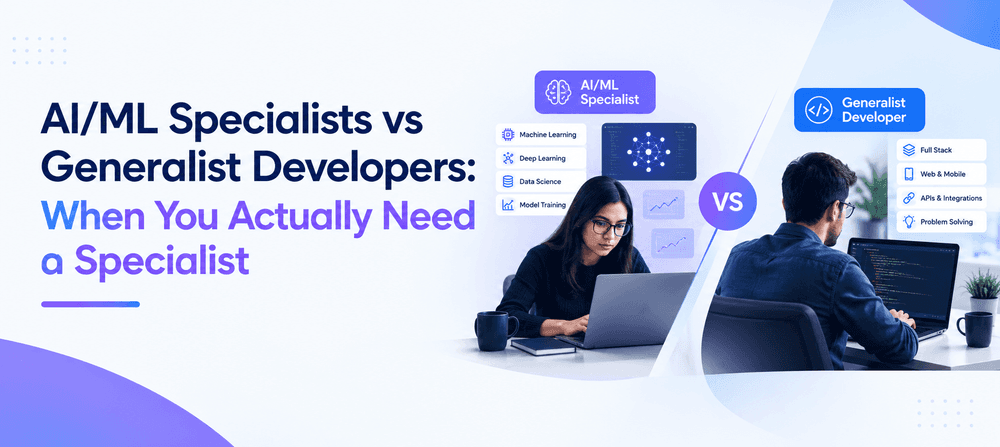
Every engineering leader eventually hits the same fork. A new feature needs machine learning, or a model that worked fine in a notebook has to run in production, and the question lands on your desk: do we hand this to the strong generalist we already trust, or do we go find an actual AI/ML specialist?
It's a more expensive decision than it looks. Reach for a specialist too early and you pay a premium for someone who spends their week on work any senior engineer could have done and gets bored enough to leave. Lean on a generalist too long and you get a model that demos beautifully, then quietly degrades in production while nobody understands why. Both mistakes are common, and both are costly.
This guide is about telling the two situations apart. We'll look at what actually separates an AI/ML specialist from a capable generalist, the real cost of getting the match wrong in either direction, the concrete signals that you've crossed into specialist territory, and how to source each without overpaying or under-hiring.
First, What Actually Is the Difference?
The line isn't "one knows AI and one doesn't." Plenty of strong generalist developers can call an API, fine-tune a model with a tutorial open, or wire up a recommendation feature that works. The real difference shows up in the parts that don't come with a tutorial.
A generalist developer is a breadth specialist. They move fluidly across the stack frontend, backend, databases, infrastructure and their value is that they can own a feature end to end and adapt to whatever the product throws at them. Give a good one an unfamiliar problem and they'll figure it out. That versatility is exactly what most software needs most of the time.
An AI/ML specialist is a depth specialist. Their value lives in the places where machine learning stops behaving like ordinary software: data pipelines that have to stay clean at scale, the maths of why a model is drifting, the trade-offs between model architectures, the discipline of MLOps versioning, monitoring, retraining, and deployment of models that decay over time. They've seen the failure modes that only appear at scale or six months in, and they know which ones matter.
Here's the distinction that saves you money: a generalist can usually get a model working. A specialist is who you need to keep it working, trustworthy, and economical once it's carrying real load. Most teams don't need that depth for every AI feature but when they need it, nothing else substitutes for it.
The Real Cost of Getting the Match Wrong
Both directions of mismatch have a price, and it helps to see them side by side before you decide.
Using a generalist for genuine specialist work: This is the more dangerous error because it hides. The feature ships, the demo lands, everyone moves on and then the model's accuracy slips as real-world data drifts from the training set, and there's no monitoring to catch it. Costs balloon because nobody optimised inference. A subtle data-leakage bug means the impressive test numbers never materialise in production. The generalist isn't at fault; they were handed a problem outside their depth and did their best. But the cleanup, often paid in lost trust and a specialist hired in a panic later, costs far more than hiring right the first time.
Using a specialist for generalist work: The quieter waste. A senior ML engineer commanding a premium salary spends their weeks building CRUD endpoints and fixing frontend bugs because that's what the backlog holds. They're overqualified, underused, and critically bored. Specialists leave roles that don't use their specialism, and now you're re-hiring one of the hardest profiles on the market. You paid top rates to create your own retention problem.
The honest framing is that neither profile is "better." They're tools for different jobs, and the cost of the wrong tool is real in both directions. The skill is matching the hire to the work in front of you the same principle behind deciding whether you need more people or different skills when your team is under pressure.
Signals You Genuinely Need an AI/ML Specialist
Vague ambition ("we want to do more with AI") is not a signal. These are. If several of these describe your situation, you've likely crossed into specialist territory.
Models are going into production, not just demos: A proof of concept in a notebook is generalist-friendly. The moment a model has to serve live predictions reliably, at latency, with monitoring and a retraining plan, you need someone who has operated models in production before.
Model performance is the product, not a feature: If your core value proposition is the quality of the prediction — a fraud engine, a diagnostic tool, a pricing model then squeezing out accuracy and reliability is the business, and that's specialist work by definition.
You're dealing with scale, drift, or cost problems: When inference bills are climbing, accuracy is mysteriously degrading over time, or your pipeline buckles under real data volume, these are classic depth problems. A generalist can't reliably diagnose what they haven't seen before.
The maths genuinely matters: Custom model architectures, novel loss functions, rigorous evaluation design — when the hard part is the modelling itself rather than the engineering around it, you need the depth.
Regulation or risk is in play: Explainability, bias auditing, and model governance in regulated sectors aren't things you improvise. They require someone who treats them as a discipline.
If your situation matches these, the next question is sourcing and understanding where AI/ML engineers actually are, and what they cost is the realistic starting point, because this is one of the scarcest and most competitive profiles in the market.
When a Generalist Is Actually the Right Call
Just as important, and more often true than teams admit. Reaching for a specialist by reflex is how budgets get wasted.
You're validating an idea: Early-stage AI features that may not survive contact with users don't need production-grade ML rigour yet. A strong generalist using existing APIs and pre-built models gets you to a learning point faster and cheaper. Bring the specialist in once the bet is proven.
The AI part is small and well-served by APIs: A huge amount of useful "AI" today is a well-integrated call to an existing model. Integrating it cleanly into a product is exactly what a good generalist does best and handing it to a specialist wastes their depth on plumbing.
The real work is the software around the model: Often the model is 10% of the effort and the product the interface, the data flow, the reliability is the other 90%. That 90% is generalist territory, and a versatile engineer who can own the whole feature serves you better than a narrow expert who only touches the model.
You need flexibility more than depth: At a small company where priorities shift weekly, a generalist who can move across the stack is often more valuable than a specialist whose depth sits idle between AI projects. This is a big part of why staff augmentation works well for shifting needs you can add the exact profile the moment the work calls for it, rather than carrying it permanently.
A good rule of thumb: start with the generalist, and bring in the specialist when the specialism becomes the bottleneck. You'll know when it does.
Don't Forget the Hybrid Reality
The cleanest version of this decision one role, one hire is often not how it actually plays out. The strongest AI products are usually built by a team with both profiles, not by choosing one.
In practice, a specialist owns the model, the pipeline, and the ML infrastructure, while generalists build the product around it the application, the data interfaces, the user experience. The specialist's depth makes the model trustworthy; the generalists' breadth turns it into something customers can actually use. Pit the two against each other and you miss the point. The real question for most teams isn't "which one," it's "what mix, and in what order."
That mix is also why rigid hiring plans fail. The right blend shifts as a project moves from validation to scale, which is why building a technology workforce that can flex its composition tends to beat locking in a fixed headcount of one profile.
How to Source Each Without Overpaying or Under-Hiring
Once you know which profile you need, the sourcing problem is different for each, and getting it wrong reintroduces all the cost you were trying to avoid.
Sourcing generalists. The larger talent pool, but "senior full-stack engineer" spans a enormous range of actual ability. The risk here is paying senior rates for mid-level delivery. Real technical vetting not resume-matching is what protects you, and the markers for choosing a partner who vets properly apply directly. Get a realistic read on what developers actually cost before you benchmark offers, so you neither overpay nor lose good people to a low one.
Sourcing AI/ML specialists: A different game entirely. The pool is small, the competition is fierce, and crucially most generalist recruiters can't tell a genuine ML specialist from someone who's done a couple of courses. Screening for real depth takes someone who understands the discipline well enough to probe it. This is precisely where specialist search beats volume recruiting: you're looking for a handful of right people, not a pipeline of plausible ones, which is the same logic behind specialist and leadership search versus high-volume recruiting.
Sourcing in India specifically: For both profiles, India offers deep talent but access isn't the same as a good hire. Compensation norms, notice periods, and intense competition for AI/ML talent in particular mean local market intelligence is what separates a confident hire from an expensive miss.
A Practical Checklist Before You Hire
Run your situation through these before you commit to either profile.
- Is the model going to production, or staying a demo?
Production reliability pushes you toward a specialist; a throwaway prototype doesn't. - Is model quality the product, or a feature?
If accuracy is the business, hire depth. If the model is a small part of a larger product, breadth usually wins. - Can an existing API do this well enough?
If yes, a generalist integrating it is faster and cheaper than a specialist building from scratch. - How stable are your priorities?
Shifting week to week favours a flexible generalist; a sustained ML roadmap justifies dedicated specialist depth. - Do you actually need one, or a mix?
Be honest about how much of the work is the model versus the software around it. Most AI products need both profiles in some ratio. - Does whoever is hiring understand the difference?
A recruiter who can't tell real ML depth from a course certificate will cost you either way. Insist on genuine technical vetting.
Where SquadXP Fits
We'll be straight about the value here. The hardest part of this decision isn't usually the strategy it's the sourcing, because most hiring channels can't reliably distinguish a true AI/ML specialist from a generalist who's dabbled, and they can't tell a genuinely senior generalist from a well-marketed mid-level one.
SquadXP's specialist hiring practice is built for exactly that gap. We run targeted, technically rigorous searches for the roles where depth matters AI/ML engineering, cloud architecture, and other scarce skills backed by real market intelligence so you're seeing pre-vetted people, not a pipeline of plausible resumes. And because most AI products need a mix of depth and breadth, specialist search sits alongside dedicated teams that pair the two, built on the principle of teams measured by outcomes, not just headcount. Whether you need one rare specialist or a balanced squad, the aim is the same: the right profile for the work, vetted properly, contributing from the first sprint.
Build Your Next Team With Confidence
The honest answer to "specialist or generalist" is that it depends entirely on the work in front of you and that most teams need both, in a ratio that shifts as the project matures. Generalists give you breadth, flexibility, and speed for the large majority of software, including a lot of what gets called AI. Specialists give you the depth that keeps a production model trustworthy, efficient, and defensible when model quality is the business.
Get the match right and both profiles earn their keep. Get it wrong a generalist out of their depth, or a specialist underused and heading for the door and you pay for it, usually twice. If you want help telling which one your situation actually calls for, and sourcing it without overpaying or under-hiring, we would be glad to talk it through. Reach out about specialist hiring or a dedicated team for your AI roadmap.