
Most advice about IT augmentation is written for companies that have an engineering manager on every team and a procurement department to read the contract. Startups have neither. The founder evaluating augmentation is usually the same person who will interview the engineers, review their pull requests, and explain the product to them on a Tuesday night.
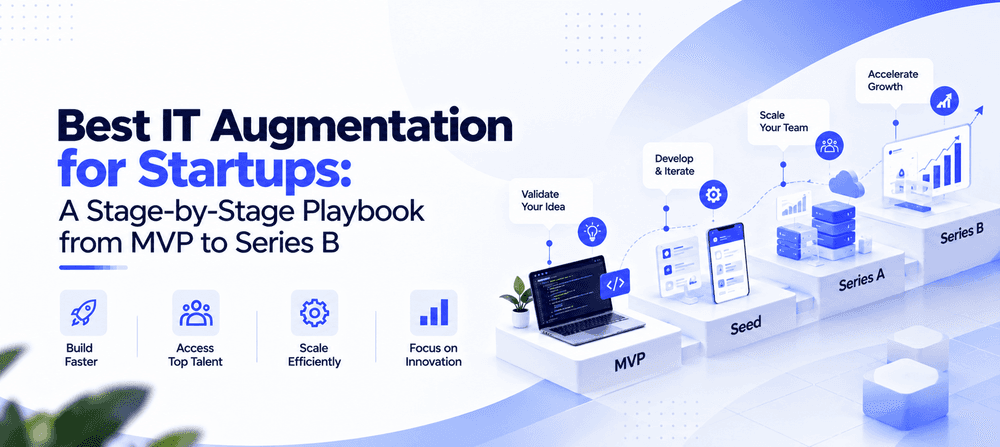
That changes what “best” even means. The best IT augmentation for a startup isn’t the vendor with the biggest bench or the lowest hourly rate. It’s the arrangement that fits your stage: how much product certainty you have, how much leadership capacity you can spare, and how soon you’ll need people you own outright. This guide walks through four stages, from pre-seed MVP to Series B, and shows what to augment, what to keep in-house, and what to watch for at each one. If you want the broader case for augmentation first, the guide on when to use staff augmentation covers the general scenarios.
Why startup augmentation is a different problem
Enterprises use augmentation to add capacity to a system that already works. Startups use it while the system is still being invented, and three things follow from that. First, direction changes often; a startup can rewrite its roadmap after ten customer calls, so augmented engineers have to tolerate ambiguity and your contract has to tolerate changes in role and headcount. Second, management bandwidth is the real constraint, not budget; augmentation keeps day-to-day direction with you, so if nobody on your side can set priorities and review work, adding engineers adds noise, not speed. Third, ownership matters earlier than you’d think; investors, acquirers, and future senior hires will all ask who actually knows the codebase, and if the answer is “people at a vendor,” that becomes a risk you need a plan for.
Stage 1: Pre-seed and MVP
At this stage you’re buying learning speed. The goal is to get a working product in front of users and find out what they actually do with it.
What to augment: one or two strong generalists, usually a full-stack engineer and, if your product is mobile-first, a mobile developer. Seniority matters far more than headcount here. One senior engineer who can make sensible architecture calls without supervision is worth more than three juniors who need direction you can’t give. What to keep in-house: product decisions and the relationship with early users, and if you have a technical co-founder, they should own the architecture even if they write almost none of the code.
A few things to watch for. Be wary of engineers who build exactly what the ticket says without questioning it, because at MVP stage you want people who notice when a feature doesn’t make sense. Watch for over-engineering too, since an engineer used to enterprise work may build for a scale you won’t reach for years. And never accept code you can’t read: insist on a shared repository under your own organisation’s account from day one, with documentation on how to run and deploy the product.
Stage 2: Seed, after early traction
Once you have paying or active users, the work shifts. Bugs now hit real customers, and you’re building features users asked for rather than features you guessed at.
What to augment: this is often where a small pod makes sense, say two or three engineers plus part-time QA. What to keep in-house: your first technical lead. If you don’t have a technical co-founder, this is the stage to hire one or bring in a fractional technical leader, because augmented engineers perform best when someone on your side owns the technical roadmap.
Two things to watch. Don’t let knowledge concentrate in one augmented engineer; rotate code reviews so at least two people understand every critical system. And revisit contract terms that made sense at MVP stage but now block you, checking notice periods and whether you can swap roles, say from a frontend engineer to a backend one, without signing a new contract. Getting the real cost picture right matters here too, and the US-vs-India cost-per-engineer breakdown is a useful reference as the pod grows.
Stage 3: Series A
A Series A usually brings a hiring plan, a board that asks about engineering velocity, and pressure to show the team can scale. This is the stage where a lot of startups misuse augmentation, either leaning on it too heavily for core work or abandoning it too early and stalling on slow permanent hiring.
What to augment: specialist and surge capacity. Data engineering, DevOps, security reviews, and integrations are strong candidates because they’re well defined and often needed before you can justify a permanent role, and augmentation is also useful for bridging the months it takes to fill senior permanent positions. What to keep in-house: core product engineering leadership and the engineers who own your most important systems. By Series A you should be building a permanent team, with augmentation around it rather than instead of it.
Watch for an augmented team that grows faster than your ability to lead it; a good rule of thumb is that each in-house lead should direct only as many augmented engineers as they can genuinely review and mentor. And guard against vendor lock-in through undocumented systems by making documentation and runbooks part of your definition of done. If you’re adding scarce specialist roles at this stage, understanding what it takes to hire AI/ML engineers in India helps set realistic expectations on cost and availability.
Stage 4: Series B and beyond
By Series B, many startups start asking a bigger question: should we have our own engineering presence in a lower-cost talent market? For companies looking at India, this is where models like Build-Operate-Transfer become relevant.
Under Build-Operate-Transfer model, engineers are hired on our payroll and work exclusively for your company while SquadXP handles payroll, statutory compliance, and HR. Once your own India entity is ready, the team transfers to you. For a startup, that avoids waiting on entity registration before you can hire, while still ending with a team you own. What to augment: teams for new product lines or markets, and capacity you’re not yet sure you need permanently. What to keep in-house: everything that defines your product’s competitive edge, plus the leaders who’ll run any offshore team you build.
Augment, own, or decide later: a quick reference
A simple way to hold the decision: MVP builds suit augmentation with senior generalists, as long as architecture ownership stays with a founder or lead. Customer-facing bug fixing suits augmentation too, provided fixes are reviewed by someone who knows the product. Core product architecture should rarely be augmented, since it’s long-term intellectual capital. DevOps, data pipelines, and integrations are often good to augment because the scope is well defined, and the same goes for security reviews and audits, which are specialist skills you only need occasionally. Engineering leadership should not be augmented; hire it permanently, or use a fractional leader as a bridge. And a new market or product line can be augmented or run through a BOT model, which keeps the option to own the team later.
How to evaluate an IT augmentation partner as a startup
Generic vendor checklists fixate on bench size and certifications. For a startup, a different set of criteria matters more. First, the seniority of the profiles you actually see, so ask to review real profiles before you sign. Second, flexibility in the contract, minimum terms, notice periods, and whether you can change roles or scale down without penalty. Third, replacement terms: if an engineer isn’t working out, how fast is a replacement provided, and who pays for the overlap? Fourth, conversion and transfer terms, because high fees to hire an engineer permanently can trap you in a vendor relationship. Fifth, time-zone overlap, so if you’re a US-based startup working with India-based engineers, agree a daily overlap window up front, which the time-zone overlap playbook explains how to do without burning people out. And sixth, IP and access: code, cloud accounts, and design files should belong to your company from the first commit. For a deeper list of warning signs, the red flags to avoid when choosing a staff augmentation company is worth reading before you commit.
Common mistakes startups make with augmentation
The most frequent mistake is hiring for the job title, not the stage; a “senior engineer” from a large enterprise may struggle in a startup that changes direction weekly. Skipping onboarding is another, because augmented engineers need the same context as employees: product goals, customer problems, and why past decisions were made. Treating augmented engineers as outsiders, leaving them out of planning and retrospectives, slows them down and pushes up turnover. And going in with no exit plan is the quiet killer: decide early which roles you eventually want to own, and write the conversion or transfer path into the contract from the start.
A 30-day plan for your first augmented hires
In week one, define the one or two outcomes you need next quarter, not just the roles, then shortlist partners and request profiles. In week two, interview with a practical exercise that reflects your real codebase, and confirm contract terms on notice, replacement, and conversion. In week three, onboard with access to the repository, product documentation, and a short walkthrough of your customers’ problems, then assign a small, shippable first task. In week four, review the first merged work together, and adjust scope, communication rhythm, or the role itself based on what you actually see. That cadence gets you from signature to shipped code with the control you need, which is the whole point of building a scalable technology workforce in India the right way.
Conclusion
The best IT augmentation for a startup changes as the startup changes. At MVP stage, it’s a few senior generalists who can work with little direction. At seed, a small pod around an in-house lead. At Series A, specialists and surge capacity around a growing permanent team. At Series B, a path to owning an offshore team rather than renting one indefinitely. SquadXP supports startups across these stages through dedicated teams built for seed to Series C companies, specialist hiring for critical roles, and the Build-Operate-Transfer model for teams you want to own. If you’re planning your next engineering hires, the right starting question is simple: what do you need to own, and what can you rent for now?