
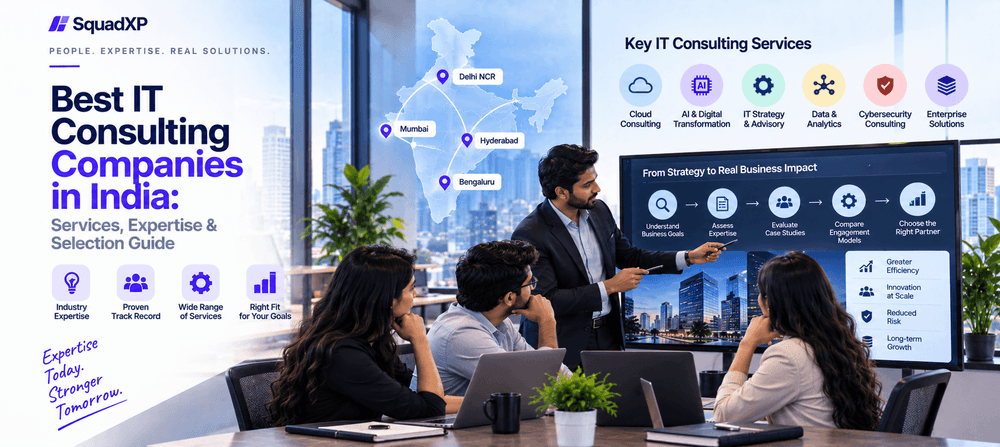
Type "best IT consulting companies in India" into Google and the results almost work against you. Global consulting giants sit next to mid-size IT services firms, boutique specialists, software development shops, staffing agencies, and team-building partners. On the surface they look interchangeable. They are not.
One business needs a cloud migration plan. Another needs a modern software architecture. A funded startup needs a fractional tech strategy for a few months. A global enterprise needs to stand up an engineering team in India that it will own for the next decade. The same search returns all of them, which is exactly why so many companies pick the wrong partner and feel it later.
Here is the shortcut most buyers miss: the "best" firm is rarely the biggest one. It is the one whose expertise and operating model match the problem you are trying to solve right now.
Quick answer: The best IT consulting company in India depends on your problem, not a ranking. Evaluate partners on technical depth, relevant experience, senior involvement, delivery method, security, and measurable outcomes. Then match their engagement model to your stage, whether that is advice, a dedicated team, or a full capability center.
What IT consulting companies in India actually do
At their core, IT consulting firms help you make better technology decisions and then execute the hard parts. The work spans IT strategy, software architecture, cloud, cybersecurity, data and analytics, AI adoption, legacy modernization, and engineering organization design.
Some firms stop at advice. Others carry the work through to implementation and team building. That difference matters more than the service list on their homepage, because a roadmap nobody can build is just an expensive PDF.
Why India is now a partner, not a back office
For years India was seen as a place to cut costs. That framing is out of date. The country now holds one of the deepest technology talent pools in the world across engineering, cloud, AI, data, cybersecurity, and product. Global companies are no longer outsourcing tickets here. They are building long-term engineering and product capability, often as Global Capability Centers.
That shift changes how you should judge a partner. Beyond "can you build it," ask whether the firm understands local talent availability, realistic hiring timelines, compensation benchmarks, and how to structure teams that stay. A strategy that needs forty niche engineers in a market where those profiles barely exist is not a strategy. It is a wish.
The main types of IT consulting companies, and what each is good for
Not every firm solves the same problem. Broadly, you will meet four kinds.
Global consulting firms serve large enterprises with broad transformation programs across strategy, cloud, data, and security. Their scale suits complex, multi-country work, and usually carries a matching price tag.
Specialist consultancies go deep on one area such as AI, cloud, data engineering, or cybersecurity. When your problem is narrow but technically hard, a specialist beats a generalist every time.
Digital transformation firms focus on modernizing aging systems and slow processes, from legacy rebuilds to cloud migration and automation.
Talent and team-building partners solve a different problem. Instead of only advising, they help you build the people to execute, through dedicated teams, specialist and leadership hiring, and GCC setup. This is the category SquadXP sits in.
How to evaluate an IT consulting company
Once you know your problem, judging firms gets easier. A few checks separate the strong ones from the confident-sounding ones.
Start with specialization. A homepage listing thirty services tells you nothing. Ask what they do exceptionally well, then ask for proof.
Check relevant experience. Look for work with companies close to yours in size, industry, technology, and geography. General experience is not the same as relevant experience.
Ask who actually does the work. A common trap is senior consultants selling the deal and junior staff delivering it. Get the real delivery structure in writing before you sign.
Probe technical depth. A strong advisor explains trade-offs, not just names technologies. "Microservices scale well" is a slogan. "Here is when microservices add cost you do not need" is expertise.
Pin down the delivery method. Phases, governance, reporting, milestones, and escalation should be clear from day one.
Take security seriously. Ask about access controls, data handling, IP ownership, and certifications. If the answers are vague, keep looking.
Finally, check scalability. Your needs will change. A useful partner can move with you from strategy to build, or connect you to delivery and proven results when you get there.
Why the cheapest quote is often the most expensive
The cost is real, but rate cards mislead. Suppose one firm quotes 60 dollars an hour and another 90. The cheaper option becomes the pricier one the moment requirements get misread, architecture needs a redo, senior help is missing, or delivery drags to twice the timeline. Rework, delays, and constant back-and-forth never appear on the quote. They appear in your calendar and your budget.
The right comparison is total cost and outcome, not the hourly number. For consulting, the value is often the expensive mistake you never made. For delivery, it is reliable software shipped faster. Judge both on where you land, not on what you pay per hour.
Consulting, or building your own team?
Consulting is not a substitute for owning capability. A healthy path usually looks like this: consult, plan, build, scale.
You use advisors to set strategy and architecture. Then you need hands to build. If capacity is the constraint and the direction is clear, a dedicated team that works as an extension of your organization usually beats a long advisory engagement. And if technology is core to your business and demand is here to stay, that team can grow into a capability you fully own through a GCC in India. The question stops being "who advises us" and becomes "do we want to own this for the long term."
Why workforce intelligence changes the answer
For anyone planning to expand engineering in India, strategy and the talent market cannot be separated. Where you hire, what you pay, which roles you fill first, and how you design the team all depend on real market data. Workforce intelligence, meaning talent availability, compensation benchmarks, and hiring trends, is what turns a good plan into one you can actually staff. Choosing a partner that leads with data instead of guesswork is one of the highest-leverage decisions you will make.
A quick selection checklist
Before you sign, get clear answers to these:
- Does the firm understand our industry and stage?
- Has it solved a problem like ours before?
- Who leads the engagement, and who delivers it?
- What are the deliverables, and how is success measured?
- How does it handle security and IP ownership?
- Can the engagement scale after the first phase?
If a firm answers these clearly, you are in good hands. If it dodges them, no ranking will save the project.
Conclusion
There is no single "best" IT consulting company in India, and any list that claims otherwise is selling something. A startup needs architecture and product clarity. A scaleup needs modernization and engineering expansion. An enterprise needs transformation, governance, and complex delivery. A global company entering India needs talent intelligence, leadership hiring, and eventually its own engineering or GCC capability.
So stop asking which firm is best. Ask which partner fits the problem in front of you, then measure their expertise, senior involvement, delivery, security, and outcomes against it. That is how you end up with a partner who builds capability, not just invoices.
If you are weighing your options for India, talk to our team. We will help you work out whether you need a dedicated team, specialist hires, or a full capability center, before you commit to anything.