
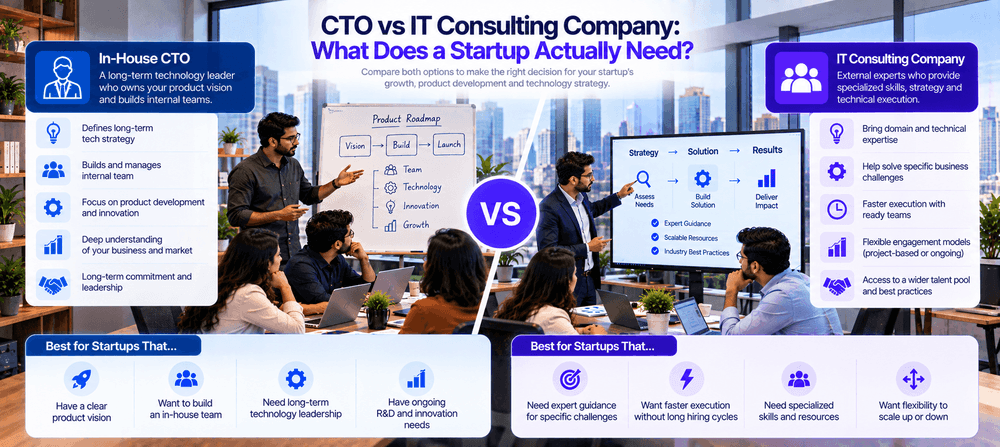
The biggest technology decision a startup makes early on often is not hiring its first developer. It is deciding who owns technology strategy in the first place. That single choice shapes your architecture, your hiring, and how fast you can move, long before any code ships.
Which is why founders keep landing on the same question: do we hire a CTO or bring in an IT consulting company? The honest answer is that it depends on your stage, how complex your technology is, and where your product is headed. Get the diagnosis right and the choice is obvious. Get it wrong and you either over-hire an executive you cannot yet use or under-serve a problem that needed real ownership.
Quick answer: A startup needs a CTO when technology leadership is a continuous, strategic function that requires owning product, architecture, and engineering. An IT consulting company fits when you need temporary specialist expertise, architecture guidance, a technology assessment, or transformation help. Many startups run a hybrid of both, and switch the mix as they grow.
What a CTO actually owns
A CTO owns technology strategy, and that is an organizational role, not a task. The remit usually spans architecture, the engineering organization, the technology roadmap, technical hiring, security, product engineering, technical debt, vendor selection, and engineering culture. Notice how much of that is about people and direction over time, not a one-off deliverable. A CTO is accountable, internally and permanently, for where the technology goes.
What an IT consulting company gives you
A consulting company brings external expertise for a defined need: architecture, cloud, security, AI, technology strategy, or technical due diligence. The relationship is contractual, with a clear scope and an end. You get sharp skill on a specific problem without adding a permanent executive to the payroll. What you do not get is someone who lives inside your company and owns the outcome for the long haul.
Your stage changes the answer
Before product-market fit, you may not need a full-time CTO yet. What you often need is technical architecture, MVP development, product engineering, and technical validation, and external specialists or a small team can cover a lot of that ground. Once you hit early growth and engineering becomes central to the product, permanent technology leadership starts to matter far more. By the scaleup stage, you generally need real organizational leadership, a CTO managing a VP of Engineering, engineering managers, platform, and security. The role grows from "help us build" to "run our entire technology organization."
The cost that really matters
A CTO is a senior permanent executive, so the cost includes salary, benefits, equity, recruitment, and management responsibility. But the bigger number is not on the offer letter. It is the organizational commitment of adding a C-level leader before the company is ready to use one. Consulting, by contrast, flexes. You can engage experts for a specific requirement instead of committing to permanent executive headcount. For an early team watching the runway, that flexibility is often the deciding factor.
What consultants cannot replace
Here is the honest limit of consulting. External experts cannot permanently own company-specific leadership, culture building, long-term engineering management, product ownership, or executive accountability. They deliver expertise and then leave. Someone inside the company still has to be accountable for the technology. Consultants sharpen decisions, but they do not carry them forever, and pretending otherwise is how startups end up with great advice and no one to own it.
The hybrid model most startups actually use
In practice, few startups pick one and stop. A common early shape is founder or CEO, plus a fractional CTO, plus specialist consultants, plus an engineering team. As the company grows, that evolves into a full-time CTO, a VP of Engineering, an internal team, and specialist consultants brought in as needed. You keep ownership where it counts and rent expertise where owning it would be premature. When the gap is people rather than leadership, specialist hiring fills key roles without forcing an early executive hire.
When to hire a CTO
Reach for a full-time CTO when technology is the core product, engineering is growing, technical hiring is ramping up, the architecture is getting genuinely complex, and product and technology decisions have become strategic. In short, when technology is the business, it needs an owner every single day.
When to use consulting
Reach for a consulting company when architecture needs an independent review, cloud expertise is missing, security needs specialist support, technical due diligence is required for a raise or acquisition, or a transformation is temporary. These are moments where outside skill is exactly right and a permanent hire would be overkill.
Where a dedicated team fits
There is a third bottleneck people often misdiagnose as a leadership or advice problem: capacity. If you already have product direction and technical leadership but simply do not have enough engineers, neither a CTO search nor a consulting engagement solves it. A dedicated team does, giving you faster product development, flexible team sizes, and access to experienced engineers who work as an extension of your startup. SquadXP positions dedicated teams for exactly this, and you can see how startups used them in our client case studies.
Conclusion
A CTO and an IT consulting company are not really rivals. A CTO provides ongoing organizational leadership. A consulting company provides external expertise for a defined need. A startup can, and often should, use both at different stages. The skill is naming your actual bottleneck: if it is leadership, hire a CTO; if it is specialist expertise, consult; if it is engineering capacity, build a team.
Not sure which one you are facing? Talk to our team and we will help you pin down whether you need leadership, expertise, or capacity before you spend on any of them.