
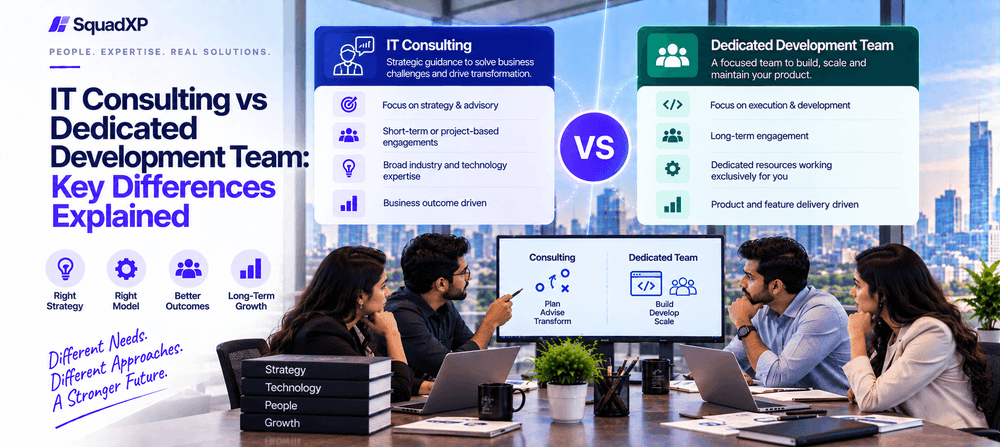
On the surface, choosing between a dedicated team and an IT consulting firm looks like a simple vendor comparison. It is not. The two models answer completely different questions. A consulting firm helps you solve a technology problem. A dedicated team helps you execute technology work continuously. Once that distinction clicks, the usual worries about cost, control, and scalability get much easier to reason about.
The mistake is judging both against the same yardstick. That is like comparing an architect to a construction crew on "who is cheaper per hour." They are not doing the same job. So before you compare quotes, get clear on which problem you are actually solving: do you need a decision, or do you need execution?
Quick answer: Dedicated teams provide continuous engineering capacity and tight integration with your workflows. IT consulting firms provide strategic, technical, or specialist expertise. The right choice depends on whether your main constraint is execution capacity or technology decision-making. Many companies use both, at different moments.
Cost: two different structures
Consulting cost tracks seniority, scope, duration, and specialization. You are paying for expertise applied to a defined problem. Dedicated team cost tracks the number of people, their roles, experience, engagement length, and location. You are paying for sustained capacity over time. Neither is inherently cheaper, and comparing an hourly consulting rate to a monthly team cost tells you nothing useful. Compare each against the outcome it is meant to deliver.
Control: convenience versus command
Consulting firms often run their own engagement, which is convenient when you want expertise without managing it day to day. Dedicated teams work more closely inside your world, using your tools, workflows, and delivery processes. That gives you more direct control over priorities and execution. If keeping a firm grip on how the work happens matters to you, the dedicated model leans your way. If you would rather hand off a defined problem and get an answer back, consulting fits better.
Scalability: specialist depth versus team growth
Dedicated teams are built to expand. As the roadmap grows, you add engineers, QA, DevOps, product, data, or AI capacity around the same core. Consulting firms can scale specialist expertise on demand, but they are not designed for continuous product development month after month. If you expect a long build, the dedicated model scales with you. If you expect bursts of specialized advice, consulting flexes better.
Expertise: strategy versus execution
Consulting shines when you need strategy, architecture, transformation, or specialist advice, meaning the thinking that sets direction. A dedicated team shines when you need engineering, product development, QA, DevOps, and continuous execution, meaning the hands that build. This is the cleanest way to tell which one your situation calls for: are you missing the plan, or the people to run it?
Management: who carries the load
Here is an honest trade-off. A dedicated team needs client-side leadership to set and manage priorities. That is not a drawback so much as the price of tighter alignment with your product organization. But if you have no engineering leadership in place, a raw dedicated team can strain you, and you may need added leadership support or senior specialist hires to steer it. Consulting, by contrast, can lighten that management burden for a focused strategic project because the firm runs its own engagement.
Time horizon: short problem or long build
A simple filter cuts through a lot of the noise. A short-term strategic problem points to consulting. A long-term development requirement points to a dedicated team. Match the model to how long the need will realistically last, not to whichever quote looks cheaper this quarter.
A concrete example
Say a SaaS company wants to move its monolith to a modern architecture. A consultant assesses the system, designs the target architecture, and defines the migration roadmap. A dedicated team then refactors the services, builds the APIs, migrates the infrastructure, tests, and deploys. In real life, the company often uses both: consulting to decide the route, a team to drive it. Strategy and execution are not competing purchases, they are sequential ones.
How this differs from staff augmentation
It is worth separating two things people lump together. Staff augmentation gives you individual professionals to plug gaps. A dedicated team gives you an intentionally structured group built to work as a unit, with coordination and continuity baked in. That difference matters the moment a project depends on the team working together over time rather than on a few extra pairs of hands. This is why SquadXP positions dedicated teams as a way to build lasting engineering capability, not just fill open seats.
Where a GCC fits in the progression
There is a natural path that many scaling companies follow: consulting, then a dedicated team, then a GCC. It is not mandatory, and plenty of companies stop at one stage. But it is a useful map. You start by buying expertise, move to renting sustained capacity, and eventually, if technology becomes core and demand holds, you build and own the capability outright. Each step trades a little flexibility for a little more ownership.
Conclusion
Choose an IT consulting firm when your primary challenge is technology expertise and direction. Choose a dedicated team when your primary challenge is engineering capacity and continuous execution. Use both when strategy and delivery need to happen at the same time. The trick is to stop judging them by the same criteria and start matching each to the specific gap in front of you. You can see how different teams made that call in our client case studies.
If you are not sure which side of the line you sit on, talk to our team and we will help you work out whether you need advice, a dedicated team, or a capability center you own.