
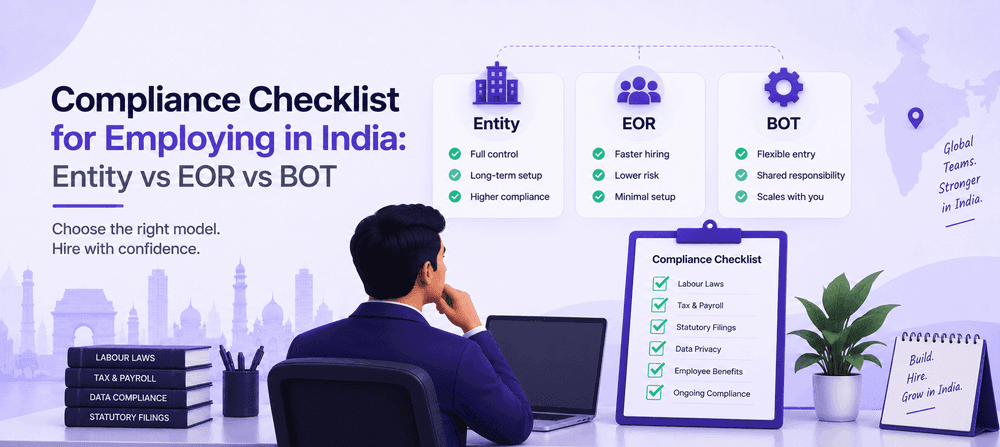
Hiring people in India is fairly simple once you know your operating model. The tricky part is deciding who should legally employ those people while you're still establishing your India presence.
For an international company, there are three common routes. You can set up your own Indian legal entity, use an Employer of Record (EOR), or use a Build-Operate-Transfer (BOT) model while you work toward long-term ownership. The right choice comes down to your timeline, headcount, risk appetite, how much control you want, and your long-term India strategy.
The key thing to understand is that these three are not interchangeable. An EOR is mainly an employment and payroll structure. An entity is your own Indian operating company. A BOT model is a broader capability-building approach where a partner builds and runs the team before handing it over to you. SquadXP's BOT model deliberately sets itself apart from an ordinary EOR by combining talent acquisition, team deployment, operations, and eventual transfer, rather than just acting as the employment intermediary.
Important: Employment, tax, and corporate compliance requirements vary by employee profile, state, activity, and operating structure. This checklist is a strategic planning guide, not legal or tax advice. Validate your structure with qualified Indian legal, tax, and payroll professionals before employing staff.
Entity vs EOR vs BOT: quick comparison
Here's the shape of the decision in plain terms. With an Indian entity, your own entity is the employer, speed to hire is slower, control is highest, payroll runs internally or via a vendor, and the full compliance burden is yours; team building is internal, ownership is immediate, and it's best for permanent scale with no transition step involved. With an EOR, the provider is the legal employer, hiring is fast, control is moderate, payroll and compliance are provider-managed, team building usually isn't the core offering, and long-term ownership requires a later transition; it's best for early or limited hiring, with any exit depending on the contract. With a BOT, the partner is the employer initially, hiring is fast, you keep high operational control, and the partner manages payroll and compliance during the build phase; team building is the core capability, long-term ownership is designed into the model through a structured transfer, and it's best for launching a GCC or a full team.
Indian entity: maximum control
An Indian subsidiary, or another appropriate legal structure, gives you direct ownership of your employment and operations. It's usually the strongest long-term model when you already know India will become a significant strategic market. The Ministry of Corporate Affairs has confirmed that an overseas company can incorporate an Indian subsidiary under the Companies Act framework.
The advantages are real: a direct employer relationship, full organisational control, permanent infrastructure, direct banking and contracting, a strong foundation for a large GCC, and easy integration into your long-term corporate structure. The catch is that entity setup is only the starting line. After that, you have to manage payroll, employment contracts, statutory registrations, EPF, ESI where applicable, state-level requirements, tax withholding, professional tax where applicable, leave and employment policies, gratuity, employee records, HR administration, and a full compliance calendar. That's a lot of operational overhead before your first engineering team is even fully productive, which is one reason it helps to plan the whole thing against a scalable technology workforce roadmap rather than sorting it out role by role.
EOR: speed without immediate entity formation
An Employer of Record employs workers on your behalf. You manage the day-to-day work while the EOR generally handles the formal employment administration. That makes it attractive when you want to test the Indian market, hire a handful of people, or start recruiting before your own entity is ready.
EOR works well for your first few employees, market testing, short-term hiring, remote hiring, early expansion, and any business still evaluating India. Where it gets less attractive is scale. An EOR isn't really built to stand up a complete GCC. If you need 50 engineers, founding leadership, engineering management, recruiting infrastructure, team design, an office, and long-term workforce planning, then employment administration is only one small piece of the puzzle. That's where BOT starts to matter.
BOT: Build, Operate, Transfer
The BOT model is designed around eventual ownership. The partner builds the team, runs the employment and administrative layer during the initial phase, and transfers the team to your organisation once you're ready. SquadXP describes its Talent BOT model as building and deploying an India engineering team immediately while managing employment, payroll, compliance, and HR until your India presence is ready for the handover. That combination is what makes BOT especially relevant for companies launching GCCs, and it lines up closely with the case for why your first India hire should often be a site leader, not ten engineers.
India employment compliance checklist
Whichever model you pick, work through the following areas.
Employment contracts: should clearly set out the employer, the role, compensation, working location, hours, leave, notice, confidentiality, intellectual property, data protection, termination, and benefits. For international businesses, IP ownership deserves particular care.
Payroll: must correctly handle salary, tax withholding, benefits, statutory deductions, reimbursements, bonuses, and variable pay, because payroll mistakes turn into employee-relations problems fast.
On EPF: for covered establishments and employees the Employees' Provident Fund framework creates both employer and employee contribution obligations. EPFO currently states the standard structure as 12% from the employee and 12% from the employer, subject to the applicable rules and wage structures, with the employer's share split across EPF and the relevant pension and insurance components. Don't just bolt "12%" onto every salary budget without checking applicability, wage structure, and current rules.
On ESI: Employee State Insurance can apply to eligible employees and establishments, with ESIC currently identifying a 3.25% employer contribution and 0.75% employee contribution of applicable wages, and eligibility assessed case by case.
Gratuity: obligations belong in your long-term cost model, and this matters especially for GCCs, since a company hiring hundreds of people should forecast statutory liabilities rather than be surprised by them later.
Income-tax withholding: is generally required across Indian payroll, and international companies should have compensation structures reviewed by Indian tax professionals, particularly for equity, cross-border pay, relocation, expatriates, bonuses, and international assignments.
State-level compliance: matters because India isn't one uniform employment jurisdiction; professional tax, shops and establishments rules, leave, working hours, holidays, and local registrations can all vary, which gets important the moment you hire across multiple cities. If a distributed setup is on the table, it's worth reading how Tier-2 cities like Jaipur, Indore, Coimbatore, and Ahmedabad change that calculus.
EOR vs entity: when should you choose each?
Choose an entity when India is a long-term strategic market, you expect substantial headcount, you want direct control, you need permanent organisational infrastructure, and you intend to build a GCC with real ownership.
Choose an EOR when you need a small initial team, speed matters more than infrastructure, you're testing the market, and entity setup isn't yet justified.
Choose BOT when you want to build a significant team quickly, the long-term goal is ownership, you need hiring plus operational support, you're launching a GCC, and you want the team operating before the entity is fully ready.
The hidden question: who owns the team?
This is the most important distinction of all. With an EOR, the EOR is the legal employer. With your entity, you are the legal employer. With BOT, the partner initially operates the employment model along a planned path to your ownership. That's exactly why the transition plan becomes so critical, since it decides how cleanly control eventually lands with you.
What should a BOT agreement define?
Before you start, document the essentials. Nail down the team scope (which employees are being built), the hiring standard (what technical and cultural criteria apply), the operating period (how long the partner runs the team), and the transfer trigger (when ownership moves). Then cover the transfer economics (what the transition costs), employment continuity (how you protect employees through the handover), and IP (who owns the work product at each stage). Finish with data and security controls, a replacement plan for anyone who leaves before transfer, and governance for who runs the team day to day. SquadXP's BOT model puts real emphasis on transition planning and employee continuity, including structured transfer practices, and understanding how GCC setup compares with staff augmentation and dedicated teams helps you frame these clauses correctly.
Compliance does not end with an EOR
A common misconception is that because the EOR is the employer, the client carries no compliance risk. That's too simplistic. You still have to manage data access, security, IP, workplace policies, manager conduct, employee classification, cross-border information, and your own contractual obligations. Exactly how responsibility gets split depends on the contractual structure, so read it carefully rather than assuming the provider absorbs everything.
A practical decision framework
Six questions usually settle it. First, how many people will you hire, since ten employees and 300 create very different economics? Second, how quickly do they need to start, because if speed is critical, EOR or BOT tends to win? Third, is India strategic, since if it is, an entity eventually becomes more compelling? Fourth, are you building a capability or simply hiring employees, because of its capability, BOT is often the better fit? Fifth, who will run the team, since if the parent lacks India leadership, no employment structure alone will fix that organisational gap? And sixth, what's the exit or transition plan, because every temporary structure should have a clearly defined long-term destination. Getting the pay side of those answers right also means benchmarking against a proper software engineer salary report for India rather than guessing.
Example: 20-person India engineering team
Picture a US SaaS company that wants 20 engineers in India.
Option A (entity), you set up the Indian structure first and then recruit; the advantage is maximum control, the disadvantage is that hiring waits for setup.
Option B (EOR), you hire all 20 through an EOR; it's faster, but you still have to build the recruiting, leadership, and operating capability yourself.
Option C (BOT), the partner builds the engineering team, runs employment and HR, and transitions the team once your entity is ready; the advantage is that hiring and capability-building happen at the same time. The point is that the right answer flows from your business objective, not just the legal wrapper.
Conclusion
The best India employment model isn't decided by compliance alone. It's decided by the balance between speed, control, scale, risk, and long-term ownership.
An EOR can be excellent for early hiring. An entity is often the strongest long-term structure. BOT can bridge the gap when you want to build a serious engineering capability before your permanent infrastructure is ready. So for GCC leaders, the real question was never "which model is cheapest?" It's "which model gets us from today's hiring need to tomorrow's India capability with the least execution risk?" That's the question a good India workforce strategy should answer.