
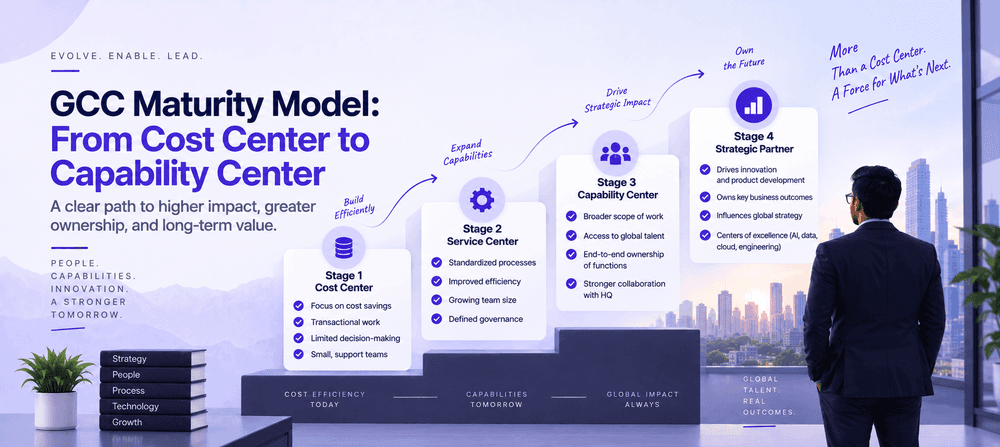
Not every GCC is strategic. Some are still primarily delivery centers. Others run as centers of excellence. The most advanced have become global product, engineering, and business capability owners. Which raises a question every GCC leader should be able to answer honestly: how mature is our GCC, really?
Headcount can't tell you. A 500-person center can still lean on headquarters for every decision, while a 100-person center can own a globally critical platform. The difference isn't size, it's capability, autonomy, and business ownership. India's market is clearly moving this way: PwC's 2026 analysis describes an ecosystem shifting beyond delivery toward value creation, with one in five centers targeting global P&L responsibility by 2030. Here's a practical model for assessing where you actually stand.
The five stages of GCC maturity
The framework runs through five stages: Cost Center, Delivery Center, Capability Center, Strategic Partner, and Global Owner. They aren't rigid, a GCC can be mature in engineering but immature in product ownership, and the point of the model is to expose exactly those gaps.
Cost Center: The objective is cost reduction, and the pitch is "we can do this work in India cheaper." It handles back-office work, IT support, testing, maintenance, and transactional processes. Leadership is administrative, hiring prioritises availability and cost, and most strategic decisions sit at headquarters. Success is measured in cost savings, headcount, and SLAs. The risk is bluntly existential: if another location gets cheaper, the business case weakens.
Delivery Center: The center moves into scale and owns meaningful delivery, software development, QA, cloud, infrastructure, operations, analytics. Local managers and engineering leaders emerge, hiring gets more specialised, and teams gain execution autonomy. It's a real step up, but priorities still mostly arrive from headquarters.
Capability Center: This is where the GCC becomes strategically differentiated, developing expertise the wider company depends on in AI, cybersecurity, data, cloud, R&D, or product engineering. It's no longer just executing; it's creating expertise, backed by strong local leaders and more staff, principal, and specialist talent. This is where the term "Global Capability Center" starts to mean something.
Strategic Partner: The GCC enters global decision-making, influencing product strategy, leading technology initiatives, owning global platforms, and driving transformation. Headquarters stops asking "what work can India execute?" and starts asking "what can India help us build?"
Global Owner: The most advanced centers own complete outcomes, products, platforms, global engineering domains, business functions, revenue, even P&L. At this point the organisation is effectively a global business unit, and India is the center of ownership, not just the location.
How do you know which stage you're in?
Ten questions cut through it. Who defines the roadmap? Who owns architecture? Who owns product decisions? Who hires senior leaders? Where does innovation actually originate? Who talks to customers? Who owns the IP? Who owns business metrics? Can the center operate without headquarters? And the sharpest one: what happens if headquarters stops assigning tickets? If the center has no independent roadmap, it's still an execution center, whatever the org chart says.
The biggest maturity trap: headcount
Headcount is easy to measure, maturity isn't, which tempts everyone into "more employees equals more mature." It's wrong. A 1,000-person organisation can still be a delivery center; a 75-person team can own a critical global platform. The metric that matters is value per capability owned.
How leadership and talent change as the GCC matures
Leadership requirements evolve stage by stage, from an operations manager, to a delivery or engineering manager, to a functional leader, to a GCC or site executive, to a global business or product executive. The mandate expands from "deliver the work" to "build the organisation" to "own the business outcome." This is precisely why founding leadership belongs at the start of the GCC journey, not as a later hire, and why the first ten hires and their order shape everything that follows.
Talent strategy shifts in parallel: from hiring available talent, to technical talent, to scarce specialists, to leaders and domain experts, to global business and product leaders. Compensation has to follow, so the center competes on scope, ownership, career growth, technology, and leadership, not salary alone, which is where benchmarking against the real market earns its keep.
How to move between stages
Stage 2 to Stage 3 is often the first hard jump. Pick three capabilities India can become exceptionally good at, say AI engineering, cloud infrastructure, and data platforms, then invest in leadership, specialist hiring, training, architecture, and product integration. Don't try to be excellent at everything.
Stage 3 to Stage 4 requires decision rights. Give the GCC responsibility for a platform, a product, a technical domain, or a global transformation, then measure the outcomes. That's the bridge from expertise to strategic influence.
Stage 4 to Stage 5 requires business accountability, budget, revenue, product and customer metrics, P&L, and executive leadership. At that point the GCC becomes hard to distinguish from any other global business unit, which is the endpoint described in what a GCC actually owns under GCC 4.0.
The role of AI in GCC maturity
AI is accelerating the shift. Routine work is increasingly automatable, which puts execution-only GCCs under pressure while letting capability centers push productivity up. The future question becomes "how much capability can 100 people create?" rather than "how many people can we hire?" That raises the value of architecture, data, product, AI, domain expertise, and leadership all at once.
A GCC maturity scorecard
Score your GCC from 1 to 5 on leadership autonomy, technical autonomy, product ownership, customer access, IP ownership, specialist talent, innovation, business accountability, talent development, and global influence. Mostly 1s and 2s means delivery-oriented; a 3 means capability-oriented; a 4 means strategic; a 5 means global owner. It's not an industry standard, it's a practical diagnostic you can run in an afternoon.
What prevents maturity?
The usual blockers: headquarters dependency where every decision routes back to HQ; weak local leadership with no one owning the evolution; low-complexity work; a talent strategy that can't attract senior specialists; wrong incentives that reward headcount over outcomes; and no product connection, so engineers never see customers or business context. GCC building isn't a one-off recruitment project, the requirements change as the center matures, from location and leadership early, to specialists and scale later, to ownership, productivity, and retention eventually.
Conclusion
GCC maturity is a function of ownership, not headcount. The journey starts with cost, moves through delivery and capability, becomes strategic partnership, and ends, for the most mature, in global ownership. So the question for anyone building an India GCC in 2026 isn't "how quickly can we reach 500 employees?" It's "what should those 500 people be capable of owning?" That single reframe produces a far stronger roadmap.