
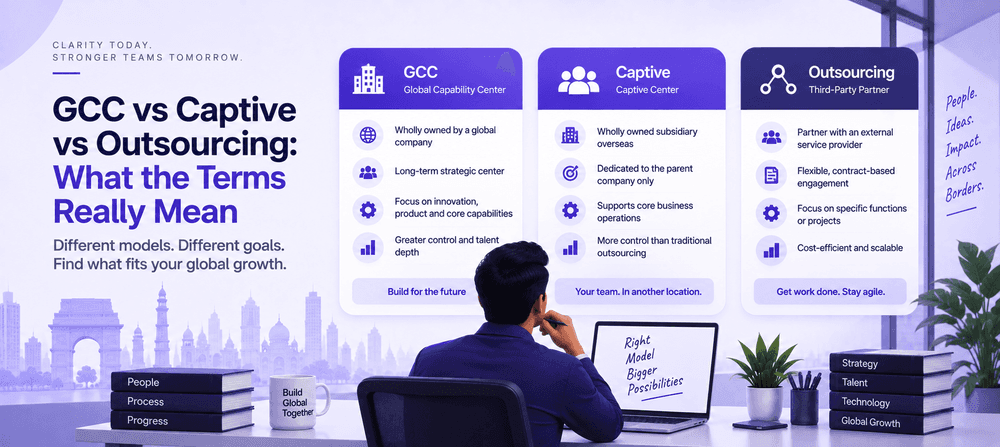
The terms GCC, captive center, GIC, shared services center, and outsourcing get thrown around as if they mean the same thing. They don't, and treating them as interchangeable is how companies end up with the wrong operating model.
If you're deciding how to build a technology or operations organisation in India, these labels describe genuinely different setups. A GCC can be internally owned. A captive center is often just another name for that same internal offshore organisation. Outsourcing hands delivery responsibility to an external provider. A dedicated team sits somewhere in between. And a Build-Operate-Transfer model gives you a path from external operation toward eventual ownership.
Getting the vocabulary right matters, because the wrong model quietly sets the wrong incentives, cost structure, and level of control from day one.
GCC vs captive vs outsourcing: the short answer
Here's the distinction in plain terms.
A GCC: is owned by the parent company, employs people through the parent or a local entity, and exists to build long-term capability.
Captive Center: is structurally the same thing, owned by the parent, but the label emphasises internal ownership rather than the strategic role.
Outsourcing: puts both ownership and employment with a provider, and its purpose is to buy external delivery.
Dedicated Team: is usually owned and employed through a partner and exists to give you focused capacity.
BOT: is operated by a partner at first but is ultimately owned by you, built specifically as a path to ownership.
So GCC and captive effectively describe the same fundamental structure. "Captive" stresses ownership; "GCC" stresses the center's strategic role. That's the whole nuance.
What is a GCC?
A Global Capability Center is an internal organisation a company sets up to serve its own global business, handling engineering, product development, R&D, AI, data, cybersecurity, finance, analytics, operations, or customer experience. The defining trait is that the capability belongs to the parent, not a vendor.
India's GCC ecosystem has moved well beyond back-office work. EY describes Indian GCCs as increasingly involved in technology advancement, advanced analytics, innovation, and R&D, which is exactly the shift covered in the India GCC guide.
What is a captive center?
A captive center is a company-owned offshore operation. Historically the term described centers set up to do work internally rather than through an outsourcing vendor. Today many companies prefer "GCC" because "captive" can carry the whiff of a low-value delivery model.
Structurally, though, there's massive overlap. The cleanest way to hold it: captive describes ownership, GCC describes the capability model. A mature captive center effectively becomes a GCC the moment it takes on broader strategic responsibility.
What is outsourcing?
Outsourcing means contracting an external organisation to perform a function or deliver an outcome. The provider generally owns employment, workforce management, hiring, delivery, and operational processes. You own the business requirement.
It can work extremely well when the capability isn't strategically differentiating, think infrastructure operations, commodity support, standardised testing, certain back-office functions, or short-term specialist capacity. You genuinely don't need to own every capability, and pretending otherwise just adds cost.
The biggest difference: ownership
The most useful question isn't "which model is best," it's "who should own this capability?" If the honest answer is "we want a provider to manage it," outsourcing fits. If it's "we want this to become part of our organisation," a GCC fits. That distinction gets sharpest for core product engineering, AI, proprietary platforms, cybersecurity, critical data systems, product management, and IP, the things you rarely want living inside someone else's company.
GCC vs outsourcing: control, speed, cost
Control: A GCC lets you own hiring standards, compensation, architecture, product priorities, culture, career paths, and IP. With outsourcing, the provider controls more of the delivery organisation while you keep scope, the commercial relationship, and governance. That can actually be an advantage when you want flexibility without building infrastructure.
Speed: outsourcing usually starts faster because the provider already has people, infrastructure, HR, payroll, recruiting, and management in place. A GCC takes longer because you're building those foundations. Modern models close that gap, though: SquadXP's Build-Operate-Transfer model is designed to let you start building an India team while your permanent presence is still coming together.
Cost: outsourcing often looks cheaper at the start, but the honest comparison is total cost of ownership. A GCC carries salaries, benefits, office, technology, recruitment, HR, compliance, management, and overhead. Outsourcing carries provider margin, service and management fees, transition costs, and change requests. Compare total cost per productive engineer, not salary versus vendor rate, or you'll draw the wrong conclusion.
GCC vs outsourcing: knowledge and flexibility
Knowledge retention is the underrated difference. In a GCC, institutional knowledge stays inside your organisation. With outsourcing, it can concentrate on the vendor relationship, so when you switch providers, some of that knowledge walks out the door. A GCC reduces that dependency by making the capability internal.
Flexibility cuts both ways. Outsourcing gives rapid access to capacity. A GCC gives long-term organisational flexibility: an internal team can be moved between products, platforms, research, architecture, and internal systems without renegotiating a provider contract every time priorities shift.
GCC vs dedicated team
A dedicated team is built around your needs but operated through a partner. It suits startups, product companies, temporary scaling, MVP work, and engineering expansion, and it often becomes a bridge to a GCC. Plenty of companies start with 10 dedicated engineers, learn the India market, then set up an entity and build their own organisation. SquadXP positions Dedicated Teams around exactly that: fast engineering scale without compromising quality, culture, or speed. If you want the full model-by-model decision, the live breakdown of GCC vs outsourcing vs dedicated teams walks through it.
GCC vs BOT
BOT is different because its destination is ownership. The partner builds the team, runs operations during the initial phase, and transfers the organisation to you when you're ready. That makes it especially useful when you want ownership, your entity isn't ready, hiring needs to start now, and your internal India infrastructure is thin. One caveat worth knowing: SquadXP's own BOT guidance notes that below roughly 20 to 30 people, a formal BOT structure often costs more than it saves, and a dedicated team may be the better call. BOT isn't automatically right just because you want a GCC eventually.
The strategic mistake: choosing the model before defining ownership
Companies often open with "should we use a GCC?" That's the wrong first question. Ask "what do we want India to own?" If it's a temporary delivery capability, a dedicated team may work. If it's a global engineering platform, a GCC is stronger. If you want the GCC but can't build the organisation yet, BOT bridges the gap. The model should follow the ownership decision, never the other way round.
How the models work together
These aren't mutually exclusive. A single company can run outsourcing for commodity IT, dedicated teams for rapid product capacity, a GCC for strategic engineering, and BOT during the GCC launch. Deloitte's 2026 research points to exactly this trend, with organisations increasingly blending GCCs, AI, and managed service providers into multidimensional workforce strategies. A portfolio approach is often smarter than forcing everything into one model.
Conclusion
GCC, captive, outsourcing, dedicated teams, and BOT aren't synonyms. They're different answers to one question: who should own the capability? Commodity or temporary work points to outsourcing; focused engineering capacity points to a dedicated team; long-term strategic ownership points to a GCC; and wanting that GCC before your infrastructure is ready points to BOT. The best India strategy isn't picking one model universally, it's matching the model to the capability you want to build.