
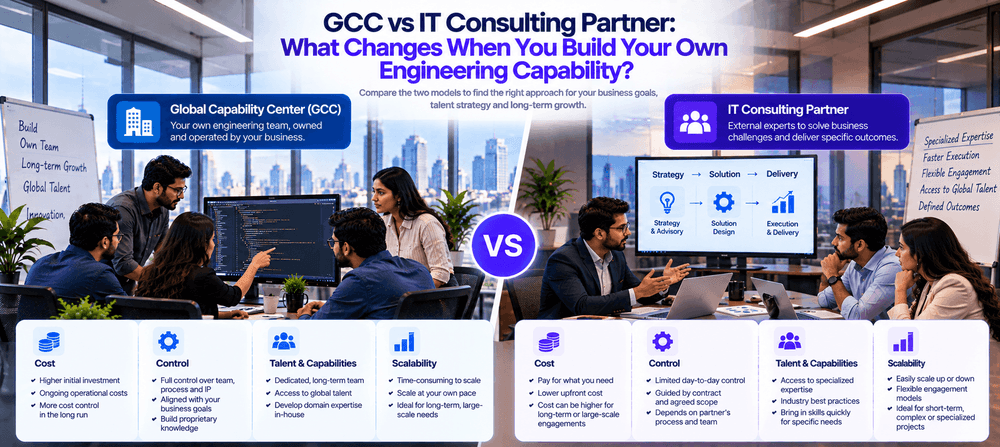
There is a world of difference between using a technology capability and owning one. It is the same gap as renting an apartment versus buying a house. Both give you a place to live, but the responsibilities, the control, and the long-term math are nothing alike. That is exactly the choice in front of companies weighing an IT consulting partner against a Global Capability Center.
An IT consulting partner brings you expertise on demand: architecture, transformation, modernization, specialist skills. A GCC is different in kind, not degree. It creates an organization that becomes part of your company. This distinction gets very real the moment a global business decides to build engineering capability in India, because everything downstream, cost, control, talent, governance, changes based on which side of that line you choose.
Quick answer: An IT consulting partner gives you external technology expertise under a contract. A GCC creates an internal organization you own. Moving from consulting to a GCC shifts your control, talent ownership, governance, IP, operating responsibility, and long-term capability. Consulting is renting expertise. A GCC is owning it.
What an IT consulting partner gives you
A consulting partner provides expertise for a defined need: strategy, architecture, transformation, cloud, AI, security, and access to technology specialists. The relationship is contractual, with a clear scope and an end date. You get senior skill applied to your problem without taking on the long-term responsibility of employing that skill. When the engagement wraps, the partner moves on, and you keep the deliverables.
What a GCC actually is
A Global Capability Center is an internal organization a company sets up to run strategic capabilities for its global business. Unlike a vendor arrangement, a GCC can own engineering, product development, R&D, AI, data, cybersecurity, and analytics outright, as part of the company itself. The framing that matters here is ownership of long-term capability rather than repeatedly buying external delivery. You are not hiring help. You are building a piece of your own company in another location.
Ownership: the fork everything hangs on
Strip it down and the core difference is ownership. Consulting means an external provider. A GCC means an internal organization. That one distinction drives almost everything else on this page, because who owns the capability determines who controls the talent, the IP, the processes, and the roadmap. Get clear on how much you want to own before you weigh any other factor, because it reframes the entire decision.
Talent: whose people are they
With consulting, the people working on your problem are employed by the provider. Skilled, yes, but not yours. With a GCC, those people become part of your organization, which changes culture, career paths, compensation, retention, and leadership. Owning the talent means you shape how they grow and how long they stay, and you carry the responsibility that comes with that. If deep, retained institutional knowledge is the goal, ownership is the route. If you just need skill for a season, it is overkill. For the middle ground, specialist hiring can bring key roles in-house without standing up a whole center.
IP: control over what gets built
Ownership tends to simplify long-term control of institutional knowledge and IP, subject to the corporate and legal structure you set up. With consulting, none of that is automatic, so your contracts have to spell out IP rights explicitly, who owns the code, the frameworks, the documentation, and the data. It is manageable either way, but the default posture differs: a GCC keeps IP inside by design, while consulting keeps it inside only if the paperwork says so.
Governance: two very different operating loads
A consulting relationship runs on statements of work, contracts, SLAs, and vendor governance. Relatively light to operate. A GCC is a different animal. It needs leadership, an org structure, performance management, HR, finance, local operations, and India-to-headquarters governance. That is a real operating commitment, not a line item. The upside is control. The cost is responsibility. Go in knowing you are taking on the running of an organization, not just a contract.
Cost: variable services versus fixed capability
Consulting costs are usually tied to external services you switch on and off. GCC costs are broader and more fixed: compensation, recruitment, office, IT, HR, compliance, leadership, and infrastructure. A GCC carries far more fixed-cost responsibility, which is precisely why it only makes sense at sufficient scale and sustained demand. Below a certain size, renting expertise is cheaper and smarter. Above it, owning capability starts to pay for itself. The right answer depends entirely on how much capability you need and for how long.
When building a GCC makes sense
Lean toward a GCC when India is strategically important to you, when headcount is set to grow, when engineering is core to how you compete, when product ownership matters, and when long-term talent investment is clearly justified. In short, when the capability is central and here to stay, owning it beats renting it again and again.
When an IT consulting partner makes more sense
Stick with a consulting partner when the problem is temporary, the expertise is specialized, internal demand is uncertain, the capability is non-core, or you simply do not want the responsibility of running local operations. There is no prize for owning capability you do not need. If any of these describe you, consulting is not a compromise, it is the correct call.
You do not have to leap straight to a GCC
The jump from consulting to a fully owned center is not the only path, and rushing it is a common mistake. A more measured route looks like this: consulting, then a dedicated team, then build-operate-transfer, then a GCC. Each step lets you validate demand and talent before committing to a permanent operating model. You start by buying expertise, move to sustained capacity, and only build the owned organization once the case is proven. Because SquadXP spans both dedicated teams and GCC ramp-up, this staged path is a practical way to grow engineering capacity in India without betting everything on day one. You can see how teams progressed in our client case studies.
Conclusion
The heart of the GCC versus IT consulting partner decision is ownership. Consulting hands you external expertise. A GCC hands you an internal organization. The right choice comes down to three honest questions: how strategic is this capability, how long will you need it, and how much operating responsibility do you actually want to carry. Answer those and the model chooses itself.
If you are mapping out engineering capability in India and are not sure where on the path you belong, talk to our team. We will help you decide whether a consulting partner, a dedicated team, or a full GCC fits your stage before you commit to anything.