
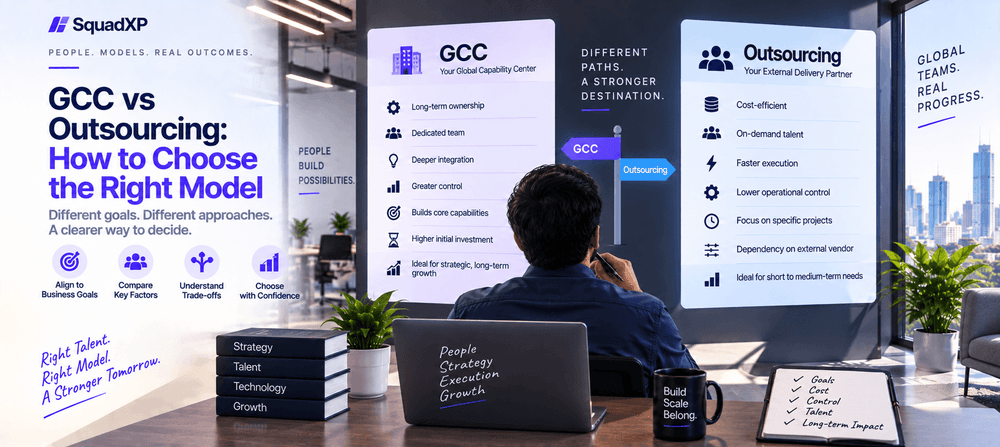
When comparing GCC vs Outsourcing, the choice comes down to control versus overhead. A Global Capability Center (GCC) establishes an owned, long-term extension of your company that preserves intellectual property and culture. Outsourcing transfers operational ownership to a third-party vendor for a defined scope, reducing immediate management overhead but sacrificing strategic alignment and direct quality control over your engineering talent.
Choosing the wrong model can lead to severe operational friction. If you outsource strategic, core product development, you risk losing critical institutional knowledge and facing escalating costs through change orders. Conversely, attempting to build a full GCC for a short-term, well-defined project can saddle your organization with unnecessary administrative and compliance overhead. Understanding the structural differences between these two approaches is essential for any engineering or business leader looking to scale globally.
Understanding the Core Differences in GCC vs Outsourcing
At their core, GCCs and traditional outsourcing represent two entirely different operational philosophies. A GCC is a captive entity—a fully owned subsidiary of the parent organization operating in an offshore or nearshore location. The employees working in a GCC are your employees; they share your company culture, participate in your equity plans, and work directly on your core products. This model is designed for long-term capability building, allowing companies to tap into global talent pools while maintaining absolute control over their operations, security, and intellectual property.
Outsourcing, on the other hand, is a service-delivery model. You contract a third-party vendor to deliver specific services or projects. The personnel doing the work are employed by the vendor, not by you. While this significantly reduces your operational footprint and eliminates the need to establish a legal entity abroad, it introduces a layer of separation between your leadership and the people executing the work.
Because every business grows differently., there is no single path that works for every organization. Some companies require the deep integration and cultural alignment of a captive center, while others need the rapid, transactional execution that outsourcing provides. When evaluating your global expansion strategy, understanding the nuances of staff augmentation vs outsourcing is critical to avoiding management overhead and ensuring your operational structure matches your long-term business goals.
Who is Each Model Built For?
Deciding between a GCC and an outsourcing partner requires an honest assessment of your strategic goals, product maturity, and internal management capacity. Neither model is universally superior; instead, each serves a distinct set of business needs.
When a GCC is the Right Choice
A GCC is ideal for organizations that view technology and product development as core competitive advantages. If you are building proprietary software, handling highly sensitive customer data, or planning to scale your global engineering team to dozens or hundreds of developers over several years, a GCC provides the necessary foundation. It allows you to build deep domain expertise within your offshore team, ensuring that the engineers writing your code understand your business context and long-term vision.
Establishing a captive center is also the preferred route for companies that want to build a lasting employer brand in talent hubs like India. By hiring full-time employees directly, you can attract top-tier talent who are looking for stable, long-term career growth rather than temporary contract work.
When Outsourcing is the Right Choice
Outsourcing is best suited for well-defined, non-core projects with clear boundaries and predictable deliverables. If you need to build a customer-facing mobile app from scratch, migrate a legacy database to the cloud, or handle tier-1 customer support, outsourcing allows you to execute quickly without the burden of long-term hiring commitments.
This model is also highly effective when you lack the internal leadership or management bandwidth to oversee a global team. By outsourcing the work, you transfer the management responsibility to the vendor, who is contractually obligated to deliver against a specific Service Level Agreement (SLA) or Statement of Work (SOW).
We recognize that every industry has unique talent challenges., which means your choice must align with your sector's regulatory environment, talent availability, and competitive landscape. A fintech company handling sensitive financial transactions will naturally lean toward the security of a GCC, while a retail brand looking to build a seasonal promotional website may find outsourcing far more efficient.
Evaluating GCC vs Outsourcing Across Key Business Metrics
To make an informed decision, business leaders must evaluate both models across several critical dimensions: control, quality, financial commitment, and long-term value.
Control and IP Protection
In a GCC, you retain 100% control over your processes, technology stack, and security protocols. Because the team members are direct employees of your subsidiary, your intellectual property remains entirely within your corporate boundary. This minimizes the risk of IP leakage and ensures compliance with strict global data protection standards.
In an outsourced model, you must rely on the vendor’s security infrastructure and contractual agreements to protect your IP. While reputable outsourcing vendors have robust security measures in place, the inherent risk is higher because your data and code are being handled by third-party employees who may also work on projects for other clients.
Talent Quality and Cultural Alignment
When you build a GCC, you control the hiring bar. You can screen for cultural fit, technical excellence, and alignment with your company values. This direct relationship fosters a sense of ownership and loyalty among team members, resulting in lower turnover rates and higher-quality output. We focus on delivering teams built for outcomes, not just headcount., ensuring that every engineer is fully aligned with your product roadmap.
By focusing on building high-performing teams, organizations can transition from simple cost-saving exercises to creating genuine competitive advantages. In contrast, outsourcing vendors often optimize for utilization rates, meaning the developers assigned to your project may be rotated out or split across multiple accounts, leading to inconsistent quality and lost momentum.
Financial Commitments and Cost Math
Establishing a GCC requires significant upfront capital expenditure. You must handle legal entity setup, lease office space (or set up compliant remote-work infrastructure), secure local tax and legal counsel, and build an HR and recruitment pipeline. However, once established, the ongoing operational costs are typically much lower than outsourcing because you do not pay a vendor markup on salaries.
Outsourcing has virtually zero upfront capital requirements. You pay a predictable monthly fee or a fixed price per project. While this is highly cost-effective in the short term, the long-term operational costs are higher due to the vendor's profit margins. Additionally, any changes to the project scope will result in change orders, which can quickly erode your initial savings.
How SquadXP Solves the Talent Acquisition Puzzle
At SquadXP, we believe that building global capability should not require choosing between the high upfront costs of a traditional GCC and the quality trade-offs of traditional outsourcing. We combine deep market knowledge, specialist hiring expertise, and workforce intelligence to help companies build high-performing teams that support long-term growth.
Our structured approach, backed by workforce intelligence, allows global businesses to scale their engineering, technology, and leadership teams across India with absolute confidence. Whether you need to establish a comprehensive captive center or embed a dedicated engineering squad directly into your existing sprints, we tailor our strategy to your specific goals and operating model.
SquadXP provides the specialized talent that fuels your growth, ensuring that your engineering capabilities expand without compromising on speed, culture, or technical excellence. Our partners have seen significant velocity gains, achieving real business outcomes that traditional outsourcing vendors simply cannot match.
Related Offerings: Tailoring to Your Stage of Growth
We understand that global expansion is a journey, and your talent needs will evolve as your business matures. To support you at every stage, SquadXP offers three distinct pathways designed to deliver lasting business value:
- GCC Ramp Up: Build a high-performing Global Capability Center that delivers from day one. We handle the complexities of talent acquisition, market intelligence, and local onboarding, allowing you to launch with confidence and create a scalable foundation for long-term growth.
- Dedicated Teams: Scale faster with teams built around your business. Add experienced engineering and technology talent that integrates seamlessly with your existing stack and sprint cadence, doubling your delivery velocity without the administrative overhead of entity setup.
- Specialist Hiring: Access exceptional leadership and specialist talent for your most business-critical roles. We find the people your business cannot afford to miss, ensuring your founding leadership team in India is sharp, experienced, and ready to execute.
A Practical Decision Checklist for Engineering Leaders
Before committing to either a GCC or an outsourcing model, run through this quick checklist to determine which path aligns with your current operational reality:
- Core vs. Non-Core: Is the work you are scaling central to your company's proprietary technology and competitive advantage? (Yes = GCC | No = Outsourcing)
- Timeline: Do you need a team stood up in weeks to hit an immediate deadline, or are you building a multi-year engineering hub? (Short-term = Outsourcing | Long-term = GCC)
- Management Capacity: Do you have internal engineering managers and product owners who can direct the daily work of a global team? (Yes = GCC | No = Outsourcing)
- IP and Compliance: Does your industry require strict, audited control over who accesses your codebase and customer data? (Yes = GCC | No = Outsourcing)
- Budget Structure: Are you looking to minimize upfront capital expenditure, or are you focused on optimizing long-term operational costs? (CapEx-light = Outsourcing | OpEx-optimized = GCC)
Build Your Next Team with Confidence
Building a global engineering presence is one of the most impactful strategic decisions your company will make. Whether you choose to establish a fully owned GCC or embed a dedicated squad of specialists, the key to success lies in execution.
SquadXP helps you navigate this transition smoothly, combining deep market intelligence with a structured recruitment methodology. Let us help you build the high-performing teams that drive real business growth and deliver lasting value. Contact us today to design your tailored global talent strategy.