
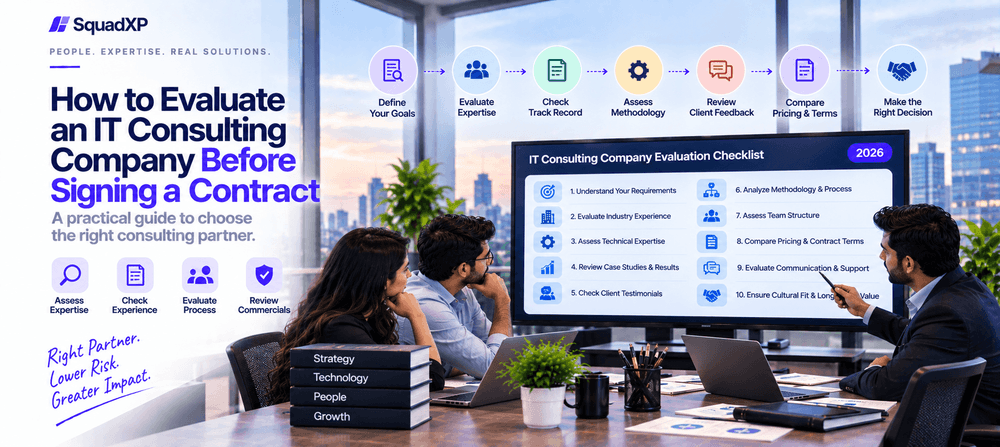
Picking an IT consulting company is one of those decisions that quietly shapes the next year of your business. Get it right and a hard problem gets solved cleanly. Get it wrong and you inherit delayed timelines, shaky architecture, cost overruns, security exposure, vendor lock-in, and knowledge that walks out the door when the engagement ends.
Yet a lot of teams still evaluate consultants on a painfully short list: brand name, price, a wall of client logos, and how slick the proposal looks. That is not due diligence, that is decoration. A consulting firm is a technology partner, and it deserves to be vetted like one. Here is how to do that properly before you sign anything.
Quick answer: Evaluate an IT consulting company across seven areas: relevant expertise, delivery methodology, the actual team assigned to you, security, commercial terms, intellectual property, and measurable outcomes. Do not judge on brand, website, or hourly rate alone. The people on your engagement and the fine print of the contract matter just as much as the pitch.
Start with your own problem, not their pitch
Before you look at a single vendor, get clear on what you are actually trying to solve. Are you modernizing legacy technology, migrating to the cloud, building an AI capability, hardening cybersecurity, writing a technology roadmap, or standing up an engineering organization? If you cannot state your problem in a sentence or two, the vendors will happily define it for you, and they will define it in a shape that suits their offering. A clear problem statement is your best negotiating tool.
Check relevant experience, not just volume
Ask for examples that look like your situation, and match on industry, technology, scale, complexity, and geography. A firm that boasts 500 completed projects is not automatically right for you if none of them resemble your problem. Relevant beats impress every time. Ten projects in your exact space tell you more than five hundred scattered across industries you will never touch.
Meet the people who will actually do the work
This is one of the most important checks, and the one buyers skip most. Ask directly: who will work on our project day to day? Then meet them, the engagement lead, technical lead, architect, and key specialists. The classic trap is the "pitch team" of senior stars who win the deal and vanish, replaced by a junior bench once the ink dries. If the people selling are very different from the people delivering, treat that as a warning, not a detail.
Test technical depth with real questions
Do not settle for a list of technologies the firm supports. Ask something specific, like why they would recommend microservices for your architecture. A strong consultant will happily walk through the benefits, the risks, the alternatives, the cost, and the operational complexity. A weak one recites buzzwords. The difference surfaces within about two minutes of a genuine technical conversation, so have one before you commit.
Understand the methodology and pin down deliverables
Ask how the engagement actually runs, from discovery and assessment through recommendations, validation, implementation, and reporting. A serious engagement has clear stages, not a vague promise to "help."
Then nail down the deliverables. "Provide strategic technology guidance" is not a deliverable, it is a fog. Insist on concrete outputs: an architecture assessment, a technology roadmap, a migration plan, a risk register, a target-state architecture, and an implementation roadmap. If you cannot tell what you will physically receive, neither can they.
Get security and IP in writing
On security, ask about access controls, confidentiality, data storage, security policies, employee access, incident response, and any compliance requirements you carry. Vague answers here are a hard stop.
On intellectual property, clarify who owns the architecture documents, source code, custom frameworks, documentation, models, data, and every other deliverable. IP clauses are exactly the kind of thing to run past legal counsel before signing, because "we assumed we owned it" is an expensive lesson.
Understand pricing and change management
Know how you are being charged: hourly, fixed, retainer, or milestone-based, what is excluded, and what triggers extra fees. Then look at how change is handled, because technology projects always shift. A good contract spells out the change process up front, so a mid-project pivot is a conversation rather than a fight.
Check references and post-engagement support
Talk to previous clients where you can. Ask whether the project landed on time, whether the team truly understood the problem, how responsive the provider was, whether costs moved, and the most revealing question of all, would they hire the firm again.
Then ask what happens after the strategy is delivered. Will the firm support implementation, train your internal team, hand over documentation, or provide engineering resources to execute? This matters more than it seems, because a strategy with no path to execution just creates a capability gap you will scramble to fill.
Evaluate scalability and fit
A good consulting engagement often reveals a bigger workforce need. A modernization plan might quietly imply 15 engineers, 3 DevOps specialists, 2 architects, and a security lead. Ask whether the partner can support that next stage or connect you to it, whether through specialist hiring or a larger team, rather than leaving you stranded after the roadmap. And do not ignore fit: these people will work alongside your CTO, CIO, engineering leads, product, finance, and security teams, so communication style is part of the job, not a soft extra.
Watch for the red flags
A few signals should make you slow down: guarantees offered with no assumptions attached, prices that look too low to be real, no named senior team, generic copy-paste proposals, no mention of security, vague deliverables, zero clarity on IP, and pressure to sign quickly. Any one of these deserves a hard question. Several together is your answer.
Score it, do not just feel it
To keep the decision honest, score each provider on technical expertise, relevant experience, team quality, methodology, security, commercial terms, IP, communication, and scalability. The scorecard is there to structure the conversation, not to replace judgment, but it stops a polished pitch from quietly outweighing a stronger, plainer one. You can also ground your review in evidence by asking for proof from past clients rather than taking claims at face value.
Sometimes you do not need a consultant at all
Here is the twist the evaluation sometimes reveals: you do not need consulting, you need people. If your strategy is already clear and the real gap is engineering capacity, more advice will not help. A dedicated team that assembles around your goals and works inside your tools and processes is the better fit, and it is exactly what SquadXP is built to provide. Spotting that early can save you a whole consulting cycle you did not need.
Conclusion
The best way to evaluate an IT consulting company is to look past the sales presentation and weigh what actually determines success: people, expertise, methodology, security, commercials, IP, and outcomes. The delivery team, the scope, and the contract terms will tell you far more than any marketing claim.
If your evaluation points more toward capacity than advice, talk to our team and we will help you figure out whether you need specialist hires, a dedicated team, or a full capability center before you commit to anything.