
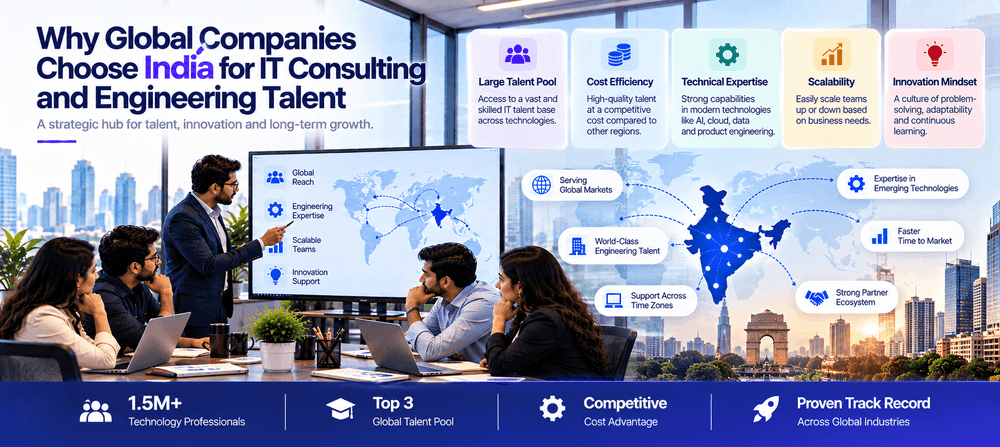
India's technology story has changed, and a lot of decision-makers are working off an outdated version of it. The old picture was simple: a place to get software built for less. The current reality is very different. Global companies now run product engineering, AI, data, cloud, cybersecurity, R&D, technology consulting, and full capability centers out of India, not because it is cheap, but because it is capable.
That shift matters for how you approach the market. If you still treat India as a low-cost vendor location, you will make vendor-shaped decisions and miss the bigger opportunity: building real, owned technology capability. This is exactly why serious partners now lead with GCC building, dedicated teams, and specialist hiring rather than transactional recruitment.
Quick answer: Global companies choose India for its large technology workforce, broad engineering expertise, fast-growing AI and cloud capability, multiple tech hubs, and long track record supporting global organizations. For lasting needs, they use consulting, a dedicated team, or an India GCC, depending on how much ownership they want.
Deep access to technology talent
India offers a large ecosystem of software engineers, architects, data professionals, cloud specialists, and technology leaders. That depth gives you options when expanding a team, but volume is not the whole story. The real question is not "does India have talent," it is "can this specific market supply the specific roles I need, at the seniority I need." That reframing saves a lot of pain later.
Genuine engineering specialization
The market spans backend, frontend, mobile, DevOps, cloud, data, AI and ML, cybersecurity, and platform engineering. So the depth is real across disciplines. But keep the focus on availability for your particular capability rather than headline talent numbers. A market can be enormous in general and thin for a niche role, and it is the niche role that will slow your build if you assume otherwise.
Multiple technology hubs, not one
India's major technology markets include Bengaluru, Hyderabad, Pune, Chennai, and Delhi NCR, each with its own strengths. Increasingly, tier-2 cities such as Jaipur, Indore, Coimbatore, and Ahmedabad are becoming viable for selected capabilities, though the depth of any given market varies by role. The practical takeaway: location is a capability decision, not just a cost one. Pick the city that can actually staff your roles, not simply the cheapest pin on the map.
Cost, read honestly
India can offer real cost advantages over some Western markets, but salary is the wrong number to anchor on. The fair comparison is fully loaded cost: recruiting, benefits, infrastructure, management, retention, office, and compliance. Premium technical talent here is competitive and priced accordingly, so "India equals cheap" is a myth that leads to bad budgeting. If you want the real numbers before you plan, SquadXP's developer hiring cost data shows how much they move by role and region, and a cost calculator helps you model your own.
Time zone: an advantage you have to design for
India gives you solid overlap with Europe and partial overlap with North America, which can genuinely speed up delivery. But the overlap is only an asset if you build for it. Deliberate async work, strong documentation, and clearly defined ownership turn the time difference from friction into a follow-the-sun advantage. Teams that ignore this feel the gap; teams that design around it barely notice it.
Consulting, dedicated team, GCC, or BOT
Global companies have several ways into India, and they suit different goals. Use IT consulting for strategic or specialist problems. Use a dedicated team as an extension of your global organization when you need sustained capacity. Build a GCC when you want an internal capability center you own. Or use build-operate-transfer to have a partner build and run the team before you take ownership. The right entry point is a function of how much you want to own and how certain your long-term demand is.
India's GCC growth
India is now central to global capability strategies, and GCCs here have moved well beyond old cost-arbitrage models into engineering, product development, AI, data, cybersecurity, and genuine strategic ownership. That is the headline shift: the India center is no longer a back office, it is increasingly where core product and R&D happen. If technology is core to your business, that trajectory is worth factoring into your planning now, not later.
What global companies should evaluate
Before committing, work through a short list of hard questions. Talent availability: can the city actually support your specific roles? Compensation: are your salary bands genuinely competitive there? Leadership: can you hire the leaders needed to scale, not just engineers? Operating model: dedicated team, GCC, BOT, or consulting? And governance: how will the India organization interact with headquarters day to day? Answer these before you sign anything, because they are far cheaper to solve on paper than in production.
Common mistakes to avoid
A few traps come up again and again. Assuming India means low cost, when premium talent is competitive. Hiring engineers before leadership, when a lasting organization needs local leadership first. In fact, establishing the site-leader role early, rather than assembling a group of engineers and hoping leadership appears later, is one of the most reliable predictors of a healthy India expansion. Then there is ignoring location, since the cheapest city is not always the right one for a given capability, and treating India as a vendor location, which quietly caps the value you can get if you actually want strategic ownership. You can see how companies avoided these in our client case studies.
The bottom line
India gives global companies a deep technology talent ecosystem and several ways to build capability on top of it. The right model follows the goal: expertise points to IT consulting, engineering capacity points to a dedicated team, temporary flexibility points to staff augmentation, long-term ownership points to a GCC, and a bridge toward ownership points to build-operate-transfer. Start from what you want to own, not from the lowest quote.
If you are planning an India move and weighing these options, talk to our team and we will help you match the right operating model to your goals before you commit.