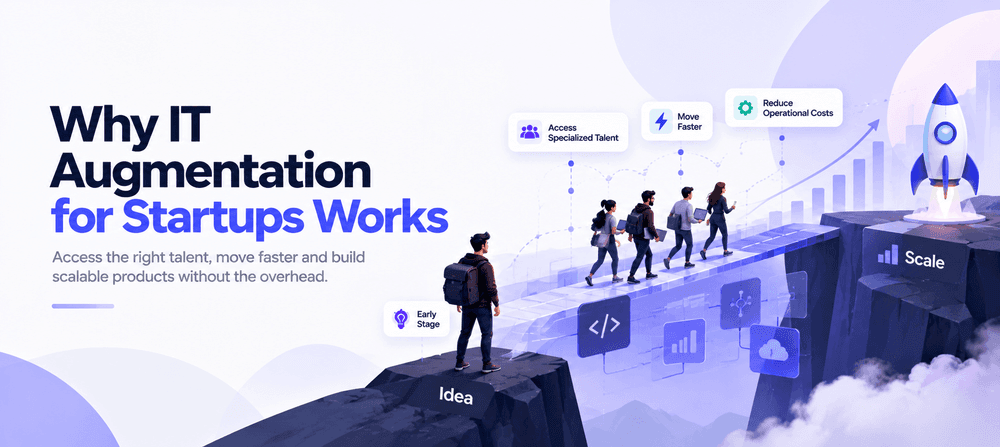
A good idea gets a startup noticed. It rarely gets a product shipped. For that you need working technology, people who actually know how to build it, and an engineering team that can turn a pitch deck into something customers can log into. The hard part is that the moment you need those people most, usually right before a launch or a funding milestone, is also the moment hiring them the traditional way is slowest and most expensive.
Classic recruitment does not move at startup speed. Writing the job description, sifting CVs, running technical rounds, negotiating offers, waiting out notice periods, then onboarding someone new to your codebase. Each stage eats weeks. For an early-stage company with a short runway, weeks are not a rounding error. They are the difference between hitting a release date and watching a competitor get there first.
This is the gap IT augmentation for startups quietly fills. Rather than carrying the full weight of permanent hiring for every role, you bring experienced engineers into the team you already have, matched to what the current build actually demands. It is one of the more practical ways founders can put together a scalable technology workforce without betting the whole budget on headcount they may not need in six months. Whether you are shipping a first MVP, growing a SaaS platform, or bracing for a growth spurt, the model gives you access to specialists sized to the work in front of you, not the org chart you hope to have one day.
In this guide we will walk through how IT augmentation actually works, which startups get the most out of it, how your hiring needs shift as you grow, and what to look for when you pick a partner.
What Is IT Augmentation for Startups?
At its simplest, IT augmentation is a flexible way to add outside engineering talent to the team you already run. Instead of hiring every developer as a permanent, benefits-and-equity employee, you work with a talent partner who finds people with the specific skills and experience your project needs, for as long as you need them.
These engineers are not a side team working in a silo. They sit inside your process. They join your standups, pick up tickets from your board, follow your coding standards, and move the roadmap forward alongside your core people.
Picture a SaaS startup building a CRM platform. The in-house team might be a product manager and two developers, which is plenty to prove a concept but thin for a serious feature launch. Before that launch the company realises it needs a couple more React developers, a backend engineer, and someone to own QA. Recruiting each of those roles the long way could easily take a quarter. With augmentation, those people can be contributing in a fraction of that time.
The point worth holding onto is this: you stay in charge. Priorities, architecture calls, what gets built first, all of it remains your decision. What changes is that you now have more capable hands to do the building.
Who Benefits Most from IT Augmentation?
The model stretches across almost every stage of a startup's life, but it earns its keep most clearly when you need particular skills and do not yet want to grow permanent headcount to get them.
1. Early-Stage Startups
Early teams run lean by necessity. Small budget, small crew, and a to-do list that still includes validating the idea, building a prototype, and getting an MVP in front of real users. Standing up a full in-house engineering function at that point is usually premature and often unaffordable.
Augmentation lets founders pull in exactly the developers and specialists the current milestone calls for, and nothing they do not.
2. SaaS and Technology Startups
SaaS never really stops needing engineering. There is always another integration, another round of testing, infrastructure to harden, a feature customers keep asking for. Extra developers can push those releases out faster while your core team stays focused on strategy and what customers actually want next.
3. Startups Expanding into New Markets
Moving into a new region brings its own technical to-do list: localisation, new integrations, security and compliance work, infrastructure that holds up in a different geography. Augmented engineers can reinforce the team through that stretch without you committing to permanent hires in a market you are still testing.
4. Startups Building AI-Powered Products
AI products tend to need people who are genuinely hard to hire: machine learning engineers, data scientists, AI engineers, cloud specialists. Trying to build every one of those capabilities in-house from day one is slow and risky. Augmentation gives you a faster route to that talent, and if you are specifically after that profile, it helps to understand what it takes to hire AI and ML engineers in India before you start.
5. Businesses with Temporary Skill Gaps
Sometimes the team is strong but missing one thing. You might have a solid product crew and simply need a cloud architect for a modernisation push, or a security specialist for one tricky implementation. There is no sense hiring a permanent role for a short-lived need. Augmentation covers the gap and then steps back.
How Startups Can Use IT Augmentation at Different Growth Stages
What you need from engineering at seed stage looks almost nothing like what you need at Series B. A flexible staffing approach is useful precisely because it can track your roadmap instead of forcing your roadmap to track your hiring.
Seed Stage: Build Your MVP
At seed, the job is to prove the thing works and that someone will pay for it. You want core functionality in the market, early users poking at it, and honest feedback coming back.
A SaaS build at this stage usually calls for a handful of roles:
- A frontend developer to put the interface together.
- A backend developer for the APIs and application logic.
- A UI/UX designer to make the experience something people enjoy using.
- A QA engineer to make sure the essentials hold up.
Rather than hiring a standing team for all of that, founders can bring in just the skills needed to get the MVP built and validated.
Series A: Accelerate Product Development
Once customers are signing up and the funding is in, the product gets more demanding. Now you are thinking about additional developers, QA specialists, and DevOps engineers to improve functionality, keep performance steady, and make the whole thing more reliable.
A SaaS company growing its user base, for instance, might need extra backend developers to keep the system quick under load and frontend developers to ship the features customers are asking for. Augmentation adds that capacity while your in-house team keeps its hands on the roadmap.
Series B: Scale Engineering Operations
By Series B the picture is bigger: more customers, more features in flight, and infrastructure that has quietly become complicated. The roles reflect that:
- Senior software engineers.
- Cloud architects.
- Data engineers.
- AI and machine learning specialists.
- DevOps professionals.
- Engineering managers and technical leads.
At this stage many companies mix individual augmentation with dedicated development teams to cover different parts of the business at once. The aim is an engineering structure that can keep scaling without breaking every time you grow.
Technology Professionals Startups Can Hire Through IT Augmentation
Which roles you actually need comes down to your product, your architecture, and what matters most to the business right now. That said, a few profiles come up again and again.
Frontend Developers
These are the people who build what your customers see and touch, working in React, Angular, Vue.js, and the other modern frameworks.
Backend Developers
Backend engineers handle the machinery underneath: application logic, APIs, databases, server-side work, usually in Node.js, Python, Java, or .NET.
Full-Stack Developers
Full-stack developers move comfortably between frontend and backend. They are handy for startups that want someone able to contribute across the whole application rather than one slice of it.
AI and Machine Learning Engineers
This group builds the intelligent parts of a product: integrating models, creating automation workflows, and supporting anything data-driven.
Cloud and DevOps Engineers
Cloud and DevOps people keep the lights on and the deployments smooth, covering infrastructure, deployment automation, cloud migration, scaling, and reliability.
Quality Assurance Engineers
QA engineers test the product, hunt down defects, and make sure new features behave. Depending on the role that can mean manual testing, automation, or performance testing.
Data Engineers
Data engineers build the pipelines and infrastructure that turn raw information into something your analytics and BI tools can actually use.
The right mix is rarely all of the above. It is whichever combination matches your technical needs and where you are trying to take the product.
A Structured Approach to IT Augmentation for Startups
Dropping extra developers into a team and hoping for the best is not a strategy. Augmentation works when there is a real process behind it, so outside engineers plug in cleanly rather than creating more overhead than they remove.
Step 1: Define Technical Requirements
Begin by getting specific about the skills, experience, and responsibilities the work needs. Write down the tech stack, the deliverables you expect, the seniority you are after, and how long the engagement is likely to run.
Step 2: Identify Suitable Professionals
With a hiring partner, line up candidates whose background genuinely fits. Look at their technical history, the projects they have shipped, and whether they have worked in a domain like yours.
Step 3: Conduct Technical Assessments
Before you commit to anyone, interview them and run role-specific technical assessments. This is where you find out whether the person can actually solve the kind of problems your project will throw at them, not just talk about them.
Step 4: Integrate Professionals into the Existing Team
Give new engineers the keys they need: development tools, documentation, communication channels, project management access. Make sure they understand the roadmap, who does what, and the standards the team holds itself to.
Step 5: Monitor Performance and Collaboration
Set clear expectations around responsibilities, progress updates, communication, and reviews. Regular check-ins catch friction early and keep everyone pointed at the same goals.
Flexible Scaling Models: Individual Staff Augmentation, Dedicated Teams and GCCs
Not every growth problem is solved the same way. There are a few distinct models, and knowing the differences saves you from forcing the wrong one onto your situation.
Individual IT Staff Augmentation
This is the straightforward version: you add one or more outside engineers to the team you already have. Maybe you run a solid product engineering group but need two more React developers and a senior DevOps engineer. They join your existing process and work the way your team already works.
Best suited for: Businesses with established technical leadership that need extra skills or capacity, not a whole new structure.
Dedicated Development Teams
A dedicated team is a group assembled to carry your ongoing technology work, often a blend of developers, QA engineers, designers, and specialists. It suits companies that need a larger engineering unit or want to push product development harder than a few extra hands allow. If you are weighing this up, it helps to know roughly how long it takes to build an offshore team in India before you plan around it.
Best suited for: Startups and growing businesses that need a full team rather than a couple of individual additions.
GCC Ramp-Up
A Global Capability Center is an offshore operation set up to support a company's broader business and technology functions, not just a single project. Companies look at a GCC when they want a long-term engineering, operations, or research presence in a place like India. It is a bigger commitment than short-term staffing, involving workforce structure, infrastructure, governance, and a clear read on the cost of setting up a GCC in India.
Best suited for: Established startups and global businesses planning a long-term India footprint.
How to Choose the Right IT Augmentation Partner
Your partner shapes the quality of the people you get and how smoothly the whole thing runs, so this choice deserves more than a quick look at a pricing page. A few things are worth checking before you sign anything, and it is worth reading up on how to choose a staff augmentation company in detail too.
1. Technical Expertise and Experience
Can the provider actually source people who know your stack? Look at the projects they have delivered, the specialisations they claim, and the industries they have worked in.
2. Candidate Screening Process
Ask how candidates are vetted before they ever reach you. A serious process includes technical interviews, coding assessments, communication checks, and real verification of experience, not a quick CV skim.
3. Industry Understanding
A partner who already knows SaaS, fintech, healthcare, ecommerce, or enterprise technology will grasp your requirements faster. Relevant experience beats a glossy generic service description every time.
4. Communication and Collaboration
Outside engineers have to work shoulder to shoulder with your team, so settle the practicalities early: working hours, channels, reporting, meeting rhythm, escalation paths. If you are hiring across borders, the US and India time-zone overlap is one of the first things to pin down.
5. Engagement Flexibility
Your needs will move as you grow. Check that the provider can handle individual engineers, full teams, different engagement lengths, and changing resource counts without a fuss.
6. Data Security and Intellectual Property
Get clear on confidentiality, access controls, data protection, and who owns the IP. This matters doubly if you are dealing with customer data, financial information, or proprietary tech.
7. Client References and Case Studies
Look at testimonials, case studies, and real outcomes. Ask providers to talk you through the problems they solved, the people they supplied, and the results, and compare that against lists of the best staff augmentation companies so you are judging real experience rather than marketing copy.
IT Staff Augmentation vs Traditional Hiring vs Outsourcing
There is more than one way to bring in outside engineering muscle, and the right one depends on how much control you want, how flexible you need to be, and who you want holding the delivery risk.
Traditional In-House Hiring
Here you recruit people as permanent employees and own the whole relationship: recruitment, onboarding, pay, performance, long-term development. It makes sense when the roles are genuinely permanent and you want to build lasting internal capability.
IT Staff Augmentation
With augmentation, outside engineers join your team and generally work under your day-to-day direction. You keep control of priorities, workflows, and technical decisions while gaining the extra expertise. It fits when your existing team needs reinforcing or a specific skill it does not currently have.
Outsourcing
With outsourcing, you hand a defined project or responsibility to an external provider who manages the execution and delivery against an agreed scope. This works when you would rather an outside partner own a particular project end to end.
In short, the choice comes down to one question: do you need permanent employees, extra people working inside your team, or an outside provider accountable for delivery?
How SquadXP Helps Businesses Scale Their Technology Teams
Finding good engineers is only part of building a team that works. The rest is workforce planning, getting the technical requirements right, structuring the team sensibly, and keeping an eye on where the business is headed.
SquadXP helps companies strengthen their technology capability through individual specialist hiring, dedicated development teams, and GCC ramp-up support. The approach starts with understanding what the business actually needs, finding talent that fits, and building teams that line up with the technology roadmap rather than cutting across it.
Startups and growing businesses tend to come to SquadXP when they want to:
- Add individual developers and specialists to an existing team.
- Build dedicated engineering teams for ongoing product work.
- Hire across software engineering and specialist technology roles.
- Strengthen AI, data, cloud, and DevOps capability.
- Explore a longer-term technology presence in India.
If you are evaluating a hiring partner, it is worth reviewing their case studies, talking through your requirements, and understanding the proposed engagement model before you decide.
Looking to expand your engineering team? Connect with SquadXP to discuss your technology hiring requirements.