
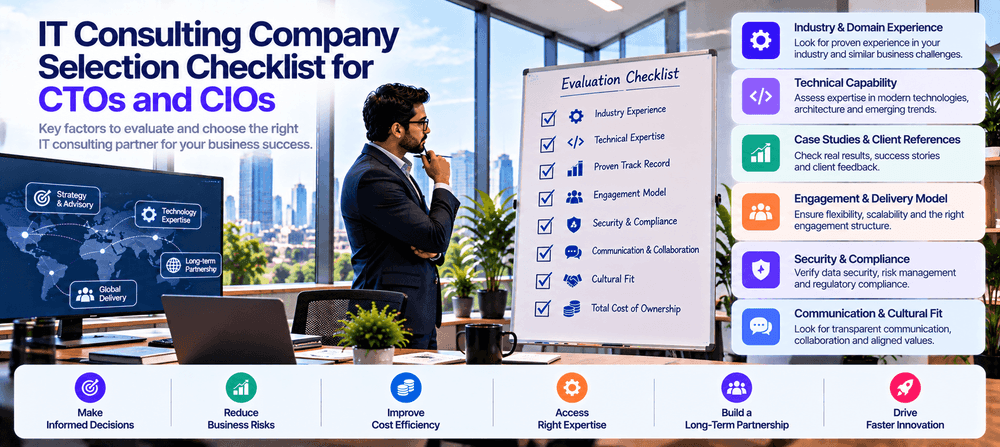
Picking an IT consulting company is an executive decision, not a procurement formality. The partner you choose can shape your architecture, your technology spend, your transformation timelines, and your engineering costs for years. Yet in a lot of organizations the selection quietly collapses into four steps: read the proposal, sit through the presentation, compare the price, sign the contract. That is how you end up with an impressive-looking firm solving the wrong problem.
A CTO or CIO deserves a sharper process than that. The goal is not to find the vendor with the longest service list or the slickest deck. It is to find the partner whose real capabilities match your actual technology problem. This checklist is built to get you there, and to keep a polished pitch from outweighing a stronger, plainer one.
Quick answer: Evaluate IT consulting companies across business understanding, technical expertise, relevant experience, the delivery team, methodology, security, IP, pricing, scalability, and measurable outcomes. A structured, weighted checklist stops selection from becoming a beauty contest of brand names and hourly rates.
Start with business understanding, not tech
Before anything technical, check whether the firm actually understands your business: your model, your customers, your industry, your revenue drivers, and your strategic priorities. Technology recommendations only matter if they connect to business outcomes. A consultant who cannot explain how a proposed architecture affects your revenue or risk is selling you technology for its own sake, and that is a fast way to spend a budget on the wrong things.
Test technical expertise and relevant experience
Look hard at expertise across architecture, cloud, data, AI, security, DevOps, and modernization, and ask for evidence rather than a logo wall. Then check relevance: projects similar to yours in size, industry, technology, and complexity. A firm with hundreds of engagements is not automatically right if none resemble your situation. Ten projects in your exact space tell you more than five hundred scattered everywhere else.
Meet the delivery team and confirm seniority
This is the check executives skip most and regret most. Ask who will actually deliver, then meet them: the architect, engagement lead, consultants, and specialists. Pin down how much senior involvement is genuinely included, because the classic pattern is senior stars who win the deal and quietly vanish after signing, leaving a junior bench behind. If the people selling differ sharply from the people delivering, treat that as a red flag, not a detail.
Understand methodology and lock down deliverables
A serious engagement has a clear shape: discover, assess, design, validate, implement. Not every project needs every phase, but the methodology should be explicit. Then define the outputs concretely. "Strategic technology guidance" is fog. Insist on real deliverables like an assessment, a target architecture, a roadmap, a business case, a risk register, and an implementation plan. If you cannot tell what you will physically receive, neither can they.
Get security, IP, and commercials in writing
On security, review access control, data protection, confidentiality, security processes, and incident response. Vague answers here are a stop sign. On IP, define who owns the code, documentation, architecture, data, and custom assets before you sign, ideally with legal input. On commercial terms, look past the headline number to the payment schedule, expenses, change-request pricing, termination, and renewal. Two proposals with the same fee can differ enormously once you read the fine print.
Check scalability and geographic capability
Ask what happens if the requirement grows. Can the partner add consultants, engineers, product specialists, cloud experts, or AI talent, or will you be stranded after the roadmap? This matters because a modernization plan often reveals a much larger workforce need. If you are planning to build in India specifically, evaluate their talent-market knowledge, compensation benchmarking, location expertise, hiring timelines, and leadership recruitment. Workforce intelligence is what separates a plan you can staff from one that stays on paper, and it is central to how SquadXP approaches building teams in India through specialist hiring and GCC ramp-up.
Do not ignore fit, governance, and references
A technically brilliant firm can still fail on communication and working style, so weigh cultural fit honestly. Nail down governance up front: weekly meetings, executive reviews, reporting, escalation, and decision rights. And talk to references. Ask previous clients whether the firm met expectations, whether costs stayed predictable, whether communication worked, and whether the team actually delivered. The "would you hire them again" question tells you more than any case study.
Measure outcomes, not hours, and plan the exit
Do not judge consulting by hours billed. Measure what the business feels: time saved, cost reduced, reliability, technology risk, delivery speed, and business impact. Just as important, plan the exit before you enter. Ask what happens after the engagement, who owns the knowledge, what documentation you receive, and whether knowledge transfer is included. A strategy that walks out the door with the consultants leaves you with a capability gap, so build the handover into the deal.
The most important question: do you even need consulting?
Here is the check that can save you an entire engagement. If your strategy is already clear and you simply need, say, 20 engineers, consulting is the wrong tool. More advice will not close a capacity gap. In that case a dedicated team is the better fit, built around ongoing engineering capacity for startups, high-growth companies, and enterprises. And if India is becoming strategically important, ask whether the engagement should evolve into a dedicated team, a build-operate-transfer arrangement, or eventually a full GCC. Matching the model to the real problem is worth more than any vendor comparison.
Score it with a weighted scorecard
To keep the decision objective, score each provider and weight the criteria to your priorities. A practical starting split: technical expertise 20%, relevant experience 15%, delivery team 15%, methodology 10%, security 10%, commercial model 10%, scalability 10%, and business alignment 10%. Adjust the weights to reflect what matters most for your organization, then apply the same scorecard to every vendor so you are comparing like with like.
Before you sign, confirm the essentials are all in place:
- Business problem and scope documented
- Deliverables and success metrics defined
- Delivery team named and senior expertise confirmed
- Security and IP terms reviewed
- Pricing, change process, and governance agreed
- References checked and exit process documented
Conclusion
CTOs and CIOs get the best results when they treat IT consulting companies as strategic technology partners rather than interchangeable vendors. The right process weighs expertise, people, delivery, security, commercials, scalability, and outcomes together, not price in isolation. And if the honest diagnosis is that you need engineering capacity rather than advice, the evaluation should turn toward a dedicated team or another workforce model instead. You can see how teams made that call in our client case studies.
If you want a second set of eyes on your shortlist, or help deciding whether you need consulting or capacity, talk to our team before you commit to anything.