
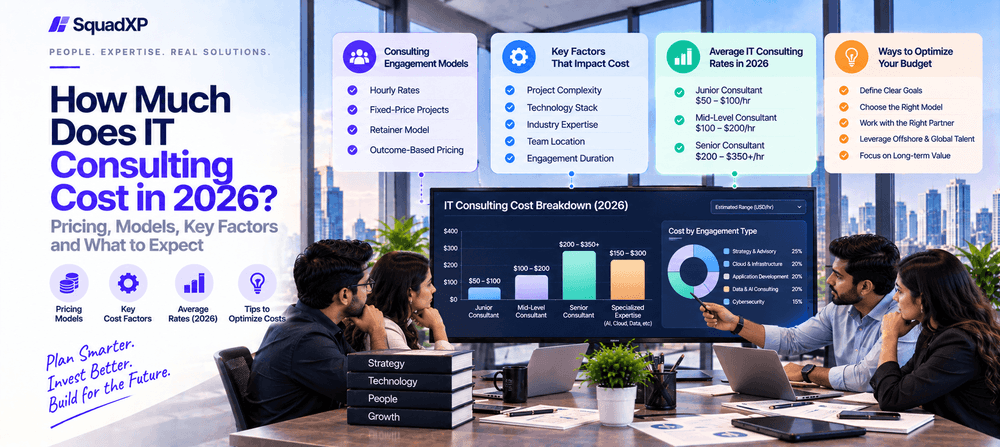
"How much does IT consulting cost?" sounds like it should have a tidy answer. It does not. A startup that wants a few hours of architecture advice is solving a completely different problem from a multinational planning a multi-year cloud transformation. Both type the same question into Google, and the honest answer for each is miles apart.
So a pricing guide that hands you one number is doing you a disservice. What actually helps is understanding what drives the cost, so you can estimate your own figure and spot when a quote is too good to be true. That is what this guide does.
Quick answer: IT consulting costs in 2026 depend on geography, consultant seniority, technical specialization, project complexity, and engagement model. You might pay hourly, daily, per project, or on a monthly retainer. Rather than trust a generic rate, work out your total cost from scope, expertise, duration, expected outcomes, and implementation needs.
The main IT consulting pricing models
Before you can judge a quote, it helps to know which pricing model you are even looking at. There are five common ones.
Hourly pricing: You pay for the hours worked. It is the go-to for advisory work, troubleshooting, architecture reviews, short engagements, and one-off specialist consultations. Flexible, but the final bill is harder to predict.
Daily rates: Some consultants price by the day, which suits workshops, assessments, and short specialist stints where a full day is the natural unit.
Project-based pricing: A fixed price for a defined scope. Great for budget certainty, but it only works when the requirements are genuinely clear. Fuzzy scope plus fixed price is a recipe for change requests and friction.
Monthly retainer: A set monthly fee for ongoing access to expertise. This fits fractional CTO support, continuous technology advisory, and standing architecture guidance where you want a trusted expert on call.
Team-based pricing: For bigger programs, you are paying for a multidisciplinary team, and the cost tracks team composition, seniority, duration, location, and complexity.
What actually drives the price
Once you know the model, a handful of factors move the number up or down.
Seniority is the big one. A junior consultant and a principal architect are not interchangeable, and the senior rate buys experience, sharper judgment, domain depth, and leadership. Technical specialization matters too, because scarce skills like AI, cybersecurity, cloud architecture, data engineering, and enterprise architecture command a premium. Then there is complexity, since a quick assessment is nowhere near a full transformation, and geography, because rates genuinely vary by region.
On geography, one myth is worth killing. India offers access to a deep technology talent pool, but assuming every Indian consultant should be cheap is simply wrong. Specialized talent here is competitive and priced accordingly, and compensation swings widely by specialization, experience, city, and company type. If you want a realistic read on that, SquadXP's India salary and hiring data shows how much the numbers move across roles and regions.
The hidden cost of cheap consulting
A low hourly rate can quietly turn into the most expensive option you had. When cheap work produces weak architecture, rework, delays, miscommunication, security gaps, or technical debt, the savings evaporate.
Here is the math that trips people up. Consultant A charges 100 dollars an hour and finishes an architecture assessment in 50 hours, so 5,000 dollars. Consultant B charges 60 dollars an hour but takes 120 hours and delivers recommendations that need extra rework, so 7,200 dollars before you even fix the gaps. The lower rate was lost. Rate is not cost, and the two get confused constantly.
How to calculate your total consulting cost
Instead of fixating on the rate, add up the whole picture:
Total cost = professional fees + internal management time + implementation + rework + transition + technology costs.
That formula gives you something a rate card never will: a realistic number you can actually budget against. If part of your decision is really about building capacity rather than buying advice, run those figures through a developer hiring cost calculator as well, so you are comparing like with like.
Consulting cost is not engineering cost
Do not confuse the two. A consultant might spend 20 hours designing an architecture that then guides a team of 30 engineers for two years. The value is not in those 20 hours. It is in the quality of the decisions that shape everything built afterward. Judging that engagement by its hour count misses the entire point.
How to build a consulting budget
Start with the business problem, not the price. Then define your current state, desired state, the expertise you need, scope, timeline, deliverables, internal resources, and what implementation will require. Only after that does estimating the consulting effort make sense. Budget backward from the outcome you want, not forward from an hourly rate you found online.
A quick look at how this scales by stage:
- Startup: Often a short, specialist-led engagement: architecture review, security assessment, cloud planning, and a technical roadmap.
- Scaleup: A larger effort covering architecture modernization, cloud migration, DevOps, and an engineering operating model.
- Enterprise: A big program with leadership, enterprise architecture, cloud, security, data, and change management, sometimes running for months or years with multiple consultants.
How to compare proposals fairly
When quotes land, put them side by side on more than price. Compare scope, deliverables, the team and its seniority, timeline, fees, assumptions, exclusions, the change-request process, support period, IP terms, and security obligations. Two proposals with the same headline fee can be wildly different once you read the assumptions and exclusions. That table is where you catch it.
Consulting cost versus a dedicated team
There is a case where consulting is the wrong tool no matter the price. If you already know what needs to be built and simply do not have enough engineers, advice will not solve a capacity problem. In that situation, a dedicated team is usually the better spend, giving you ongoing engineering capacity that plugs into your tools, workflows, and priorities. And when the gap is one or two hard-to-find roles rather than a full team, specialist hiring is the cleaner fix. Match the spend to the problem, not to whichever quote looks lowest.
Conclusion
There is no single IT consulting cost for 2026. It rides on expertise, scope, complexity, duration, geography, and engagement model. The safest habit is to compare total cost and expected outcome instead of hourly rates, because for strategic decisions the cheapest consultant can become the most expensive one the moment their recommendation saddles you with long-term technical debt.
If you want help sizing an engagement or figuring out whether you need advice, a dedicated team, or specialist hires, talk to our team. You can also see how the right model changed the numbers for other companies in our client case studies.