
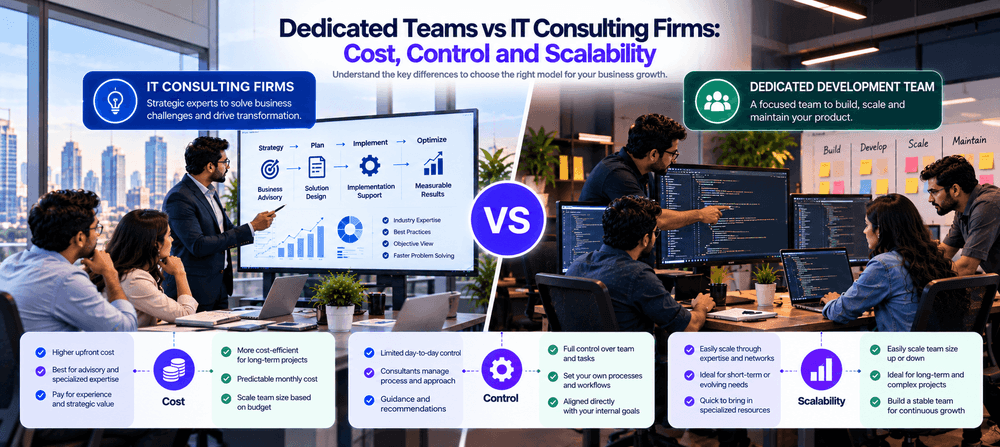
Ask most teams to choose between a dedicated team and an IT consulting firm and they treat it like picking a vendor off a list. The real question is quieter and more important: do you need someone to tell you what to do, or someone to actually do it? Those are two different jobs, and picking the wrong one is how companies end up with a beautiful strategy nobody builds, or a busy team building without a clear plan.
A consulting firm exists to solve a technology problem with expertise. A dedicated team exists to execute technology work, week after week, as part of how you operate. Hold that distinction in your head and the money, the control, and the scaling questions all get simpler to answer.
Quick answer: IT consulting firms sell expertise and direction, meaning strategy, architecture, and specialist advice. Dedicated teams sell sustained engineering capacity that works inside your tools and workflows. Pick consulting when the gap is a decision. Pick a dedicated team when the gap is execution. Plenty of companies use both, in sequence.
Two different jobs, not two versions of one
The single most useful thing you can do before comparing quotes is name your constraint. If you are stuck on a decision, an architecture you are unsure about, a cloud move you have not planned, an AI use case you cannot scope, that is a consulting problem. If you already know what to build and simply do not have enough people to build it, that is a capacity problem, and no amount of advice fixes it. Everything below flows from that one distinction.
Cost: stop comparing a rate to a headcount
Consulting pricing rides on seniority, scope, duration, and how specialized the work is. You are paying for sharp thinking applied to a defined problem. A dedicated team is priced on the number of people, their roles and experience, how long you keep them, and where they sit. You are paying for reliable output over time.
Here is where buyers slip: they hold an hourly consulting rate next to a monthly team cost and try to declare a winner. That comparison is meaningless. One is the price of a decision, the other is the price of ongoing delivery. Judge each against the result it is supposed to produce, not against the other.
Control: hand-off convenience or hands-on command
Consulting firms usually run their own engagement. That is a feature when you want expertise without babysitting it, you hand over the problem and get a considered answer back. A dedicated team works the other way, plugging into your tools, your workflows, your delivery cadence, and taking direction from your priorities day to day.
So the control question is really about temperament and need. Want to stay close to how the work gets done and steer it continuously? The dedicated model gives you that grip. Want to offload a defined problem and keep your own team lean? Consulting suits you better. Neither is superior, they are just built for different comfort levels.
Scalability: burst expertise or a team that grows
Dedicated teams are designed to expand. As your roadmap stretches, you add engineers, QA, DevOps, product, data, or AI capacity around the same core group, and the team absorbs it because continuity is built in. Consulting firms scale differently. They can surge specialist expertise for a defined stretch, but they are not the natural home for continuous, months-long product development. If you are staring at a long build, the dedicated model grows with you. If you need sharp advice in bursts, consulting flexes more cleanly.
Expertise: the plan versus the people
Consulting is at its best when the deliverable is thinking: strategy, architecture, transformation planning, or a specialist opinion you cannot get in-house. A dedicated team is at its best when the deliverable is working software: engineering, product development, QA, DevOps, and steady execution. When you are unsure which you need, ask yourself whether you are missing the plan or the people to run it. That answer usually ends the debate.
Management: the trade-off nobody mentions upfront
Time for the honest part. A dedicated team runs best when someone on your side owns prioritization. That client-side leadership is not a burden so much as the thing that keeps the team aligned with your product goals. But if you have no engineering leadership at all, a bare team can overwhelm you, and you may need added leadership support or a few senior specialist hires to steer it well. Consulting can lighten that load for a focused project, because the firm manages its own people and process. Factor this in before you choose, not after.
Time horizon: short problem, long build
A quick filter cuts through most of the noise. Short-term strategic problem points to consulting. Long-term development need points to a dedicated team. Match the model to how long the requirement will realistically last, and resist choosing on whichever number looks smaller this quarter, because the cheaper option for a three-month problem is often the wrong option for a three-year one.
A real example
Picture a SaaS company moving its aging monolith to a modern architecture. A consultant assesses the system, designs the target architecture, and lays out the migration roadmap. Then a dedicated team refactors the services, builds the APIs, migrates the infrastructure, tests, and ships. Notice that these are not competing purchases. They are two stages of the same journey, and many companies buy both: consulting to choose the route, a team to drive the distance.
Dedicated team versus staff augmentation
These two get lumped together, and they should not be. Staff augmentation hands you individual professionals to fill specific gaps. A dedicated team hands you an intentionally structured group built to operate as a unit, with coordination and continuity designed in from the start. The difference stops mattering when you just need an extra pair of hands, and starts mattering a lot when success depends on a group working together over time. That is why SquadXP frames dedicated teams as a way to build durable engineering capability rather than a quick way to fill seats.
Where a GCC comes in
There is a well-worn path here worth knowing: consulting, then a dedicated team, then a GCC. It is not compulsory, and many companies happily stop at the first or second stage. But as a map it is clarifying. You begin by buying expertise, graduate to renting sustained capacity, and eventually, if technology becomes core and demand holds steady, you build and own the capability outright. Each step swaps a bit of flexibility for a bit more ownership and control.
Conclusion
Reach for an IT consulting firm when your main challenge is expertise and direction. Reach for a dedicated team when your main challenge is engineering capacity and continuous execution. Use both when strategy and delivery have to move together. The one habit that keeps this decision clean is refusing to judge the two by the same measuring stick, and instead matching each to the specific gap in front of you. If you want to see how other teams made that call, our client case studies show it in practice.
Not sure which side of the line you are on? Talk to our team and we will help you figure out whether you need advice, a dedicated team, or a capability center you own, before you spend a rupee or a dollar.