
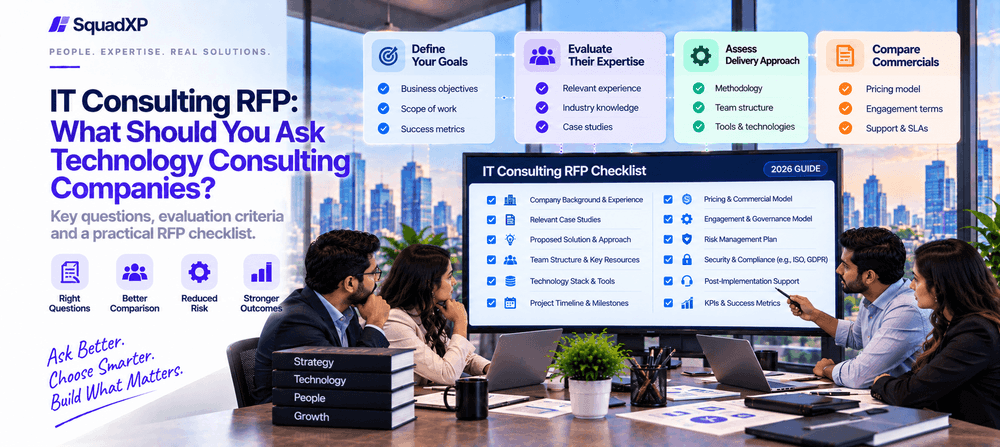
A good IT consulting RFP is not just a way to request proposals. It is the thing that makes those proposals comparable in the first place. Skip it, or write a weak one, and every vendor answers a slightly different question. One firm pitches strategy, another pitches implementation, a third proposes a dedicated team. The quotes come back wildly apart, and you cannot line them up because the scopes never matched. A clear RFP fixes that before it starts.
Think of the RFP as the brief that forces everyone to solve the same problem, on the same terms, so you are comparing apples with apples instead of guessing. Here is how to build one that does exactly that, and the questions worth asking every provider.
Quick answer: An IT consulting RFP should define the business problem, current environment, objectives, scope, deliverables, timeline, evaluation criteria, security requirements, and commercial structure. It should also require each vendor to state assumptions, risks, team composition, methodology, and measurable outcomes, so proposals are genuinely comparable.
What an IT consulting RFP actually is
An RFP, or Request for Proposal, is the document you send to technology consulting companies inviting them to propose a solution to a defined requirement. A solid one usually covers business background, current environment, a clear problem statement, objectives, scope, deliverables, timeline, security requirements, commercial requirements, and evaluation criteria. Miss any of these and you leave a gap that vendors will fill with their own assumptions, which is exactly what makes proposals impossible to compare.
Set the context: background and problem
Start with who you are: industry, geography, business model, technology environment, and rough size. Enough for a vendor to understand you, without dumping confidential detail you do not need to share.
Then, and this is where most RFPs fail, write a sharp problem statement. "We need technology transformation" tells the vendor nothing. "Our application architecture struggles to scale during peak demand and needs manual infrastructure intervention" tells them everything. Specific problems produce specific, useful proposals. Vague problems produce vague, padded ones.
Describe the current and future state
Lay out your current state so vendors are not guessing: architecture, infrastructure, applications, team structure, technology stack, and known constraints. Then describe the future state you want as an outcome, not a prescription. "We need a scalable architecture that can support projected traffic growth" invites consultants to show their thinking. Specifying every technical answer yourself defeats the point of asking experts in the first place.
Nail down scope and deliverables
Define what is in scope, whether that is assessment, architecture, cloud, security, data, AI, or implementation planning. Then ask each vendor to spell out concrete deliverables: reports, architecture diagrams, roadmaps, recommendations, risk registers, and implementation plans. If a proposal cannot tell you what you will physically receive, it is not a proposal, it is a promise.
The questions that separate strong vendors from confident ones
A good RFP is really a set of pointed questions. Group them so nothing slips through.
On expertise, ask what similar projects they have completed, which industries they specialize in, which technologies they support, who will lead the engagement, and what share of the work senior consultants will actually do. That last one quietly exposes the sell-high, deliver-junior trap.
On methodology, ask about the engagement phases, how they gather requirements, how they validate recommendations, how they manage scope changes, and how they report progress.
On security, ask how client data is protected, where it is stored, who has access, what controls exist, and how incidents are handled. On IP, ask who owns the deliverables and custom code, whether the provider can reuse frameworks, and how your data is treated. These clauses are worth legal review before you sign.
On team structure, make them name the engagement manager, architect, consultants, specialists, and any implementation resources. On pricing, ask for fixed fees, hourly or resource rates, expenses, optional services, and change-request pricing.
Ask for assumptions and risks, on purpose
Two things buyers forget to demand. First, assumptions: make every vendor document client responsibilities, dependencies, and their technology, data, and timeline assumptions. That single requirement surfaces most hidden scope gaps. Second, risks: a credible firm will name real risks. If every proposal claims the project will be smooth and easy, the proposals are not rigorous enough to trust.
Score it consistently
Build a weighted scorecard covering technical expertise, relevant experience, team, methodology, security, commercials, and scalability, and apply it identically to every vendor. Consistency is what keeps a polished pitch from beating a stronger, plainer one. If you want to pressure-test claims, ask for proof from past clients rather than taking the deck at face value.
RFP mistakes that quietly wreck the process
A few traps show up again and again. Overprescribing the solution, because if you already know every technical answer you may not need an RFP at all. Focusing only on price, since the cheapest proposal often hides the biggest scope gaps. Ignoring implementation, so nobody addresses what happens after the recommendations land. And failing to define success, which leaves you with no measurable way to judge the result. Name your success metrics in the RFP itself.
When the RFP reveals a team-building need
Sometimes the process uncovers a bigger requirement than advice. A line like "after modernization, we will need a permanent engineering team in India" is a workforce decision, not a consulting one. That is where models beyond advisory come in: a dedicated team for ongoing capacity, specialist hiring for hard-to-find roles, or GCC building when you want to own the capability long term. Naming that need in the RFP means vendors can address the organizational side, not just the strategy. SquadXP covers exactly that organizational layer.
Conclusion
A strong IT consulting RFP creates comparable proposals by making sure every provider solves the same problem, in the same terms. The flow is simple: problem, current state, desired outcome, scope, deliverables, team, security, commercials, evaluation. The goal is not the longest document you can write. It is one clear enough that the quotes you get back can actually be compared side by side.
If your requirement is turning into more than advice, talk to our team and we will help you scope whether you need consulting, a dedicated team, or a capability center before the RFP even goes out.