
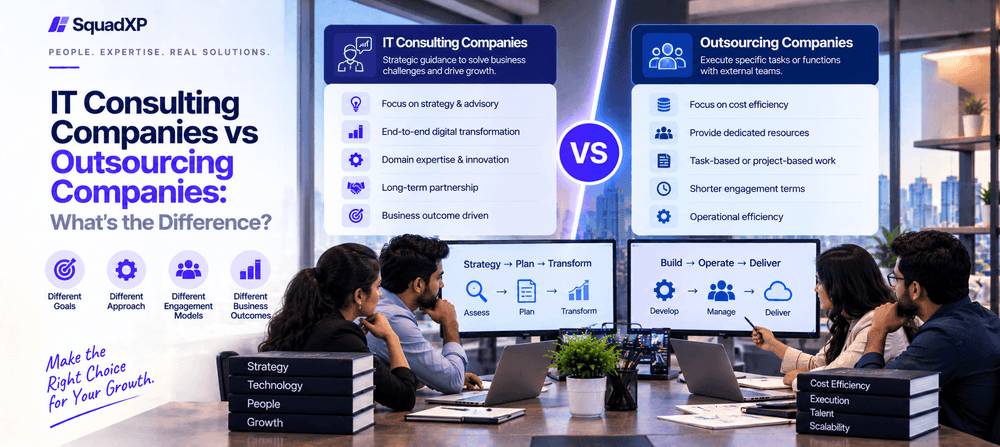
People throw the words "consulting" and "outsourcing" around as if they mean the same thing. They do not, and mixing them up is how companies end up paying for advice when they need delivery, or handing off delivery when they still need a plan.
Here is the picture in plain terms. One business hires an IT consultant to figure out how to modernize its technology, then outsources the actual build to a delivery provider. Another skips consulting entirely because the scope is already clear and goes straight to an outsourcing partner. Both are right, because they were solving different problems. The whole decision comes down to three things: who brings the expertise, who owns the execution, and how much stays on your plate.
Quick answer: IT consulting companies provide expertise, strategy, and technology guidance. Outsourcing companies take responsibility for delivering defined services, projects, or functions. Consulting helps you decide and plan. Outsourcing helps you execute without building the whole capability in-house. Many companies use both, in that order.
What an IT consulting company does
A consulting company sells thinking. It helps you solve complex technology problems through work like technology strategy, architecture, digital transformation, cloud strategy, cybersecurity, AI strategy, modernization, and technology due diligence. The output is direction: recommendations, roadmaps, target architecture, and a plan you can act on. A consultant may not run the delivery. Their value is helping you make the right call before you spend real money building the wrong thing.
What an outsourcing company does
An outsourcing company takes work off your hands. You hand over a defined scope and the provider owns delivery, whether that is application development, QA, infrastructure management, a help desk, data processing, managed IT, or software maintenance. The provider manages the people and the process, usually against agreed service levels. You describe what you need; they run it.
The core difference
The simplest way to hold it in your head: consulting is expertise and direction, outsourcing is external delivery. One tells you what to do and how. The other does a defined chunk of it for you. Modern providers increasingly blur the line by offering both, but the underlying jobs are still different, and that difference should drive your choice.
Control: how much stays with you
Consulting usually leaves you in the driver's seat. You get advice, but the implementation decisions remain yours. Outsourcing shifts more operational responsibility to the provider, which is exactly the point when your goal is to reduce internal workload. Neither is better in the abstract. It depends on how much day-to-day control you want to keep and how much you would rather offload.
Cost: look past the first invoice
Consulting fees can look steep because you are paying for senior expertise. Outsourcing can look cheaper up front because delivery resources are pooled across many clients. Both numbers are incomplete on their own. The real cost includes management overhead, rework, knowledge retention, delivery speed, vendor management, security, and transition costs when things change hands. A low quote that leaks value through rework and heavy oversight is not a bargain. Judge the total, not the headline rate.
When consulting makes sense
Reach for consulting when the path is unclear. That includes moments when the problem itself is fuzzy, the architecture needs a serious review, a technology strategy is missing, you are planning a major transformation, or your internal expertise simply does not stretch that far yet. In short, when a wrong decision would be expensive, buying clear thinking first is cheap insurance.
When outsourcing makes sense
Reach for outsourcing when the scope is well defined and the work is repeatable. It fits when internal capacity is tight, when the capability is not a competitive differentiator, and when a provider can reliably hit the service levels you need. If you already know exactly what has to be done and just need someone accountable to run it, outsourcing is often the cleaner choice.
Where dedicated teams fit
There is a model that sits between the two, and it solves a problem both can miss. Instead of handing over a finished project, you get a dedicated team that works as an extension of your own organization. You keep more day-to-day control over priorities than you would with traditional project outsourcing, without carrying the full administrative load of direct hiring.
This is the sweet spot when you know what you want to build but need reliable, business-aligned engineering capacity that stays consistent over time. It also opens the door to specialist and senior talent you might struggle to hire quickly on your own. SquadXP builds dedicated teams around exactly this need for startups, high-growth companies, and enterprises.
Where GCCs fit
A Global Capability Center pushes further toward ownership. Rather than buying external delivery again and again, you set up your own capability in India and own it outright. That makes sense when India is strategically important to you, the team is going to grow, technology is core to how you compete, IP ownership matters, and you expect the demand to last. A GCC in India is less a vendor relationship and more a long-term part of your own organization.
A quick decision framework
Match the model to what you actually need:
- Need expertise, strategy, architecture, and a roadmap? Choose consulting.
- Need a defined scope delivered against an SLA with managed execution? Choose outsourcing.
- Need engineering capacity, direct control of priorities, and team continuity? Choose a dedicated team.
- Need long-term ownership, internal capability, and strategic control? Build a GCC.
Most companies do not pick just one for life. A common and healthy pattern is to consult for direction, then outsource or build a dedicated team to execute, and eventually stand up a GCC once the capability becomes core. You can see how different models played out for real teams in our client case studies.
Conclusion
IT consulting and outsourcing are not rivals. They solve different problems. Consulting helps you understand what to do and how to approach a hard technology decision. Outsourcing gives you delivery capacity without building every capability yourself. The right answer depends on your specific problem, how much control you want to keep, how strategic the work is, and how long you will need the capability.
So do not start by asking "consulting or outsourcing." Start by asking what problem you are solving, how much of it you want to own, and for how long. Answer that and the model chooses itself. If you want a hand mapping your situation to the right model, talk to our team and we will point you to the option that fits, whether that is a dedicated team, specialist hires, or a capability center you own.