
Most teams start the hunt for a technology partner by comparing company profiles and hourly rates. That is usually where the trouble begins. Two very different types of firms show up in the same results, an IT consulting company and a software development company, and on paper they look almost identical. Both employ engineers, architects, and project managers. Both work with startups, scaleups, and enterprises. Both list overlapping services.
The real difference is not the team on the About page. It is the problem each one is built to solve. An IT consulting company starts with your business and technology problem. A software development company starts with the product you already want built. Get that distinction right and the rest of the decision gets much simpler.
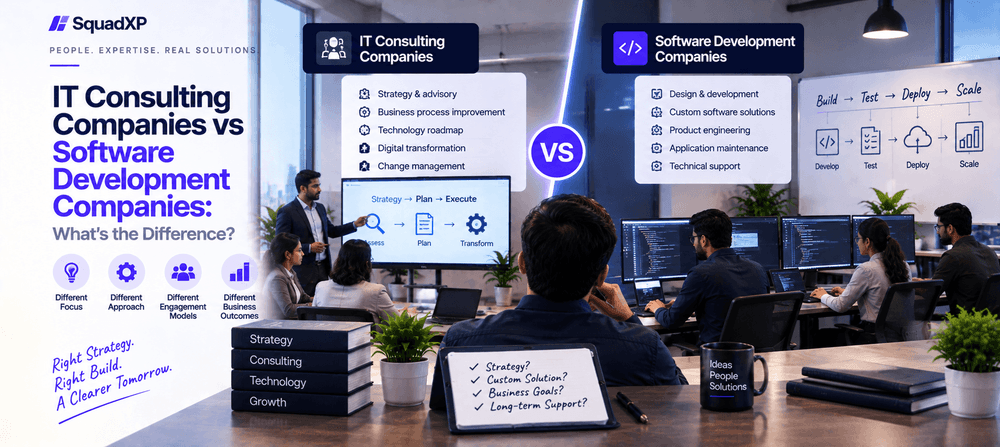
Quick answer: IT consulting companies help you decide what to build, how to build it, and what technology setup you need. Software development companies help you design, build, test, and maintain the actual software. They overlap, but their goals, deliverables, and engagement models differ, and so do the outcomes you should expect.
What an IT consulting company does
An IT consulting company sells expertise and direction. The work covers technology strategy, IT architecture, cloud strategy, cybersecurity, data and analytics, AI adoption, modernization, and how your engineering organization should be structured. Consultants may not write most of the production code. Their job is to study your current setup, find the real problems, define a target architecture, recommend the right technologies, and hand you a plan you can act on.
Picture a financial services firm running a twelve-year-old platform. It does not need "twenty developers." It first needs answers. Should the platform be rebuilt or modernized? What moves to the cloud and what stays put? Do microservices fit here, or just add cost you will regret? Which capabilities are missing, what belongs in-house, and what should be outsourced? Those are consulting questions, and answering them wrong is expensive.
What a software development company does
A software development company builds and maintains software. That means web and mobile development, backend and frontend, APIs, SaaS products, QA and testing, DevOps, and ongoing maintenance. The core question is simple: can you build this?
Say a startup already has a validated idea, an approved architecture, and a product roadmap. It does not need a long strategy engagement. It needs capacity, meaning experienced people who can turn the plan into a working product. That is a development problem, not a consulting one.
The core difference, in five parts
The cleanest way to tell them apart is to look at five things.
Objective: Consulting is about decisions and direction. Development is about delivery. One produces a roadmap; the other produces the app on that roadmap.
Starting point: Consulting begins with a business problem such as "reduce our tech costs and modernize our stack." Development begins with a defined requirement such as "build a customer app in React Native."
Deliverables: Consulting hands you strategy documents, architecture assessments, roadmaps, and business cases. Development hands you applications, APIs, databases, tests, and production releases.
Engagement model: Consulting tends to be advisory or project-based. Development runs on fixed-price, time and materials, dedicated teams, or long-term product partnerships.
Decision authority: A consultant influences the decision. A development partner usually executes a decision you have already made or agreed on together.
Where the two overlap
The line is not always clean. Plenty of consulting firms are also built. Plenty of development firms also offer architecture, cloud, and transformation advice. Often the smart path is a blend that runs in phases: assess, design the architecture, build, migrate to the cloud, then support and scale the engineering effort. This works well when the problem is complex and you do not have enough internal expertise to separate strategy from execution cleanly. The trick is to know who owns which phase before you sign, not after.
What it really costs
Cost depends on geography, seniority, technology, complexity, engagement length, and how many specialists you need. Which is why comparing hourly rates alone is a trap.
Say one firm quotes 60 dollars an hour and another 90. The cheaper one can end up costing more if requirements get misread, the architecture needs repeated redesign, senior expertise is missing, delivery takes twice as long, and rework piles up. None of that shows on the rate card. For consulting, the value often shows up as the costly mistake you avoided. For development, it shows up as reliable software delivered faster. Compare total cost and outcome, not the number per hour.
When to choose IT consulting
Lean toward an IT consulting company when the problem is still fuzzy and you are asking things like: What architecture should we use? How do we modernize legacy systems? Should we move to the cloud, and how? How do we adopt AI in a way that pays off? Which capabilities belong in-house? Should we set up an engineering center in India, and how should it be structured? Consulting earns its fee when the direction is unclear and the cost of guessing is high.
When to choose software development
Lean toward a software development company when the direction is already set: requirements are defined, the architecture exists, and capacity is the real constraint. You need an MVP, application modernization, extra engineering hands, or long-term product development. When you already know what to build, paying for months of advice only slows you down. You need builders.
Where dedicated teams fit
There is a useful middle ground. A dedicated team sits between one-off consulting and traditional project development. It works as an extension of your organization, using your tools, workflows, standards, and delivery cadence, while you keep control of priorities. This is the right call when you know what you want to build and simply need reliable capacity that stays aligned with your business. It also gives you access to specialist and senior engineers without the overhead of building a hiring function from scratch. SquadXP structures dedicated teams for startups, high-growth companies, and enterprises for exactly this reason.
Where GCCs fit
A Global Capability Center is a different move again. Instead of buying advice or renting delivery, you build a technology organization you eventually own. The question shifts from "who helps us this quarter" to "do we want to own this capability for the long term." If technology is core to your business and demand is here to stay, especially for engineering, product, AI, data, or R&D in India, a GCC in India can be the stronger long-term play. It is less about a single project and more about permanent capability.
A simple decision framework
Run through six quick questions before you commit:
- Is the problem clearly defined? If not, start with consulting. If yes, move toward development.
- Do you already have architecture? If not, architecture consulting helps. If you do, you can start building.
- Do you need advice or capacity? Advice points to consulting. Capacity points to development or a dedicated team.
- Is the capability temporary or permanent? Temporary suits a project or dedicated model. Permanent suits an internal team or a GCC.
- Who should own the knowledge? If long-term ownership matters, plan for knowledge transfer and team continuity from day one.
- Is technology a core advantage? If it is central to how you compete, a long-term internal capability deserves serious thought.
Conclusion
IT consulting companies and software development companies are not interchangeable. Consulting is about strategy, architecture, transformation, and decisions. Development is about building, testing, shipping, and maintaining. If you have a clear product and roadmap, capacity is your need. If you are facing uncertainty, consulting sets the direction before a single line of code is written. And if you want lasting capability, dedicated teams and GCC models become part of the plan.
So the question is not "which type of company is better." It is "what problem are we really trying to solve." Answer that clearly and the right partner becomes obvious.
If you want a second opinion on which model fits your stage, talk to our team. You can also see how companies scaled with the right setup in our client case studies.