
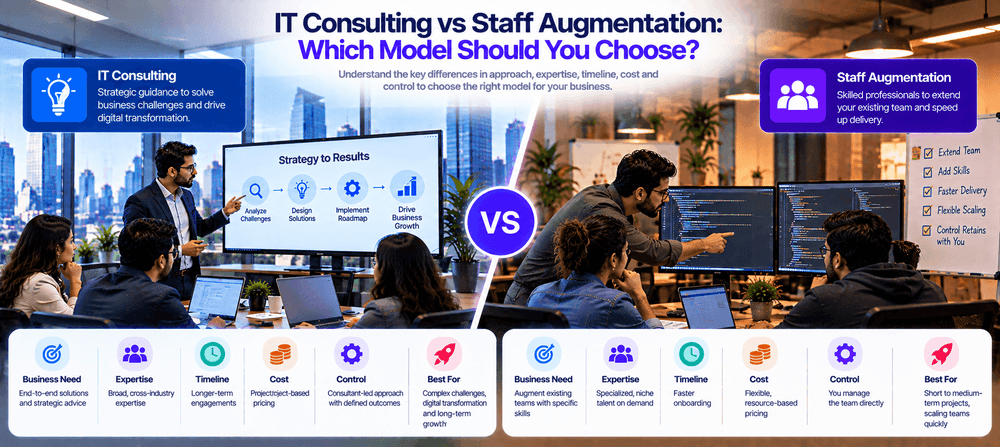
Most teams that get this decision wrong make the same mistake first: they confuse an expertise problem with a capacity problem. The two feel similar in a planning meeting, but they are not the same thing, and the fix for one does nothing for the other.
Here is the tell. If your engineering team does not know how to modernize an application, that is an expertise gap, and consulting is the answer. If your team knows exactly what to do but is three developers short of doing it, that is a capacity gap, and staff augmentation is the answer. Buy consulting for a capacity problem and you get advice you did not need. Buy augmentation for an expertise problem and you get hands on with no plan to follow. Naming the constraint correctly is most of the decision.
Quick answer: IT consulting gives you strategic or specialist expertise. Staff augmentation adds external professionals to your existing team. Choose consulting when you need advice, architecture, or transformation help. Choose staff augmentation when your plan is already clear but you lack the people to execute it.
What IT consulting is
Consulting sells thinking and direction. It covers strategy, architecture, advisory work, transformation, and specialist expertise you do not have in-house. The output is a decision or a plan: what to build, how to build it, and what to watch out for. A consultant is at their most valuable before you have committed money to a direction, when getting the call right saves you from an expensive wrong turn.
What staff augmentation is
Staff augmentation adds external professionals to a team you already have. The engineers work inside your world, meaning your codebase, your sprints, your tools, your processes, and your engineering standards. In this model, the external engineers work under your direction while the provider handles the employment and administrative side. You get more hands on your existing plan without building a hiring and HR function to get them.
The one difference that decides it
Strip everything else away and it comes down to a single line. Consulting is for when you need expertise. Staff augmentation is for when you need capacity. Almost every other factor, management, cost, duration, follows from which of those two you are actually short on. So answer that first, before you look at a single provider.
Management: who runs the work
With consulting, the firm often runs its own engagement and hands you the result. With staff augmentation, the augmented professionals work under your management and your priorities, day to day, as part of your team. If you want to keep tight control of how the work gets done, augmentation fits. If you would rather hand off a defined problem and get an answer back, consulting fits.
Duration and cost
Consulting tends to be shorter and scoped to a problem, and its cost tracks expertise and scope. Staff augmentation can run short or long depending on the need, and its cost tracks role, seniority, and duration. Neither is automatically cheaper, because they buy different things. Comparing a consulting fee to an augmented engineer's monthly rate is comparing a decision to a pair of hands. Judge each against the outcome it delivers.
When staff augmentation makes sense
Augmentation shines in a few clear situations: a temporary workload spike you need to absorb, a specialized short-term need you do not want to hire permanently, or entering a new geography where flexible capacity beats a full local build on day one. In each case, the direction is already set and you simply need more capable people on the work, fast, without the overhead of permanent recruitment.
When consulting makes sense
Reach for consulting when the architecture is unclear, the strategy still needs shaping, the technology needs an honest assessment, or a specific specialist skill is missing. These are moments where the value is in the decision, not the delivery, and a wrong decision would be far more expensive than the consulting fee.
A concrete example
Say a company is moving to Kubernetes. If it is not even sure Kubernetes is the right choice, that uncertainty is an expertise gap, and consulting helps it decide. If it already has a solid Kubernetes migration plan and just needs two experienced DevOps engineers to run it, that is a capacity gap, and staff augmentation is the cleaner fit. Same technology, completely different problem, completely different model.
Staff augmentation versus a dedicated team
These two get blurred, and they should not be. Staff augmentation adds individual professionals to your team. A dedicated team gives you a structured group built to work as a unit, with coordination and continuity designed in. The difference barely matters when you just need one or two extra hands, and it matters a lot when the work depends on a team operating together over time. SquadXP offers both, so the structure can match the requirement rather than forcing the requirement to match the structure.
Staff augmentation versus a GCC
The other end of the spectrum is ownership. Staff augmentation is externally provided and flexible, ideal when you want capacity you can scale up or down. A GCC is internally owned and permanent, built when a capability becomes core and demand is here to stay. Augmentation is renting capacity for now. A GCC is owning capability for the long term. Many companies start with the former while they figure out whether the latter is justified.
A simple decision framework
Match the model to the constraint and the choice gets easy:
- The problem is uncertainty about what or how to build? Choose consulting.
- The problem is not enough people to execute a clear plan? Choose staff augmentation.
- The problem is sustained, ongoing engineering demand? Choose a dedicated team.
- The problem is long-term ownership of a strategic capability? Build a GCC.
Most companies use more than one of these over time, often in that order, as a need grows from a one-off question into a permanent capability. You can see how teams moved between models in our client case studies.
Conclusion
The choice between IT consulting and staff augmentation stops being confusing the moment you name your real constraint. If you need expertise, consult. If you need more hands to execute a plan you already trust, augment. If you need a stable engineering capability rather than individual specialists, look at a dedicated team. And if you need permanent, owned capability in India, evaluate a GCC.
Not sure which one your situation calls for? Talk to our team and we will help you tell an expertise gap from a capacity gap before you spend on either.