
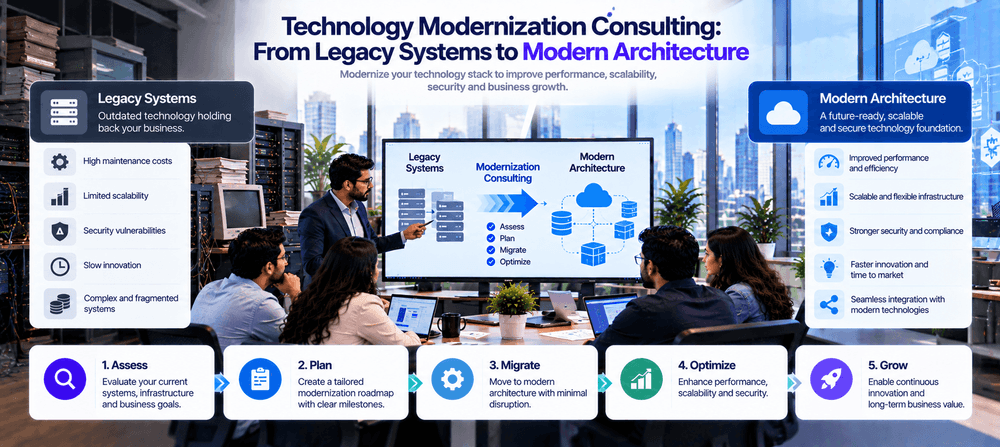
Legacy systems almost never break in one dramatic moment. They creep. A database gets chosen twelve years ago. An application is built around it. A second system is bolted on. A workaround patches a gap, then another workaround patches the workaround. Fast forward a decade and you have a technology environment that still runs, but is slow, expensive, and nerve-racking to change. Nobody decided to build a mess. It just accumulated.
That slow accumulation is exactly what technology modernization consulting exists to untangle. Done well, it does not just swap old tech for new tech. It figures out what to keep, what to fix, what to move, and what to quietly retire, so your systems support where the business is going instead of holding it back.
Quick answer: Technology modernization consulting helps you assess legacy systems, define a target architecture, prioritize what to modernize, cut technical debt, and build a realistic implementation roadmap. The goal is rarely to replace everything. Good modernization decides which systems to retain, restructure, migrate, replace, or retire, in that order of scrutiny.
What technology modernization actually means
Modernization means upgrading your systems so they can support current and future business needs, not just survive. In practice it spans application modernization, cloud migration, architecture modernization, database modernization, infrastructure modernization, API modernization, DevOps, and security modernization. That is a wide surface area, which is why a scattergun approach fails. Modernization is a sequence of deliberate decisions, not a single big-bang rebuild.
Why legacy systems get painful
Old systems quietly tax the whole business. They drive up maintenance costs, slow down releases, widen security risks, cap scalability, create integration headaches, and lean on skills that are getting harder to hire. The instinct is to rip it all out and start fresh. But a full replacement is one of the riskiest moves you can make, because those crusty old systems often run mission-critical work that nobody fully documented. The art is reducing the pain without blowing up what still works.
Modernization is not the same as rewriting
The single biggest myth is that modernization means rewriting everything. It does not. There are six honest options, and a rewrite is only one of them. You can retain a system as is when it still serves. Rehost it by moving it with minimal change. Replatform it onto a modern platform. Refactor its internal architecture while preserving what it does. Replace it with something better suited. Or retire it entirely when it is no longer needed. A good consultant runs every major system through those six choices rather than defaulting to "rebuild it all," which is where budgets and timelines usually go to die.
The modernization assessment
Everything starts with an honest assessment. Consultants should evaluate each system on business criticality, technical health, security posture, cost, dependencies, scalability, data, and integration. This is the step teams are tempted to rush, and rushing it is exactly how modernization programs derail. You cannot decide what to keep or kill until you actually understand what you have and what depends on it. The assessment is not overhead, it is the map.
Designing the target architecture
Once you know the current state, you define where you are going. A solid target architecture spells out applications, APIs, data, infrastructure, security, and observability. It is the reference point every later decision gets measured against, so it needs to be concrete rather than aspirational. Without a defined target, modernization becomes a series of disconnected upgrades that never add up to a coherent whole.
Cloud modernization, done right
Cloud is often part of the plan, but here is the trap: moving to the cloud does not automatically modernize anything. You can lift a legacy application onto a cloud server and end up with the exact same legacy application, now with a monthly cloud bill attached. Real modernization requires architectural thinking about how the application is structured, scaled, and operated, not just where it is hosted. "We moved to the cloud" and "we modernized" are not the same sentence.
Data and security: the parts people underestimate
Legacy systems usually sit on genuinely valuable data, so modernization has to handle data migration, data quality, governance, integration, and analytics with care. Lose or corrupt that data and the whole exercise backfires.
Modernization is also a rare chance to strengthen security while you are already in the code. Identity, access, encryption, monitoring, and vulnerability management are far easier to build in during modernization than to bolt on afterward. Treat the reboot as a security upgrade, not just an architecture one.
The engineering capability question
Modern architecture needs the right people to build and run it. That often means cloud engineers, platform engineers, DevOps, architects, data engineers, and security specialists, and that is precisely where modernization collides with workforce strategy. A brilliant roadmap is worthless if your current team cannot realistically execute it. So the talent question is not a side issue, it is part of the modernization plan itself, and skipping it is how good strategies stall.
Consulting sets the plan, someone has to execute it
A consultant can design a superb modernization roadmap. But a roadmap does not refactor itself. Execution needs hands, and you have options: internal teams, a dedicated team, staff augmentation, an implementation partner, or GCC engineering teams. When the gap is sustained capacity across cloud, application, data, and platform work, a dedicated team is usually the cleanest fit, and where you need one or two hard-to-find experts, specialist hiring covers it. SquadXP fields dedicated teams across engineering, AI and data, and cloud and DevOps, which makes the workforce a natural part of a modernization program rather than a scramble after the strategy lands. You can see how teams executed in our client case studies.
How to measure modernization
Do not measure success by the number of migrations you completed. Migrations are activity, not outcomes. Track what the business actually feels: deployment frequency, reliability, infrastructure cost, incident rate, development cycle time, security posture, and customer impact. If those numbers are not moving in the right direction, the modernization is not working, no matter how many systems you touch.
Conclusion
Technology modernization is not swapping old tech for new tech for its own sake. It is improving the whole environment so the business can move faster, scale more reliably, and manage risk better. The strategy that works follows a clear arc: assessment, then architecture, then prioritization, then execution, then measurement. Skip a stage and the program wobbles.
If you have a modernization plan but need the engineering muscle to run it, or you are not sure where to start, talk to our team and we will help you scope the work and the team it will take before you commit to anything.