
When a technology leader searches for "top GCC setup consulting services," they're rarely shopping for a brochure. They're carrying a decision that's already been half-made we're building a Global Capability Center in India and a nagging awareness that the setup is the part most likely to go wrong. Entity registration, compliance, the first ten hires, infrastructure, a leader who can hold it all together: get the sequence wrong and a promising India strategy turns into eighteen months of friction.
So the real question underneath that search is sharper than "who's on the list?" It's which kind of partner actually de-risks this, and how do I tell the serious ones from the firms that'll hand me a slide deck and disappear?
This guide answers that directly. It walks through what a GCC setup consulting service genuinely covers, the different types of providers you'll run into, the capabilities that separate the best from the rest, and a practical way to evaluate any partner before you sign. The goal isn't to hand you a ranking it's to help you choose well.
What GCC Setup Consulting Services Actually Cover
Here's where most buyers get surprised: "GCC setup" isn't one service. It's a stack of very different workstreams that have to be sequenced correctly, and a top consulting partner owns the whole chain rather than cherry-picking the easy parts.
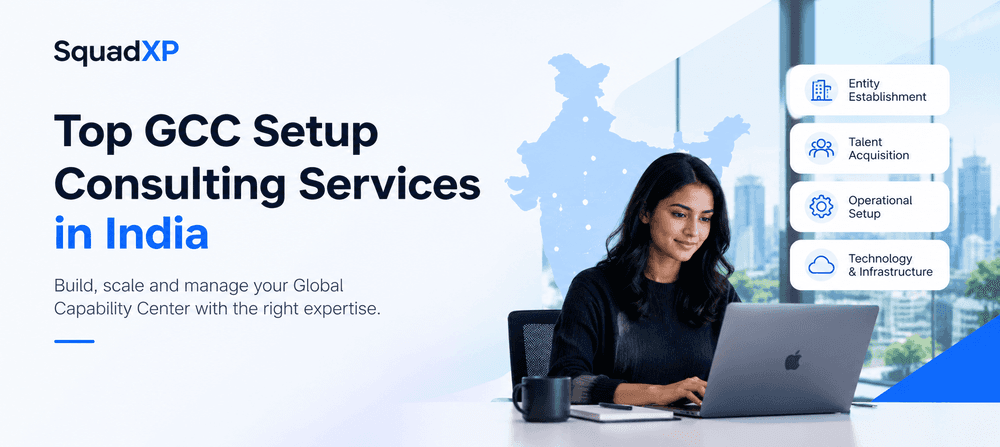
The lifecycle usually runs like this. First, strategy and feasibility deciding whether a captive center even makes sense for your scale, and what it should own. Then entity and compliance the legal structure, registrations, tax, payroll, and the question of who actually employs your people on day one. Alongside that sits location strategy, because the right city shapes your talent access and cost for years. Then comes the part that makes or breaks the whole thing: founding leadership and the first hires, in the right order. Finally, infrastructure and operational readiness office, IT environment, security, tooling and an ongoing governance and transfer plan so the center matures instead of stalling.
A weak provider sells you one slice and leaves the seams for you to stitch. A strong one treats these as a single continuous build. If you want the ground-level detail on any one layer, SquadXP's breakdowns of GCC setup cost in India and the 30 decisions to make before you hire anyone are a useful companion to this piece but the point of a consulting service is that you shouldn't have to assemble that knowledge yourself.
Why Use a Consulting Service Instead of Doing It Yourself
Plenty of companies assume they can run the setup internally. Some can. Most underestimate how much of it is local, tacit knowledge that doesn't travel well across borders.
Consider the entity decision alone. Should you register your own subsidiary, use an Employer of Record, or run a Build-Operate-Transfer arrangement where someone else holds the risk until you're ready to take over? Each choice has multi-year tax, compliance, and control implications, and the "obvious" answer for a US parent is frequently the wrong one for India. Working through the entity versus EOR versus BOT trade-offs is exactly the kind of judgment call where a good partner saves you from an expensive reversal later.
The same is true of hiring. The Indian talent market doesn't behave like the one your recruiters know. Notice periods stretch, counteroffers are aggressive, and the sequence in which you hire your first leaders changes everything about who you can attract next. A consulting service that actually understands the market gets your founding leadership and first ten hires right the first time which is worth far more than it sounds, because a bad early hire in a new center poisons recruiting for months.
The honest summary: a consulting service isn't buying you convenience. It's buying you fewer irreversible mistakes in a market where mistakes compound.
The Types of GCC Setup Providers You'll Encounter
Before any shortlist, it helps to know that "GCC setup consulting services" is a label worn by several quite different kinds of firm. Knowing the type tells you more than the logo.
The global management consultancies: The big-name advisory firms will produce an excellent strategy and a thorough operating-model design. What they often don't do is execute the talent build or hold the entity risk so you get a brilliant plan and still have to find someone to actually hire the engineers and run payroll. Expect high cost and a strategy-heavy engagement.
EOR and compliance-led providers: These firms lead with the legal and payroll layer they'll employ your people and keep you compliant. Strong on the mechanics, weaker on talent quality and engineering culture, because hiring isn't their core muscle. Good for the administrative spine, less so for building a team that ships.
Build-Operate-Transfer operators: BOT firms set up and run the center, then transfer it to you later. The appeal is that they absorb early risk; the catch is that most BOT conversations over-focus on the build and under-plan the transfer, which is where the model tends to fail. Worth understanding how the Build-Own-Transfer model really works before you commit to one.
Talent-led GCC-enablement partners: The newest category, built around the insight that a GCC lives or dies on the people. These firms combine market intelligence, leadership and specialist hiring, and operational setup into one engagement strategy connected directly to execution, rather than handed off between vendors. For most companies whose GCC exists to build product, this is the category that fits, because it treats the center as a team to be built well, not a cost line to be administered.
What Separates the Top GCC Setup Consulting Services
Once you know the categories, the question becomes: within them, what actually makes one partner better than another? A few capabilities consistently separate the top tier.
They own the whole chain: The best partners don't hand you off at the seams. Strategy flows into entity setup, which flows into leadership hiring, which flows into ramp one accountable party, not a relay race between three vendors who each blame the others when something slips.
They're backed by real workforce intelligence: Top providers advise from data current compensation benchmarks, talent availability by city and skill, attrition patterns not from opinion dressed up as experience. That intelligence is also what shapes your location strategy across India's tech hubs, and it's the difference between a plan that survives contact with the market and one that doesn't.
They hire for quality, not just speed: Anyone can forward resumes. A serious partner runs genuine technical vetting and cultural alignment, because in a brand-new center the first hires are the culture. One mediocre founding engineer sets a ceiling the whole center struggles to climb above.
They measure themselves by your outcomes: This is the quiet dividing line. Weaker firms count seats filled and milestones ticked. The strongest ones anchor to the velocity and capability your center actually delivers the principle of teams built for outcomes, not just headcount applied to an entire capability center.
They plan for maturity from day one: A GCC shouldn't stay a delivery annex forever. The best partners build in a path toward product ownership and self-sufficiency, so the center grows in strategic weight instead of plateauing as a cost arbitrage play.
Matching the Service to Your Situation
Not every company needs the same engagement, and the right partner will tell you so rather than selling you their heaviest package.
If you're still validating the idea - you need feasibility and honest counsel more than execution muscle. A smaller first step and a candid answer to whether a captive center even beats outsourcing or a dedicated team at your scale matters more than a grand setup plan. A partner willing to talk you out of a premature GCC is usually the one worth keeping.
If the decision is made and the clock is running - you want a partner who can compress the timeline without cutting corners founding leadership and an initial pod standing up in weeks, with entity and compliance handled in parallel rather than in sequence. Here, execution capability outranks advisory polish.
If you're scaling an existing center - the need shifts to specialist and leadership hiring, retention, and the governance that moves a center up the maturity curve. The setup is behind you; the challenge now is depth and durability.
A Practical Checklist for Choosing a Partner
Before you sign with any GCC setup consulting service, run it through these questions. They separate the genuine operators from the firms that are strong on promises and thin on delivery.
- Do they own the full lifecycle, or just a slice?
Clarify exactly where their responsibility ends. Every handoff you're left to manage is a risk they've quietly transferred to you. - Is their advice backed by data?
Ask for specifics on compensation benchmarks, talent availability, and attrition in your target city and skills. Vague reassurance is a red flag. - How do they actually vet talent?
For founding hires especially, "we have a large network" is not a vetting process. Look for real technical assessment and cultural-fit evaluation. - What's the entity and employment model?
Make sure they can walk you through the options and recommend one tied to your tax position and risk appetite not just the model that's easiest for them to deliver. - Who owns the IP and the center at the end?
This should be unambiguous in writing: your company owns the IP, the code, and ultimately the center itself, with a clean transfer path if the engagement starts as BOT. - Do they measure outcomes or activity?
Ask how they'll define success six months in. If the answer is "seats filled," keep looking. If it's velocity, retention, and capability, you've found a partner thinking about your long game.
Where SquadXP Fits
We'll be plain about our category. SquadXP sits in the talent-led GCC-enablement camp not a strategy-only advisory, and not a payroll-first EOR. The reason is a conviction that a capability center succeeds or fails on its people, so we connect strategy, leadership and specialist hiring, compliance, and operational setup into a single accountable engagement rather than a chain of handoffs.
In practice that means the work starts before anyone is placed: market mapping, compensation benchmarking, and genuine vetting, so your founding team contributes from the first sprint instead of the first year. It's the same philosophy behind everything from our complete India GCC guide to the centers we've stood up with founding leadership and an engineering pod live in weeks, not quarters. For companies that want their GCC to build product not just occupy a cost line that's the lane we're built for.
Build Your Capability Center With Confidence
The honest takeaway is that there's no single "best" GCC setup consulting service, because the right partner depends on where you are and what your center is meant to become. The global consultancies excel at strategy. The EOR-led firms handle the administrative spine. The BOT operators absorb early risk. And the talent-led enablement partners build the thing that actually determines whether your GCC works the team.
What matters, across all of them, is choosing a partner who owns the full chain, advises from real market intelligence, hires for quality, and measures success by the capability your center delivers rather than the seats it fills. If that's the kind of partner you're looking for, SquadXP would be glad to help you scope the setup and build the team to match. Talk to us about standing up your Global Capability Center in India.