
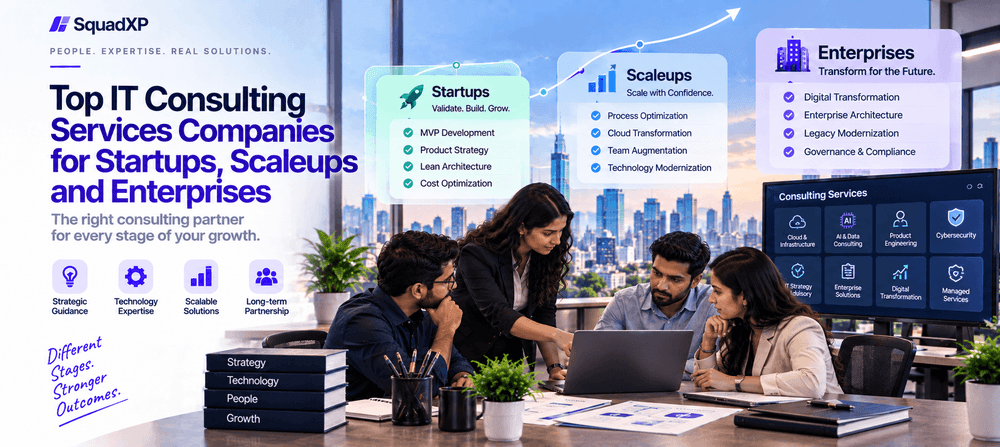
A seed-stage founder, a Series C SaaS team, and a multinational CIO can all type "IT consulting services companies" into the same search bar and mean completely different things. The founder wants help choosing an architecture. The scaleup needs to move a fast-growing platform onto infrastructure that will not buckle. The enterprise is untangling a decade of legacy systems across several countries. Same search, three very different problems.
That is the part most "top 10" lists miss. The best IT consulting company is not the one with the longest service menu. It is the one that understands the problem you are facing at your stage. So instead of asking who does the most, ask a sharper question: which provider really gets what we need right now.
Quick answer: Startups, scaleups, and enterprises need different IT consulting services. Startups need architecture, product, and technology strategy. Scaleups need modernization, engineering scale, and specialist expertise. Enterprises need transformation, cloud, security, AI, and complex integration. The right partner matches its expertise and delivery model to your stage, not the other way around.
What IT consulting services cover
At a high level, IT consulting services help you make technology decisions, solve hard technical problems, and run transformation programs. In practice that spans IT strategy, technology architecture, cloud, digital transformation, software modernization, cybersecurity, data engineering, AI, DevOps, and engineering organization design. No business needs all of it at once. The right mix depends on where you are in your journey, which is where most of this decision really lives.
Why your stage changes the answer
Technology consulting is not one-size-fits-all. A control that keeps an enterprise safe can slow a startup to a crawl. An architecture that is perfect for a scaleup can be wild overkill for a ten-person team chasing product-market fit. Get the stage right and the shortlist of "top" providers shrinks fast. Get it wrong and you will pay for capability you do not need or, worse, miss the capability you do.
IT consulting for startups: cut avoidable risk
Startups run on tight budgets, small teams, shifting requirements, and pressure to hit product-market fit, often without a senior technical leader in the room. So good startup consulting is less about ambition and more about removing risk you can see coming.
The classic early mistake is picking an architecture because it is fashionable. A young product rarely needs a sprawling microservices setup. A clean, well-structured monolith that can evolve is often the smarter and cheaper choice, and a good consultant will say so instead of selling complexity. The same clear thinking applies to the stack: languages, databases, cloud provider, authentication, monitoring, and security basics.
There is one more moment where consulting pays for itself fast. If you are raising a round or heading into an acquisition, technical due diligence surfaces the technical debt, security gaps, and scalability risks that can quietly lower your valuation before anyone catches them.
IT consulting for scaleups: grow without breaking
Scaleups have the opposite problem. The technology worked. Now it has to handle ten times the traffic, a much bigger team, and far more operational complexity. This is where platforms crack under their own success.
Typical work here includes platform modernization, cloud optimization, architecture redesign, stronger DevOps, engineering management, security, and data infrastructure, plus early AI where it earns its keep. The important part: at this stage, consulting cannot happen in a vacuum. A brilliant architecture is useless if your current team cannot realistically build and run it. That is why scaleups often pair advice with real capacity, whether through specialist hiring or a dedicated team that can execute the plan without a long ramp-up.
IT consulting for enterprises: govern the complexity
Enterprise environments are their own beast: legacy systems, multiple business units, heavy integrations, regulatory requirements, large technology teams, several clouds, and serious security demands. Here, consulting lives or dies on governance.
Programs tend to cover cloud transformation, ERP modernization, data transformation, AI adoption, cybersecurity, legacy modernization, and application rationalization. The scale is bigger, the stakes are higher, and the coordination is the hard part. For global players, this is also where owning long-term engineering capability in India, often as a Global Capability Center, becomes part of the conversation rather than an afterthought.
What separates a strong consulting company from a slide deck
Across every stage, a few traits tell you whether a firm is worth the fee.
Real technical expertise, shown through trade-offs rather than a wall of logos. Business understanding, so recommendations connect to outcomes and not just architecture diagrams. Clear communication that both engineers and executives can follow. Delivery discipline, meaning the engagement ends in decisions you can act on, not another deck. And scalability, so the partner knows what happens after the strategy is delivered. If a firm cannot tell you what comes after the PDF, that is your answer.
Consulting or implementation: settle it early
Draw this line before you sign. A consulting firm assesses, recommends, designs, and plans. An implementation partner builds, deploys, integrates, and operates. Some firms do both, which can remove painful handoffs, but you still need to know who owns each responsibility. Blurred ownership is where budgets and timelines quietly go to die.
Where dedicated teams and GCCs fit
Consulting answers "what should we do." It does not, by itself, answer "who will do it." That is where the engagement model matters, and there are several to choose from: consulting, staff augmentation, dedicated teams, outsourcing, build-operate-transfer, and a GCC.
They are not interchangeable. Staff augmentation adds temporary hands. A dedicated team gives you longer-term engineering capacity that works as an extension of your business, across engineering, product, AI and data, cloud and DevOps, and shared services. A GCC is a different decision entirely, because you are choosing to build and own the capability for the long haul. The right pick is driven by ownership and how long you will need the capability, not by the lowest hourly rate. SquadXP frames these choices around exactly that: ownership and operating needs first, rate second.
How to pick the right provider
Start with the problem, then work outward. Before you compare a single vendor, get clear on your desired outcome, technical scope, the expertise you need, timeline, budget, internal resources, security requirements, governance model, and what happens after the engagement ends. Only then does a shortlist make sense. Choosing a provider before you have defined the problem is how companies end up with an impressive partner solving the wrong thing. If you want to see how this plays out in practice, our client case studies show how the right model changed the outcome for teams at different stages.
Conclusion
There is no universal "top IT consulting services company," and any ranking that pretends otherwise is selling placement. Startups need speed and technical clarity. Scaleups need architecture, scalability, and specialist depth. Enterprises need transformation, governance, and complex execution done safely. Judge providers on expertise, business understanding, delivery, security, scalability, and fit with your stage.
And remember the part that trips teams up most: for anything beyond advice, your strategy is only as good as the people who execute it. If you want help matching the right model to your stage, talk to our team. We will help you work out whether you need specialist hires, a dedicated team, or a capability center you own, before you commit to anything.