
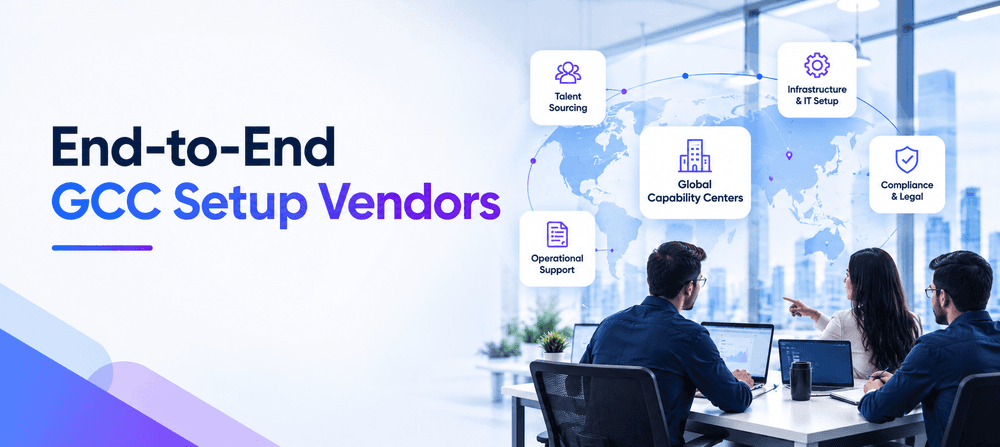
The phrase "end-to-end GCC setup vendors" usually gets typed by someone who has just realised how many moving parts a Global Capability Center actually has. They started with "how do I set up a GCC in India," discovered it involves strategy, a legal entity, compliance, a location decision, founding leadership, infrastructure, and a hiring engine and now they're quietly dreading the prospect of managing five different vendors who each own one slice and point fingers at each other when something slips.
That dread is well founded. The single biggest reason GCC setups run late isn't the market or the talent. It's the seams the handoffs between vendors where accountability quietly evaporates. Which is exactly why the search for an end-to-end vendor matters: the real question isn't "who can do GCC setup," it's "who can own the whole thing so I'm not left stitching it together myself."
This guide answers that directly. We'll cover what "end-to-end" genuinely has to include, the hidden cost of a fragmented multi-vendor setup, the case for a single accountable partner and, crucially, how to tell a vendor who truly delivers end-to-end from one who just says it on a slide.
What "End-to-End" Actually Has to Cover
Before you can judge whether a vendor is genuinely end-to-end, you need to know the full chain they're claiming to own. GCC setup isn't one task; it's a sequence of very different workstreams, and "end-to-end" means a single partner carries you through all of them without a gap.
The chain runs roughly like this. Strategy and feasibility deciding whether a captive center makes sense at your scale and what it should own. Entity and compliance the legal structure, registrations, tax, and payroll, including the question of who actually employs your people. Location strategy which city gives you the right talent access and cost. Founding leadership and hiring the right people in the right order. Infrastructure and IT office, environment, security, and tooling. And finally ramp and governance scaling the team and a plan for how the center matures or transfers to you.
A genuinely end-to-end vendor owns every link in that chain. If any one of them is missing, you're back to managing a handoff and handoffs are where setups go to die. Each of these deserves its own depth, which is why it helps to understand the full set of decisions a GCC setup involves before you judge whether a vendor can carry all of them.
The Hidden Cost of a Fragmented, Multi-Vendor Setup
On paper, assembling best-of-breed point vendors sounds smart a top advisory firm for strategy, an EOR for compliance, a recruiter for hiring, a facilities partner for the office. In practice, it's where most of the pain lives.
Accountability disappears at the seams: When the strategy vendor's plan assumes a hiring timeline the recruiter can't meet, and the recruiter's candidates need an entity the compliance vendor hasn't finished registering, whose problem is it? Nobody's which means it becomes yours. You end up as the unpaid integration manager, chasing four vendors to do the coordination you thought you were paying for.
Timelines stretch: Each vendor optimises its own piece, not the whole. The result is a setup that moves at the speed of its slowest handoff, and a launch that drifts from weeks into quarters. Understanding the real cost of a GCC setup makes it clear how quickly delay compounds into money.
Knowledge leaks: The context the strategy team built doesn't fully reach the hiring team. The compliance team's entity choice shapes the hiring model in ways the recruiter never hears about. Decisions made in one silo quietly undermine another, and nobody has the full picture least of all you.
The weak link sets the ceiling: A patchwork is only as strong as its flimsiest vendor. A brilliant strategy delivered to a mediocre hiring partner still produces a mediocre center, because the team is what a GCC actually runs on.
The Case for a Single End-to-End Vendor
Put the fragmentation problems in reverse and you have the argument for one accountable partner.
One throat to choke: When a single vendor owns strategy through ramp, there's no seam to fall through and no finger to point. If something slips, you know exactly who's responsible, and so do they. That accountability alone changes how an engagement behaves.
Coherence across the chain: The entity decision is made with the hiring model in mind. The location choice is made with the talent map in hand. The founding leadership is hired knowing the governance plan. Decisions reinforce each other instead of colliding, because one party holds the whole picture.
Speed, because work runs in parallel: An end-to-end vendor can register the entity while mapping talent while planning infrastructure, rather than waiting for one vendor to finish before the next begins. That's how founding leadership and an initial pod stand up in weeks instead of quarters.
Momentum that survives the ramp: The best end-to-end partners don't vanish at launch. They carry you into the scale phase and plan for the center's maturity from the start including how it moves toward self-sufficiency or a clean handover, which is where models like Build-Operate-Transfer come in.
"End-to-End" Is a Claim Here's How to Verify It
This is the part that matters most, because "end-to-end" is one of the most over-claimed phrases in the GCC market. Plenty of vendors say it; far fewer deliver it. A strategy firm will call itself end-to-end while quietly subcontracting the hiring. An EOR will claim full setup while having no real talent capability. Your job is to find the weak link before you sign, not after.
Pressure-test each link in the chain: Don't accept "we handle everything" ask them to walk you through exactly how they deliver each stage: strategy, entity, location, hiring, infrastructure, governance. Where the answer gets vague or suddenly mentions a "partner," you've found a seam.
Find the weak link, because there usually is one: Most vendors are strong in one or two areas and thin in the rest. The common weak spots are talent (advisory and compliance firms rarely hire well) and transfer (many BOT vendors over-plan the build and under-plan the handover). Ask pointed questions about their weakest-looking link.
Probe the entity and employment model: This is where "end-to-end" often springs a leak. A genuine partner can walk you through the entity, EOR, and BOT trade-offs and recommend one tied to your situation not just default to whatever they happen to offer.
Check the hiring depth specifically: Since the team is what a GCC lives on, scrutinise this link hardest. Do they genuinely vet talent, or forward resumes? Can they get your founding hires in the right order? A vendor strong on paperwork but weak on hiring is not end-to-end in any way that matters.
Confirm they own the infrastructure link too: Office, IT environment, and security are easy to hand-wave. Make sure the infrastructure and IT setup is genuinely theirs to deliver, not a vague promise to "coordinate."
If you want the broader evaluation framework behind all of this, our guide to what the best GCC setup consulting services deliver goes deeper, and the named comparison of GCC setup companies shows which types tend to own which links.
When End-to-End Is Right and When It Isn't
A single end-to-end vendor isn't automatically the answer for everyone, and an honest partner will tell you so.
End-to-end fits best when you're building a substantial, long-term center and you don't have the internal bandwidth to project-manage a web of vendors. The more complex the setup and the tighter the timeline, the more a single accountable partner is worth.
A lead vendor plus specialists can work when you already have strong internal capability in one area say, your own legal team handles the entity and you only need a partner for the rest. In that case, "end-to-end" for your scope might mean a vendor who owns everything except the piece you're keeping in-house.
Pure point vendors make sense only when your need is genuinely narrow a single specialist hire, say and there's no chain to integrate in the first place. The moment the work spans multiple linked workstreams, the integration risk tilts the decision back toward one accountable partner.
The deciding question is simple: how many seams are you willing to manage yourself?
A Practical Checklist for Choosing an End-to-End Vendor
Before you commit to any vendor claiming full-lifecycle delivery, run them through these.
- Walk me through every stage.
Make them detail strategy, entity, location, hiring, infrastructure, and governance. Vagueness or a sudden "partner" reveals a seam. - Where are you weakest?
A confident, honest answer is a good sign. A claim that they're equally excellent at everything usually isn't. - Who actually employs my people, and why that model?
The entity and employment answer should be tailored to your tax position and risk appetite, not their convenience. - How do you vet talent?
Scrutinise the hiring link hardest, since it's what the center runs on. "Large network" is not a process. - Who owns the IP and the center at the end?
This belongs in writing your IP, your code, your center, with a clean transfer path if it starts as BOT. - Do you measure outcomes or activity?
A partner who defines success as capability delivered rather than seats filled is thinking about your long game the spirit of teams built for outcomes, not just headcount.
Where SquadXP Fits
We'll be straight about why end-to-end is central to how we work. SquadXP's conviction is that a GCC lives or dies on its people, so we don't hand off the link that matters most. We connect strategy, entity and compliance guidance, location and market intelligence, founding leadership and specialist hiring, and operational setup into a single accountable engagement one partner across the chain, not a relay between vendors.
In practice, that means the hiring link the one most "end-to-end" vendors are weakest on is our strength, not an afterthought subcontracted away. The work starts before anyone is placed: compensation benchmarking, talent mapping, and real vetting, so your founding team contributes from the first sprint. For companies that want one partner to own the setup and the team rather than stitching a patchwork together, that's exactly the gap we're built to close.
Build Your Capability Center With Confidence
The honest takeaway is that "end-to-end" is worth insisting on, but only if you verify it. A genuine end-to-end GCC setup vendor removes the seams where accountability disappears, keeps the chain coherent, and moves faster because the work runs in parallel under one owner. A vendor who merely claims it hands you back the integration problem you were trying to escape.
So pressure-test the chain, find the weak link, and choose the partner who owns the full lifecycle especially the hiring link your center actually runs on. If that's the kind of partner you're after, SquadXP would be glad to help you scope the setup and build the team to match. Talk to us about standing up your Global Capability Center in India, end to end.