A new India GCC can have the right leader, the right engineers, and the right office, and still stall because the technology environment isn't ready.
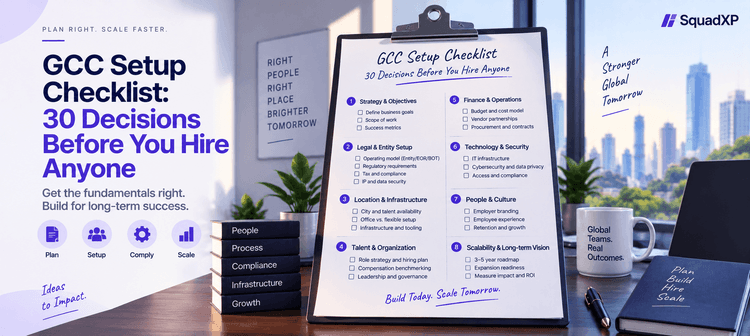
Employees arrive. Laptops aren't configured. Identity accounts aren't provisioned. VPN access is delayed. Repositories are inaccessible. Cloud permissions are unclear. Security reviews are incomplete. The engineering team spends its first month waiting on infrastructure instead of building products. That's why IT should be treated as part of GCC launch architecture, not an admin task that happens after hiring. SquadXP's GCC material is clear that building a center is more than recruitment, it needs a complete operating foundation across talent, leadership, technology, and scaling, which the GCC setup checklist captures at the decision level.
What GCC IT infrastructure includes, in five layers
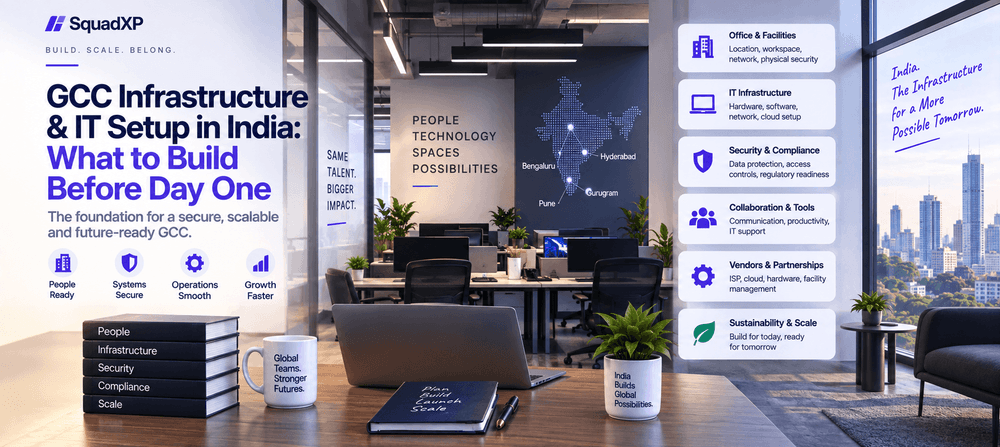
A modern GCC foundation spans network, internet, identity, devices, endpoint management, collaboration, cloud, development environments, security, monitoring, backup, disaster recovery, physical access, and IT support. The exact architecture depends on your security needs and industry, a fintech GCC and a software startup shouldn't run identical environments. It helps to picture it as five layers: physical (office, access control, power, connectivity), network (internet, LAN, Wi-Fi, VPN, segmentation), identity (SSO, MFA, identity provider, privileged access), devices (laptops, endpoint management, encryption, patching), and applications and cloud (repositories, collaboration, cloud environments, CI/CD, business systems). Security spans all five.
Get the foundations right before anyone joins
On office and connectivity, decide your workforce model, fully onsite, hybrid, mostly remote, or distributed, before signing a lease, then design for secure meeting rooms, network capacity, power redundancy, video conferencing, and access control, sized for your growth curve, not today's headcount. Engineering teams live on connectivity, so plan a primary and secondary ISP, failover, business-grade bandwidth, and monitoring. Define the network up front with VLANs, segmentation, and separate guest, corporate, development, and administrative paths, because a guest device shouldn't share an access path with a production administrator.
Identity and access management is one of the most important pieces: SSO, MFA, role-based access, joiner/mover/leaver processes, privileged access management, and access reviews. The principle is that nobody gets access just for working in the GCC, they get it because their role requires it. Device management should cover MDM, endpoint detection, encryption, patching, remote wipe, and application control, with standardised hardware to simplify procurement, support, and onboarding.
Build the engineering and cloud environment deliberately
Plan the engineering environment, source-code repositories, cloud accounts, development environments, CI/CD, package repositories, secrets management, monitoring, and production access, with development, staging, and production properly separated. Decide the cloud architecture, whether India engineers use existing global accounts, dedicated accounts, regional accounts, or separate environments, based on security, compliance, data residency, and operating model, and avoid duplicating cloud infrastructure just because the team sits in India. These access decisions carry real IP and data-protection weight, which is exactly where the data security and IP checklist comes in.
Standardise access provisioning with a workflow that has accounts created a week before joining, laptops configured three days out, security checks done the day before, core SSO tools live on day one, and role-specific access by the end of the first week, far better than reacting to requests after someone starts. Decide who runs the IT service desk (internal IT, global IT, a managed service provider, or a hybrid), set a cybersecurity baseline (MFA, endpoint security, encryption, vulnerability and patch management, logging, access controls, incident response, awareness), and plan backup, disaster recovery, and business continuity with defined RPO and RTO, rather than assuming global backups cover India.
Design security and integration in from the start
Layer in physical security (badge access, visitor management, CCTV where appropriate, secure network areas, asset tracking), data classification tied to access rules, vendor management as part of procurement, and a clean asset lifecycle for joiners, movers, and leavers. Standardise collaboration tools for messaging, video, docs, and project management to avoid fragmentation, and integrate with global HQ across identity, security, collaboration, monitoring, and cloud so the GCC feels like one organisation, not two disconnected companies. If people can work remotely, design for it from day one with secure remote access, MFA, encryption, and zero-trust principles, and remember governance and time zones matter too, as the India-to-HQ governance model lays out. Finally, build to a roadmap: essential controls at launch, automation and stronger processes at scale, advanced observability and productivity tooling later.
What to build internally, and the golden rule
Not every IT function needs an India employee. You can lean on global IT, managed services, local vendors, internal security, and cloud providers, and the split should follow scale and criticality. A 25-person GCC doesn't need a 10-person local IT department; a 500-person regulated GCC might. Above all, design architecture, security, and compliance together rather than building IT first and asking security to review it later, which matters most when the GCC will touch customer data, source code, production systems, financial information, healthcare data, or proprietary AI models.
Conclusion
GCC infrastructure isn't just an office and a stack of laptops, it's the foundation that decides whether people can work securely and productively from day one. The right approach is plan, secure, provision, test, onboard, monitor, then scale. Build only what you need initially, but design the architecture so it still holds up three years out. The aim isn't the most complicated environment, it's one where the right people can access the right systems securely and do meaningful work without friction.