Setting up a Global Capability Center in India can look deceptively simple. Find a city, set up an entity, hire a leader, recruit engineers, open an office.
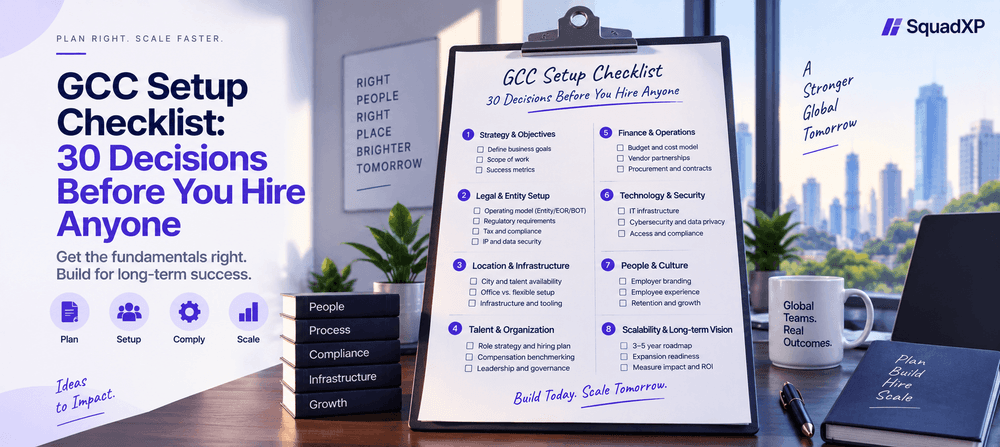
In practice, every one of those steps hides decisions that quietly shape the cost, speed, and long-term success of the GCC. The single biggest mistake is starting recruitment before you've decided what you're actually building. SquadXP's GCC guidance stresses strategy, location, workforce planning, founding leadership, and capability design before scaling, and its work on the first ten sGCC hires makes the point that hiring should follow dependencies, not run as a simple queue. This checklist sits one step earlier again: the 30 decisions to make before the first meaningful hiring wave. The goal isn't to slow hiring down. It's to stop expensive rework before it starts.
Start with why, not headcount
Before you open a single role, be clear on why the GCC exists. Possible objectives include access to engineering talent, product development, cost efficiency, AI capability, R&D, cybersecurity, data engineering, business operations, or product ownership. If the honest answer is "India is cheaper," the strategy is too shallow. A stronger version, "India will become our global product-engineering center for platform, AI, and cloud," instantly reshapes the hiring plan.
From there, settle the two hardest ownership questions.
What will India own? This is arguably the most important decision on the list, and it can be a product, a platform, a technical domain, a global engineering function, an AI capability, a data platform, or a business process, the same execution-versus-ownership line drawn in what a GCC actually owns under GCC 4.0.
What will India not own? Boundaries matter just as much; if India owns platform engineering while HQ owns global product strategy, you avoid overlapping authority later.
Plan for the organisation you'll have, not the one you're starting
Don't design around today's requirement. Build a three-year headcount plan, say 30 in year one, 75 in year two, 150 in year three, because that shapes office, leadership, recruitment, HR, IT, security, and budget. A company expecting a permanent 30 needs a very different setup from one heading to 300. Then push further to your five-year ambition: could India become a 500-person engineering center, a global product hub, an AI center, a business operations center, or a regional headquarters? That ambition should influence today's org design.
Next, pick the operating model, direct GCC, EOR, dedicated team, BOT, or outsourcing, based on ownership, speed, scale, and control, a choice explained in GCC vs captive vs outsourcing. Settle the legal structure with Indian legal and tax advisors, covering entity requirements, foreign investment, employment, tax, payroll, contracting, compliance, and banking. And don't ask "which city is best for a GCC?" Ask "which city has the talent our GCC needs?", comparing talent availability, compensation, senior leadership, competitor hiring, attrition, infrastructure, and scalability, exactly as the best-city-for-GCC analysis argues. Then decide whether you'll run a single city, a primary-plus-secondary model, or a fully distributed India footprint.
Get the capability and leadership decisions right
Sort capabilities into must-have (needed for launch), near-term (six to twelve months), and future (once at scale), which stops you hiring every function on day one. Then decide who will lead the GCC, whether that's a GCC head, country leader, site leader, or engineering leader; the title matters less than the mandate, and SquadXP's case for hiring a site leader before ten engineers applies directly here. Crucially, define the leader's authority: can they approve hiring, compensation, vendors, budgets, org design, promotions, and office decisions? Authority has to match accountability.
Sketch the initial organisation structure before recruiting, a GCC head over engineering, product, security, HR/talent, and finance/operations, shaped to your mandate. Then classify roles as critical (launch can't happen without them), important (needed for scale), and later (useful once the core is operational).
Nail compensation, budget, and the hiring engine
Choose a compensation philosophy, market median, upper quartile, premium, or role-specific premium, and don't assume one band fits every role; AI, cloud, cybersecurity, and senior leadership need different benchmarks, which is why you benchmark salaries by role, level, and city rather than guessing. Build a full hiring budget covering base, variable pay, benefits, employer contributions, recruitment, joining bonuses, equity where applicable, and leadership compensation, because salary budget is not total employment cost.
Set the hiring sequence by dependency and lead time, leadership, then architecture, then specialist capability, then core engineering, then scale, never a hundred generic vacancies with leadership left to emerge later. Define your employer value proposition (product ownership, global exposure, technical leadership, AI work, career progression, equity, flexibility, research), since salary alone rarely lands senior talent. Pick your recruitment channels (direct sourcing, referrals, specialist recruiters, communities, universities, executive search), and design the onboarding model covering pre-joining communication, equipment, access, security training, product training, engineering onboarding, manager onboarding, and first-30-day goals.
Lock down technology, security, IP, and data early
Before anyone joins, decide the IT infrastructure, laptops, identity management, SSO, VPN, endpoint management, collaboration tools, development environments, cloud access, network architecture, and backup, all covered in the GCC IT setup guide. Set a mandatory security baseline (MFA, least privilege, endpoint security, device management, encryption, logging, access reviews, incident response, vulnerability management), designed in rather than retrofitted. Clarify IP protection, ownership, employment and contractor agreements, confidentiality, invention assignment, source-code access, and repository permissions, with counsel reviewing the real documents, as the data security and IP checklist sets out. And classify data access across public, internal, confidential, restricted, and highly sensitive, then decide who can reach what.
Define governance, decisions, KPIs, risk, and success
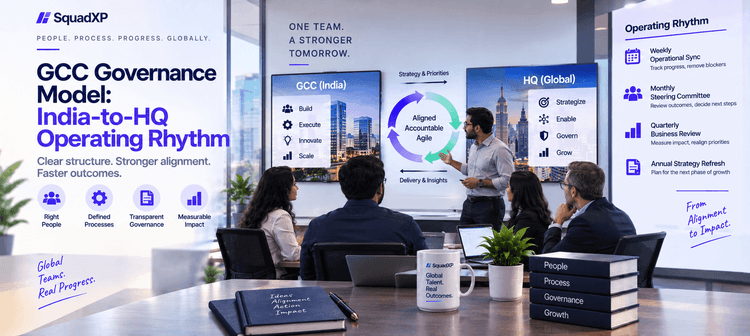
Set the governance model connecting India and HQ, daily team coordination, weekly delivery review, monthly operating review, quarterly strategy review, biannual workforce planning, detailed in the India-to-HQ governance model. Document which decisions stay at HQ (corporate strategy, global brand, certain financials, global portfolio) and which move to India (local hiring, engineering execution, technical architecture, local vendors, team organisation), moving more decision rights toward the capability as it matures.
Choose KPIs beyond headcount, hiring, and cost, adding time to productivity, attrition, product delivery, reliability, innovation, IP, business outcomes, and leadership depth. Build a risk register covering leadership hiring, talent availability, compensation, entity setup, security, compliance, infrastructure, attrition, HQ alignment, and vendor dependencies, with an owner for each. And define success upfront: operational at 12 months, owning meaningful capabilities at 36, a strategic global organisation at 60. Without those targets, "GCC success" stays subjective.
The pre-hiring test
Before your first job description goes live, you should be able to tick off the business case, mandate, ownership, location, entity model, headcount plan, leadership mandate, org design, compensation, recruitment, IT, security, IP, data, governance, KPIs, and risk register. If half are still open, the answer isn't necessarily "wait", it may mean you need a structured GCC planning phase before entering the hiring market.
Conclusion
The best GCCs aren't created by starting recruitment early. They're created by making the right decisions early. Before the first job description goes live, leadership should know what India will own, where it will operate, how it's governed, what talent it needs, how people will work, what data they can access, and how success is measured. Get those clear and hiring becomes an execution problem. Skip them and hiring becomes a strategy problem wearing a recruitment disguise.