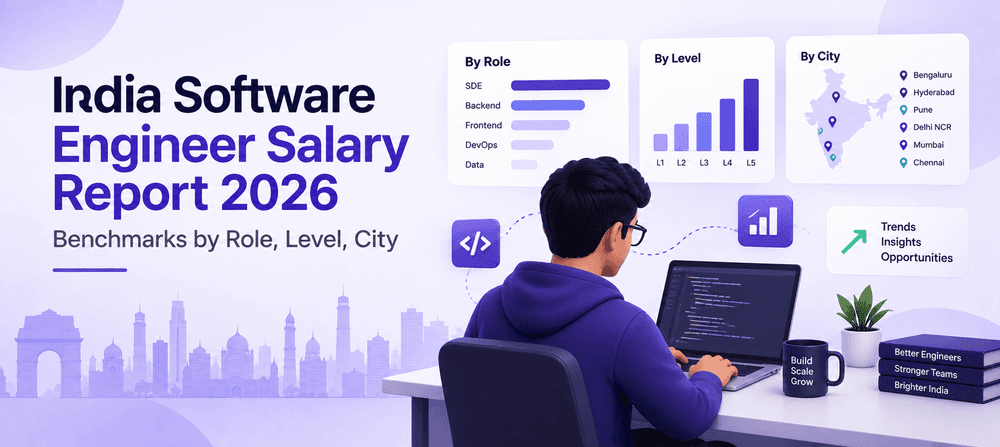
If you're budgeting an engineering team in India in 2026, the single biggest mistake you can make is anchoring your hiring plan to one national "average software engineer salary."
India's tech market is far too varied for one number to mean anything useful. A software engineer with three years of experience in Bengaluru at a global product company can sit in a completely different pay band from an equally experienced engineer at an IT services firm in Jaipur. And it isn't just about location. Company type, technical specialisation, product complexity, hiring urgency, leadership expectations, and plain talent scarcity all push the final package around.
So for any company building an India engineering team or a Global Capability Center (GCC), salary benchmarking really needs to answer a sharper question: what should we budget for the specific capability we need, at the specific level, in the specific Indian talent market? That's exactly the lens this 2026 benchmark is built around.
Quick benchmark: For planning, mainstream software engineering roles in India roughly span ₹4–10 LPA for entry-level talent, ₹12–22 LPA for mid-level engineers, and ₹25–40 LPA for experienced senior engineers, with much higher packages possible for specialised product, AI, architecture, and leadership roles. Datasets disagree partly because some report base salary while others report total CTC.
India software engineer salary in 2026: the short answer
There isn't a single "correct" software engineer salary in India, and pretending otherwise is where most budgets go wrong. A more useful way to plan is to think in bands tied to experience.
An entry or junior engineer with 0–2 years of experience usually sits around ₹4–10 LPA. A software engineer with 2–4 years lands roughly at ₹8–16 LPA, and a mid-level engineer with 4–6 years at about ₹12–22 LPA. A senior engineer with 6–10 years typically runs ₹20–35+ LPA, while a staff or principal engineer with 8–15+ years can reach ₹30–60+ LPA. On the management track, an engineering manager with 7–12+ years sits around ₹25–50+ LPA, and an engineering director or head with 12–18+ years can stretch anywhere from ₹45 LPA into ₹1 crore and beyond.
Treat these as planning bands, not guaranteed market rates. Product companies, high-growth startups, multinationals, and AI-heavy businesses can sit well above these ranges once you add equity or scarce skills into the mix.
Published 2026 datasets already show this spread clearly. One current benchmark puts the broader Indian software-engineering market around ₹6 lakh median base salary, while other datasets that focus on total CTC and stronger product-company populations land considerably higher. That gap is the whole reason hiring teams should benchmark roles, not just job titles, and it's a big part of the real cost difference between US and India engineering.
Software engineer salary by experience level
1. Entry-level software engineers: ₹4–10 LPA
Entry-level usually means graduates and people with up to two years of experience, and the market is heavily segmented here. Large IT services employers often sit at the lower end, while product companies, venture-backed startups, and anyone hiring from the most competitive engineering pools can pay noticeably more.
Technical readiness moves the needle too. A candidate who can show production-quality code, solid data structures and algorithms, cloud familiarity, modern dev practices, and real project experience will command a premium over someone whose experience is mostly academic. And a word to GCC planners: "junior" shouldn't automatically read as "cheap." If your India team is going to work on a globally important product, even junior engineers need senior technical leadership, proper onboarding, and mentoring around them.
2. Mid-level engineers: ₹12–22 LPA
The three-to-six-year band is where benchmarking really earns its keep. These engineers are expected to work independently, own services or features, join architecture discussions, and mentor juniors.
A 2026 benchmark from PeoplePilot places Tier-1 product-company engineers with 0–3 years of experience well above traditional services pay, while Tier-2 product and service environments run lower. That underlines a fundamental truth: the market doesn't price "years of experience," it prices the capability attached to those years. Four years spent maintaining a stable internal app is not the same as four years building distributed systems for a global SaaS product, and you shouldn't pay for them as if they were.
3. Senior software engineers: ₹25–40+ LPA
Senior engineers today are capability owners, not just people who write more code. At this level companies typically expect system design, technical decision-making, mentoring, production ownership, cross-functional collaboration, cloud architecture, reliability engineering, security awareness, and real input into the technical roadmap.
Senior pay gets especially sensitive to specialisation. Distributed systems, cloud infrastructure, cybersecurity, AI/ML, platform engineering, and deep backend expertise all carry premiums. Several 2026 reports place senior product-company engineers well above the ₹25–40 LPA band, particularly at the most selective employers.
Salary by software engineering role
A sensible GCC budget should never apply one "software engineer" number to every technical seat, because roles vary too much. As a rough 2026 planning guide, a frontend engineer runs about ₹6–22 LPA, a backend engineer ₹7–25 LPA, a full-stack engineer ₹7–24 LPA, and a mobile engineer ₹7–25 LPA. On the infrastructure side, a DevOps engineer sits around ₹8–28 LPA, a cloud engineer ₹9–30 LPA, a data engineer ₹8–28 LPA, and an SRE ₹10–30 LPA. A QA automation engineer comes in near ₹6–20 LPA, and a cybersecurity engineer around ₹9–30 LPA. The scarcest skills sit highest: an ML engineer at roughly ₹10–35+ LPA, an AI engineer at ₹12–40+ LPA, and a staff or principal engineer at ₹30–60+ LPA.
Again, these are market-planning ranges, not guarantees. The premium climbs when a role pairs technical depth with scarce domain expertise. A generic Python developer and an engineer who can design distributed Python services, build event-driven architecture, run Kubernetes, and make production reliability calls simply do not belong in the same compensation bucket. If AI and ML sit at the top of your wishlist, it's worth understanding what it takes to hire AI/ML engineers in India in 2026 before you set the number.
Software engineer salary by city in India in 2026
Location is still one of the most visible salary variables, so it pays to benchmark the actual market, not a national average.
Bengaluru
Bengaluru keeps its premium because it combines India's deepest tech talent pool with a dense mix of startups, product companies, multinationals, and GCCs. One current 2026 dataset puts Bengaluru software-engineering pay around 17% above its national benchmark for the tracked role. The upside for employers is talent depth. The downside is competition: the same engineer may be fielding offers from several companies at once, and expectations for specialised roles can climb fast.
Hyderabad
Hyderabad has become one of India's strongest alternatives for GCC and enterprise hiring. It offers serious engineering depth while often letting you build large teams without leaning entirely on Bengaluru's market. It's especially attractive when your requirement blends engineering, cloud, enterprise technology, and large-scale operations.
Pune
Pune stays highly relevant for enterprise software, engineering, automotive tech, cloud, and technology services. Pay is often competitive with other Tier-1 markets, though some roles come in more cost-efficient than Bengaluru.
Chennai
Chennai brings strong talent across enterprise technology, SaaS, automotive, and industrial tech. Where domain engineering matters as much as startup-style product hiring, Chennai is a genuinely interesting option.
Delhi NCR
Delhi NCR, and Gurugram and Noida in particular, is a strong market for SaaS, fintech, enterprise technology, consulting, and startup talent. Leadership and product roles can command real premiums here thanks to the competition among tech companies, which is one reason your first India hire should often be a site leader, not ten engineers.
Tier-2 markets
Ahmedabad, Jaipur, Indore, and Coimbatore can offer attractive economics for selected roles. The key word is selected. Don't assume every role can be lifted from Bengaluru to a Tier-2 city and find the same talent depth. Current data does point to a sharp acceleration in Tier-2 and Tier-3 tech hiring in 2026, with active openings rising quickly, but depth for specialised and leadership roles still lags the major hubs.
Why company type changes software engineer salaries
Two engineers with identical experience can be paid very differently, and company type is usually why. IT services tend to run more standardised salary structures. Product companies often pay more, since engineers directly shape the product and the business outcome. Startups can offer strong upside through equity, rapid progression, and ownership, though their salary structures vary a lot.
GCCs are the most situational of all, because compensation depends entirely on the capability you're building. A GCC hiring generic delivery talent will sit at one band; a GCC building AI research, platform engineering, cybersecurity, or product ownership has to compete with top product employers. That's precisely why GCC benchmarking should happen before the hiring roadmap is locked, and why it's worth being clear on how GCC setup compares with staff augmentation and dedicated teams before you commit.
The hidden cost of underpaying
Benchmarking isn't just about dodging an expensive offer. Underpaying often creates a far pricier problem. Say you budget ₹15 LPA for a role whose realistic rate is ₹20 LPA. On paper you've saved ₹5 lakh. But if the search drags on another three months, the launch slips, your existing engineers get overloaded, and the candidate you finally land asks for ₹22 LPA, that "saving" has already evaporated, with interest.
This bites hardest for founding GCC teams. SquadXP's own GCC model puts location strategy, compensation benchmarking, talent availability, and hiring roadmaps first, before any scaling begins. The sequence matters: market intelligence, then role design, then compensation benchmark, then hiring strategy, then candidate search. What you want to avoid is the reverse: writing the job description, collecting applications, and only then discovering the market is far pricier than you planned. Getting this order right is central to building a scalable technology workforce in India.
How to build a software engineer salary benchmark for your company
Work with five variables rather than one.
- Start with role complexity: defining the actual capability you need.
- Use experience: as one input, not the whole benchmark.
- Bring in location: comparing the real talent market instead of a national average.
- Add company type: benchmarking against the employers actually competing for the same candidates.
- And factor in scarcity: since AI, cybersecurity, cloud, platform engineering, and senior architecture roles carry significant premiums.
Put together, the benchmark you want looks like Role × Level × City × Company type × Scarcity, not a flat "Software Engineer = ₹X LPA."
Salary is only one part of the offer
For senior Indian engineering talent, total compensation usually runs well beyond base pay. It can include base salary, performance bonus, joining bonus, retention bonus, ESOPs, insurance, retirement benefits, flexible working, learning budgets, leadership scope, and international exposure.
At leadership level, the mandate itself becomes a lever. A Head of Engineering joining a brand-new India GCC may value the chance to build a 100-person organisation far more than a marginal bump in fixed salary, which is a useful thing to know when you're hiring a CTO or VP of Engineering in India.
What GCC leaders should budget for in 2026
A solid GCC hiring plan should carry at least four compensation buckets.
Founding leadership: covers the country or GCC leader, engineering leader, HR and people leadership, and other strategic functions.
Core engineering: covers backend, frontend, full-stack, platform, and QA.
Specialist capability: covers AI, ML, cloud, cybersecurity, data, DevOps, and architecture. And the
The scaling layer: covers engineering managers, product managers, program managers, and functional specialists.
Splitting it this way avoids the classic error: modelling a GCC budget off an average developer salary, then discovering later that the leadership and specialist layers eat up far more than you assumed.