For years, the business case for building a Global Capability Center in India was simple: get high-quality talent at a lower cost. That's still true. It's just no longer enough.
The most important GCCs in India are increasingly judged by a completely different question: what does the center actually own? Not how many people it employs, not how much the company saves per engineer, not how many tickets it clears, but what products, platforms, intellectual property, engineering capabilities, data assets, and business outcomes the India organisation truly owns. That shift is the heart of what you could call GCC 4.0.
India's GCC ecosystem has already moved well past the old back-office model. EY describes Indian GCCs as having evolved from cost centers into strategic entities supporting technology, innovation, analytics, and R&D. In 2026, the next move isn't just becoming another "strategic hub." It's becoming an ownership center.
What is GCC 4.0?
GCC 4.0 is the shift from an offshore execution model to a globally integrated capability organisation that carries real responsibility for products, platforms, innovation, and business outcomes.
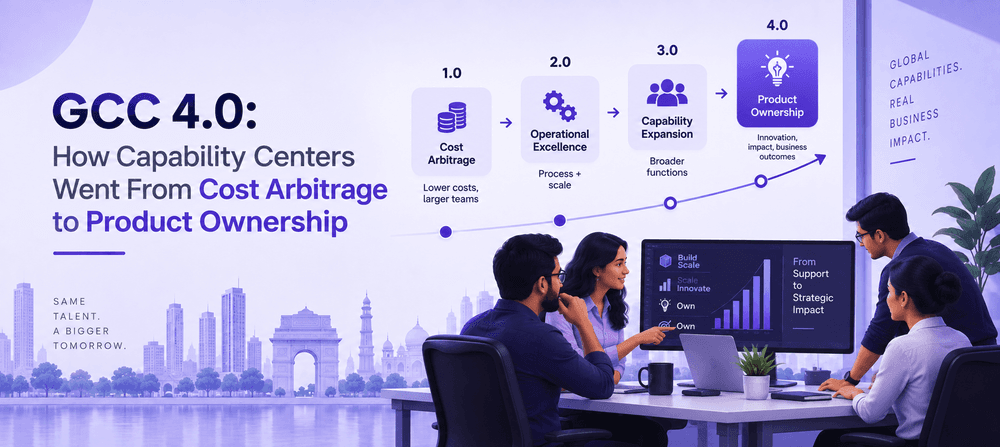
The evolution is easy to trace. GCC 1.0 was built on cost arbitrage, and its scorecard was cost savings. GCC 2.0 was about scale and delivery, measured by productivity. GCC 3.0 brought specialised capability, judged on innovation and expertise. GCC 4.0 is about product and business ownership, and it's measured by outcomes, IP, and growth. Importantly, GCC 4.0 doesn't make cost irrelevant. It turns cost into both a constraint and an advantage, rather than the reason the center exists in the first place.
GCC 1.0: The cost center
The original model ran on labour arbitrage. The logic was that equivalent work could be done in India for less, so the center handled back-office operations, IT support, testing, maintenance, finance operations, transaction processing, and routine software development. Success meant headcount, cost per employee, cost savings, SLA adherence, and delivery volume.
The model worked, and it built India's enormous technology talent ecosystem. But it also created a ceiling. When a center's value is defined mainly by cheaper labour, the business can always ask whether some other location could do the same work even more cheaply. That's a fragile place to stand, and it's a big part of why the real cost story of US versus India engineering has moved well beyond raw rates.
GCC 2.0: Scale
The next phase went past simple cost reduction. Companies began building large engineering and technology teams in India, focusing on more engineers, bigger delivery capacity, standardised processes, global support, round-the-clock operations, and technology modernisation.
India became a serious engineering execution engine. The question quietly changed from "how cheaply can we do this?" to "how much capability can we build?"
GCC 3.0: Specialized capability
Then came specialisation. Companies started standing up centers around AI, data science, cloud, cybersecurity, product engineering, digital transformation, advanced analytics, and R&D. At this point India stopped being just an execution location and became a genuine source of specialised technical expertise. EY's 2026 analysis reflects the same transition, describing Indian centers as hubs for technology, innovation, and advanced analytics rather than traditional back-office support.
GCC 4.0: Ownership
GCC 4.0 changes the organisational question entirely. Instead of "which work can we move to India?", the question becomes "which capabilities should India own globally?"
That might mean a product line, a platform, a global engineering function, AI products, cybersecurity platforms, data infrastructure, developer platforms, customer experience systems, or core business processes. Ownership changes everything downstream, from how you hire to how you measure success.
What does product ownership actually mean?
Product ownership isn't just writing code for a product that's managed somewhere else. A team that truly owns a product controls a meaningful slice of the lifecycle: product discovery, roadmap input, architecture, engineering, testing, data, security, reliability, customer feedback, product analytics, and release decisions.
The India team becomes accountable for outcomes, not tasks. That's the whole difference between "build feature X" and "own the growth and reliability of capability X." One is a to-do list. The other is a business responsibility.
Why India is well positioned for GCC 4.0
India brings several advantages together at once. It has one of the world's largest pools of software and technology talent. Its GCC ecosystem is deeply mature, with EY citing more than 1,800 GCCs and over two million professionals in 2026. It increasingly has engineering leaders who have actually built global organisations, and a growing base of engineers and leaders with real high-growth product experience. And even as salaries rise, India stays structurally competitive against major Western engineering markets. That combination is exactly what makes ownership possible, and it's why understanding how to build a scalable technology workforce in India matters more than chasing the lowest rate.
But ownership cannot be created through hiring alone
This is where a lot of GCC strategies quietly fail. A company hires 100 engineers and assumes the center will magically become strategic. It won't. Ownership requires organisational authority. If every meaningful decision still lives at headquarters, the India organisation stays an execution arm no matter how talented its people are.
The five conditions for GCC 4.0
- Leadership: you need leaders who can operate across both India and global HQ, which is why SquadXP's GCC approach puts founding leadership early in the setup, since leadership sets culture, hiring strategy, and long-term direction.
- Mandate: the team needs a clearly defined responsibility, and "engineering support" is not one, whereas "own the global billing platform" is.
- Decision Rights: because teams can't own outcomes without real authority.
- Product Connection: so engineers have direct access to product, customer, and business context.
- Talent Architecture: meaning senior technical leadership, product management, and specialist capability, not just a stack of developers.
GCC 4.0 changes the hiring sequence
Traditional thinking runs 10 engineers, then 30, then 100. GCC 4.0 runs a different order entirely: leader, then mandate, then architecture, then specialist capability, then engineering scale.
That's why SquadXP's recent guidance argues founding leadership should come before piling on headcount. A team of 10 engineers with no local leadership is just a delivery team. A leader with a clear mandate can build an entire organisation, which is precisely why your first India hire should often be a site leader, not ten engineers.
The new GCC scorecard
A traditional GCC scorecard tracks cost savings, headcount, utilisation, SLA, and attrition. A GCC 4.0 scorecard keeps some of that but adds the things that actually signal ownership: products owned, platforms owned, revenue influenced, time-to-market, patents and IP, engineering productivity, AI adoption, customer outcomes, global leadership roles, and business decisions made in India. That's not a tweak to reporting. It's a fundamentally different management system.
GCC 4.0 and AI
AI is accelerating the shift toward ownership, and the reason is blunt: routine development work is increasingly automatable. If your center is valued for churning out code volume, AI quietly erodes its perceived worth.
But if the center owns product strategy, architecture, AI implementation, data, customer insight, domain expertise, and production outcomes, AI becomes a force multiplier instead of a threat. The center moves from "more developers" to more capability per engineer. Industry commentary makes the same point, arguing India's GCCs are positioned to become co-architects of AI-enabled business models rather than low-cost delivery shops.
What GCC 4.0 means for location strategy
Ownership also reshapes where you set up. A cost center can optimize for salary. An ownership center has to optimize for talent, leadership, ecosystem, domain expertise, and scalability together. That's why Bengaluru, Hyderabad, Pune, and Delhi NCR still matter for specialised leadership and product capabilities, while emerging Tier-2 markets become valuable components of a broader distributed workforce strategy rather than straight substitutes.
GCC 4.0 and compensation
Ownership changes pay, too. A product leader responsible for a global platform can't be benchmarked against a generic delivery manager, and a staff engineer designing a global architecture can't be benchmarked against an application-maintenance engineer. The more strategic the mandate, the more capability-based compensation matters, which is exactly why you benchmark salaries by role, level, and city rather than defaulting to one flat "India number."
The BOT model in GCC 4.0
Build-Operate-Transfer can support this evolution nicely, as long as you frame it correctly. The goal isn't "outsource employees until our entity is ready." The goal is to build the organisation before the paperwork catches up, then transfer a functioning capability into permanent ownership.
SquadXP's BOT model is built around exactly that path, from building and operating an engineering team to eventual ownership, with hiring, payroll, compliance, and operations handled during the initial phase. Done well, it shrinks the gap between the decision to enter India and the first genuinely productive engineering team.
What GCC 4.0 is not
It's worth being clear about what doesn't count. GCC 4.0 is not simply hiring more engineers, rebranding a captive center, moving HQ responsibilities to India without the authority to match, bolting on an innovation lab, opening an office in Bengaluru, or handing the center a bigger budget. It's a change in organisational ownership, full stop.
A practical GCC 4.0 roadmap
Phase one is to define the mandate and decide what India should own. Phase two is to hire founding leadership, a builder who understands both the Indian talent market and the global business. Phase three is to build the specialist layer across architecture, product, cloud, data, and security. Phase four is to establish product ownership, giving teams direct responsibility for defined products or platforms. Phase five is to scale, expanding engineering around the areas where ownership is working. And phase six is to measure outcomes, moving decisively beyond headcount and cost metrics. This sequencing sits at the core of any GCC-versus-staff-augmentation-versus-dedicated-team decision.
Conclusion
GCC 4.0 was never about moving from cheap to expensive. It's about moving from execution to ownership. The most valuable Indian GCCs of the next decade won't be measured by how many engineers they employ. They'll be measured by what they build, what they own, what they innovate, and which business outcomes they actually control. That's the real journey, from cost center to capability center, and then from capability center to global product organisation.