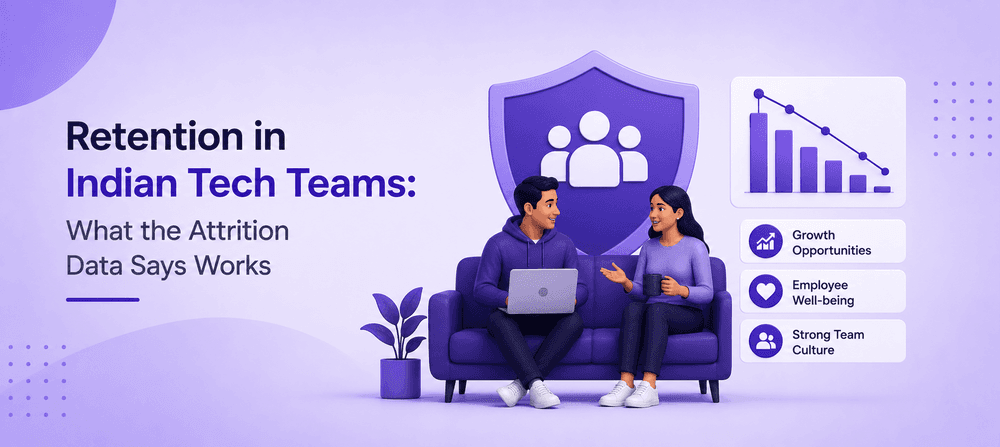
For years, every conversation about Indian technology talent circled back to one number: attrition.
Companies worried about engineers leaving. GCCs worried about losing scarce specialists. Product companies braced for counteroffers. Technology leaders built teams and then watched experienced people walk after 12 or 18 months, taking the system knowledge with them.
The latest data tells a more nuanced story. Attrition in India has been moderating. EY reported overall attrition declining from 18.3% in 2023 to 17.5% in 2024, with voluntary attrition falling from 15.2% to 14.1%. Aon showed the same gradual slide: 18.7% in 2023, 17.7% in 2024, 17.1% in 2025. And for India's GCCs specifically, the numbers are more striking still. EY's 2025 GCC Pulse research put GCC attrition at 13% in 2023, 11% in 2024 and 9% in 2025.
So is the Indian tech retention problem solved? No. Not even close. The problem has changed shape.
The market is now sorting companies into two groups: those that give people a real reason to stay, and those hoping compensation alone will do the job. For specialist engineers, architects, AI professionals and technology leaders, that sorting is happening fast, and which side of it you land on shows up in your delivery within two quarters.
First: Don't Treat Every Attrition Number as the Same
Before drawing any conclusion, get this straight: there is no single "India tech attrition rate."
Different reports measure different populations. All industries versus IT services versus GCCs. Campus hires versus experienced professionals. Voluntary exits versus total attrition. EY's GCC figure of 9% and Aon's broader India workforce figure of 17.1% are not contradictory; they're measuring different things.
And that gap between them is itself the finding. The workforce model matters. GCCs, on average, are keeping people meaningfully better than the wider market, and it's worth asking why.
GCC Retention Is Telling Us Something Important
India's GCC market has quietly changed its own job description.
The old model was "do work in India because it costs less." The newer one is "build capability in India because the talent is here." EY's GCC Pulse found 92% of centres planning to deliver value beyond cost arbitrage, 63% prioritising niche skills, and 66% prioritising deep domain expertise, AI/ML and other advanced capabilities.
That shift changes retention directly. An engineer doing low-value repetitive work is always one recruiter message away from leaving. The same engineer owning architecture, AI, product engineering, global platforms, cloud infrastructure or data engineering has a job that's building their career, and career-building jobs are harder to leave.
The lesson is simple and most companies still miss it: retention begins with the work itself. It's also why we argue that a serious mandate, starting with the first hires for a new India GCC, attracts and keeps a different calibre of person than a ticket queue ever will.
Salary Still Matters
There's an HR reflex worth resisting here. Someone resigns, and the room says "people don't leave for money, they leave managers." Comforting, and too simplistic.
Money matters, especially in a market where a skilled engineer can benchmark their value in an afternoon. EY's Future of Pay research, even while reporting declining attrition, kept naming competitive pay, career growth and flexible work as the retention levers that count.
But competitive doesn't mean highest-in-market. It means the employee understands why their compensation is fair for their contribution and market value. Opacity, not the absolute number, is what sends people to check the market, and the market always answers.
The Counteroffer Is Not a Retention Strategy
You know this pattern. An engineer resigns. The company scrambles: more money, a promotion, a new title, a retention bonus. The engineer stays.
Six months later, they leave anyway.
Because money usually wasn't the original problem. They wanted better technical work, real progression, more ownership, a better manager, more flexibility, product exposure, recognition. The counteroffer treated the symptom and paid a premium for the privilege, and the underlying reason kept ticking.
Retention means understanding why someone started looking before they started looking. Everything below is about that.
Career Growth Is One of the Strongest Retention Levers
This finding shows up in study after study on Indian IT retention: career growth, compensation, recognition, work environment and autonomy keep surfacing as the factors that decide who stays.
It makes intuitive sense. A strong engineer doesn't only ask "what am I earning today?" They ask "what will I be capable of two years from now if I stay?" For ambitious technical talent, the second question outweighs the first, and companies that can't answer it lose people to companies that can, sometimes at the same salary.
Build Technical Career Paths
Most companies have a management ladder. Far fewer have an equally credible technical one, and the gap is a retention hole they dug themselves.
An engineer shouldn't have to become a people manager to progress. Build the track: Engineer, Senior, Staff, Principal, Distinguished. The exact titles matter less than the principle: technical expertise carries status, compensation and organisational influence of its own.
Because if the only visible promotion path is management, your strongest engineers eventually face a two-option menu: become a manager, or leave. Many pick the second, and they're right to.
Give Engineers Real Ownership
Compare two sentences. "You're responsible for completing tickets assigned to this team." Versus: "You own the reliability of this service."
Same engineer, completely different relationship with the work. Ownership generates responsibility, autonomy, visibility, learning and recognition in one move, and engineers who own meaningful outcomes are consistently more engaged than engineers who complete tasks. It's also exactly the kind of mandate we tell clients to lead with when interviewing engineers in India: the candidates you most want to hire are choosing employers on this dimension.
The Quality of the Manager Matters
A technically excellent company still bleeds people through poor management, because employees don't experience "the organisation." They experience their manager.
The manager decides how priorities land, whether work is distributed fairly, whether feedback happens, whether wins get recognised, whether growth conversations occur, how conflict is handled and how much autonomy exists. Which is why retention can't live only in HR. Engineering managers are retention infrastructure, and manager quality deserves the same investment as any other critical system.
Don't Wait for the Exit Interview
The exit interview is an autopsy. The decision is made; you're documenting it.
Run stay interviews instead. What's working? What's frustrating you? What would make the job better? What do you want to learn next? What kind of work do you want more of? Is anything making you think about leaving?
The goal isn't to promise everything. It's to spot the patterns while they're still fixable, before they're resignations.
Watch the High-Risk Population
You don't need to predict individual resignations. You need to know where the risk concentrates.
The usual suspects: engineers with highly marketable skills, people without meaningful growth in a while, long promotion gaps, high performers under weak managers, below-market compensation, repetitive work, key people after a reorg, and employees approaching a career milestone. Map those overlaps and you have your watchlist. This is workforce intelligence doing real work, not dashboard decoration.
Retention Is More Important for Scarce Skills
Losing a junior developer and losing a principal cloud architect are not the same event, and treating them the same in your attrition maths hides the real damage.
A junior can be replaced in weeks. A principal engineer carries deep system knowledge, architectural context, customer understanding, internal relationships and mentoring load. Their exit opens a knowledge gap that takes quarters to close, if it closes. And replacing them means competing in exactly the AI/ML and specialist talent market where everyone else is hunting too.
That's why our own specialist hiring practice is built around long-term fit for business-critical roles, not short-term placements. And it's why retention strategy should be weighted by capability criticality, not headcount. Protecting five people can matter more than moving the overall number one point.
AI Is Changing the Retention Equation
AI has added a new anxiety to the mix. Engineers are increasingly expected to work with AI coding tools, generative AI, automation, data platforms and agents, and somewhere in that list sits a quiet question: "will my skills still matter in three years?"
The best employers answer it directly: "we'll help you build the skills that will." EY's 2025 GCC research found 81% of GCCs upskilling internal teams on GenAI and 71% prioritising reskilling. Read that as more than a capability strategy. It's a retention signal, and engineers can hear it.
Make Learning Part of the Job
Never tell engineers "you can learn AI in your own time." What they hear is "your current output matters more than your future," and they respond accordingly, usually via LinkedIn.
Integrate learning into the work instead: AI engineering projects, internal architecture reviews, technical communities, conference participation, certification support, pair programming, research time, hackathons, rotations. The target is simple to state: make yours the company where engineers become more valuable by staying. That sentence, made true, is worth more than any retention bonus you'll ever pay.
Flexibility Still Matters
Flexibility keeps showing up in the retention research, but it has to be designed, not declared.
A global engineering team needs some overlap; it doesn't need everyone on the same clock. Define core collaboration hours, async expectations, meeting principles, documentation requirements, escalation paths and time-zone responsibilities. Then hold to them. Our guidance on US-India time-zone overlap makes the operational case: sync-heavy environments burn people out across an 11-hour gap, while strong async practice makes the same gap workable for years. Good operating design is a retention tool wearing a process costume.
Recognition Matters More Than Many Leaders Think
Recognition doesn't mean an awards ceremony. It means credit given publicly, a seat in architecture discussions, work presented to leadership, mentoring responsibility, growing ownership, visible projects.
Recognition answers the question "does this organisation see the value I create?" Compensation answers "does it pay me fairly?" Employees need both answered, and a yes to only one doesn't cover for a no to the other.
Don't Build Retention Around Perks
Free food is not a retention strategy. Neither is a beautiful office.
Perks improve the daily experience, and that's all they do. They don't compensate for bad leadership, stalled careers, weak technical work, unfair pay, missing autonomy or chronic burnout. When someone resigns over those, the snacks don't come up. Fundamentals first, always.
Measure Attrition by Segment
One company-wide number can hide the fire. Overall attrition of 10% looks healthy, until you segment: engineering at 16%, principal engineers at 22%, product at 8%, finance at 5%. You have a technical retention problem wearing a healthy average.
Go deeper still. AI engineers at 19%, platform engineers at 21%, backend at 11%, and now the problem is actionable. Segment by function, seniority, skill, manager, tenure, location, compensation band, performance and business unit. The insight lives in the cuts, never in the average.
Measure Regrettable Attrition
Not every departure is a loss. People relocate, retire, change careers; some were underperforming; some roles genuinely ended.
The number leadership should stare at is regrettable attrition: who did we lose that we genuinely wanted to keep? That figure tells you whether you have a retention problem or just turnover, and the two need completely different responses.
Retention Should Start Before Hiring
One of the biggest lessons in this whole subject: retention problems are frequently manufactured during recruitment.
The recruiter sells "global architecture ownership." The engineer joins and finds ticket delivery and maintenance. The resignation clock started on day one, and no retention programme will stop it.
Hiring and retention are one system. Candidates should understand the real responsibilities, team structure, decision authority, career path, working model and technical environment before signing. An honest hiring process retains better than an attractive pitch, every time. It's the standard we hold in every search, from individual engineers up to a CTO or VP Engineering: the mandate described in the interview has to be the mandate that exists.
The First 90 Days Matter
A new engineer spends their first three months deciding whether the company is what they were promised. They need clear goals, working onboarding, system access on day one, an available manager, product context, real documentation, a sensible first project and early feedback.
Chaotic onboarding doesn't cause immediate resignation. It plants the doubt, and doubt compounds. The first recruiter call six months later lands on prepared ground.
Don't Confuse Retention With Inactivity
A warning for anyone celebrating a low attrition number: a company can have low attrition and a weakening workforce at the same time.
People stay because the market is uncertain, because they lack better options, because they're comfortable, because a bonus vests in March. That's not retention. That's inertia, and it reverses the moment the market turns.
Healthy retention means people stay because staying is valuable: career growth, meaningful work, strong leadership, fair pay, learning, autonomy, recognition, sustainable flexibility. Test which kind of retention you have before the market tests it for you.
What the Current Data Really Says
Put the evidence together and five patterns hold. Attrition has moderated: Aon shows overall India attrition down from 18.7% in 2023 to 17.1% in 2025, with EY reporting similar declines. GCC retention is stronger, down to 9% in 2025 on EY's numbers. Specialist skills remain fiercely competitive, with GCCs prioritising niche skills, AI, ML and domain depth. Compensation alone isn't enough; the research keeps pointing at career development, recognition, environment and autonomy alongside pay. And capability development is merging into retention, with the GenAI upskilling numbers as the clearest evidence.
The through-line: retention is becoming less about preventing exits and more about making the organisation worth staying with. Those are different projects, and only one of them scales.
A Practical Retention Framework for Indian Tech Teams
Six areas, built in this order. Pay: market-competitive for critical skills, and explained. Career: credible progression on both the management and technical tracks. Work: meaningful ownership and genuinely hard problems. Leadership: managers trained to coach, communicate and develop. Learning: reskilling wired into the operating model, not left to weekends. Flexibility: a sustainable working design across locations and time zones.
No single one carries the load. Together they make an employee proposition your competitors have to beat, rather than merely outbid.
What Should Companies Do First?
Not a massive retention programme. Start with the data.
Who is leaving? Who is at risk? Why? Which managers carry unusually high attrition? Which skills would take six months to replace? Where are the compensation gaps? Which teams have no visible career path?
Then prioritise ruthlessly. If five principal engineers hold up a critical platform, protecting those five outranks shaving a point off the company-wide number. Retention budgets follow criticality, not headcount.
Retention Is a Workforce Strategy
The bigger lesson underneath all of it: retention shouldn't sit at the end of the HR process. It should shape workforce planning, compensation, hiring, career architecture, leadership development, engineering strategy, GCC design and location strategy from the start.
A company that consistently loses critical engineers doesn't have an HR problem. It has a workforce design problem, and it will keep paying for it in recruiting fees until the design changes.
Final Thoughts
The Indian tech attrition story is changing. The post-pandemic churn era is over; broad attrition has moderated and GCC attrition has fallen further still.
But nobody gets to stop thinking about retention. The most valuable talent is still highly mobile, and AI, cloud, cybersecurity and data skills remain intensely competitive. The companies keeping these people aren't reliably the highest payers. They're the ones with a compelling reason to stay: fair pay, meaningful work, real progression, strong managers, technical ownership, learning, recognition and sustainable flexibility.
And increasingly, one question decides it all. Every good engineer is quietly asking: "if I stay here three more years, will I become better at what I do?"
If your honest answer is yes, retention gets much easier. If it's no, some other company eventually becomes impossible to resist, and your attrition dashboard will tell you about it a quarter too late.
If you're building or rebuilding a team in India and want the retention designed in from the hiring stage, tell us the roles and we'll send you five profiles, free. No retainer, no obligation, just candidates matched for fit that lasts.