A GCC can have great engineers, strong leadership, and a clear charter, and still struggle. The culprit is usually governance.
India says "we need faster decisions." HQ says "we need more visibility." India says "HQ keeps changing priorities." HQ says "India isn't aligned with the global roadmap." Neither side has a talent problem. They have an operating-rhythm problem. A successful GCC needs a governance model that makes decisions, escalations, priorities, and accountability predictable. SquadXP's GCC positioning stresses leadership, operating structure, workforce planning, and integration with the wider organisation, and this guide shows how to design an India-to-HQ model that works at 20 people and still functions at 500.
What a governance model is, and its three layers
A GCC governance model defines who makes decisions, who owns outcomes, how India interacts with HQ, how priorities are set, how budgets are managed, how risks are escalated, how performance is reviewed, and how strategy changes. The objective isn't more meetings, it's decision clarity. A practical model runs three layers. The operational layer covers delivery, hiring, issues, dependencies, security, and operations on a daily or weekly cadence. The business layer covers budget, KPIs, workforce, product priorities, and risks monthly. The strategic layer covers the mandate, capability ownership, expansion, org design, and investment quarterly or annually. That separation stops executives from discussing laptop issues and strategic capability in the same meeting.
Start with decision rights, not meetings
Before creating recurring meetings, define who decides. Local hiring, local vendors, and engineering architecture typically sit with India; the global product roadmap and global security standards sit with HQ; the GCC budget and senior leadership hiring are usually joint. Documenting that dramatically reduces unnecessary escalation. A RACI model helps for major processes, marking who is responsible, accountable, consulted, and informed, so local recruitment and technical execution land with India while the product roadmap and security policy land with HQ. This decision-rights clarity is the same backbone the GCC charter formalises.
Set the operating rhythm at each level
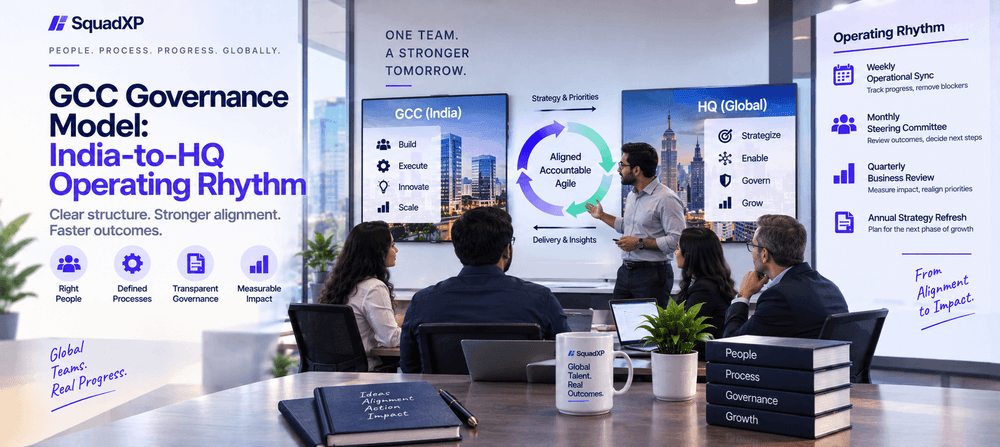
The weekly India-to-HQ meeting shouldn't become a two-hour status readout; use it for delivery, risks, dependencies, hiring, and decisions, answering what changed, what's on track, what's blocked, what decisions are needed, what shifted in the talent market, and what risks need escalation, with status reporting kept asynchronous. The monthly operating review goes broader, covering workforce (headcount, open roles, hiring velocity, attrition, critical skills), engineering (delivery, reliability, productivity, quality), finance (actual vs budget, cost per productive FTE, hiring forecast), risk, and capability. The quarterly business review answers whether you're building the organisation you intended, engaging India as a strategic organisation rather than a delivery vendor. And the annual strategy review revisits mission, mandate, headcount, location, capabilities, budget, leadership, product ownership, and governance, updating the charter if needed.
Let governance evolve, and protect against both failure modes
Governance should scale with maturity. At 20 people, focus on communication, hiring, delivery, access, and basic financial control. At 100, add functional leadership, workforce planning, formal KPIs, security governance, and capability reviews. At 500, add strategic portfolio governance, business-unit ownership, executive steering, global talent planning, and P&L where appropriate. Throughout, the India leader is the bridge, translating HQ strategy into India execution and, just as importantly, India reality into HQ decisions, telling HQ which skills are scarce, where compensation is moving, which roles are hard to fill, what competitors are doing, and where attrition risk sits. That's workforce intelligence, not just HR reporting.
Avoid the two opposite traps. The "HQ decides everything" model produces slow hiring, slow architecture, frustrated leaders, and weak local accountability, if India is expected to own capability, it needs authority. But unlimited India autonomy is wrong too; global organisations still need standards, security, brand, financial controls, and product alignment. The correct model is global standards plus local execution authority. Support it with an escalation framework (team-level issues resolved locally, cross-functional dependencies to functional leaders, budget and strategic issues to GCC and HQ leadership, major security or legal risks to executives), a decision log recording date, decision, owner, participants, rationale, and review date, and asynchronous dashboards so meetings are for discussion, not reading spreadsheets aloud.
Handle time zones and measure governance itself
India and US teams often work across large time differences, and SquadXP's India-US operating guidance recommends designing collaboration around intentional overlap rather than expecting people to stay available late every night. So a governance model should define core overlap hours, executive meeting windows, async communication, escalation availability, and incident coverage, without turning "global collaboration" into permanent after-hours work. It's also worth measuring governance itself: decision velocity, escalation rate, meeting load, action closure, and priority stability all reveal structural problems early. The first 90 days deserve tighter governance, weeks one to four on hiring, infrastructure, security, leadership, and operating model; five to eight on team integration, product alignment, and pipeline; nine to twelve on productivity, capability, and the next hiring wave, before settling into the normal rhythm. And as India moves from executing to owning products and platforms, governance should shift from "HQ decides, India delivers" toward jointly setting strategy and India owning outcomes, the exact progression in what a GCC owns under GCC 4.0.
Conclusion
GCC governance isn't about a bigger meeting calendar, it's about clear ownership and predictable decision-making. The strongest India-HQ model combines clear decision rights, defined escalation, regular operating reviews, quarterly strategic alignment, local leadership authority, global standards, and shared accountability. As the GCC matures, governance should evolve from HQ directing India toward India and HQ jointly running a global capability. That's the point where an India GCC stops behaving like an offshore team and starts behaving like a genuine global organisation.