A Global Capability Center rarely fails because a company can't find software engineers. It fails because the organisation tries to solve the wrong problem first.
The usual sequence goes something like this: pick an office, register an entity, write 20 job descriptions, start recruiting engineers, wait, then slowly discover that leadership hiring is taking longer than expected, that the compensation assumptions were off, and that nobody actually owns the India operating model. Six months later, the company has an office, a handful of employees, and very little real capability.
A better sequence starts with the people who will build the organisation. This teardown looks at the operating logic behind a faster launch: founding leadership first, then an engineering pod designed around a specific delivery mandate. SquadXP's current customer story describes a US SaaS company where the team helped stand up founding leadership and an engineering pod in weeks rather than quarters, and its GCC offering leans on the same pillars, founding leadership, hiring roadmaps, and specialist engineering capability, as part of the launch. The real lesson here isn't the six-week headline. It's what has to happen for six weeks to even be realistic.
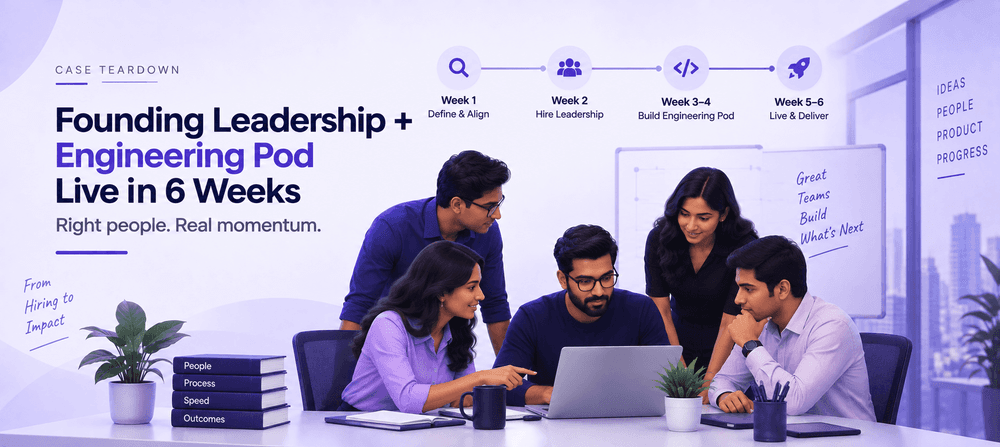
The six-week GCC launch model
An accelerated model runs week by week. Week 1 is about mandate, role design, and calibrating the talent market. Week 2 kicks off the leadership search alongside the engineering pipeline. Week 3 runs leadership interviews and technical assessments. Week 4 lands the final leadership selection and engineering offers. Week 5 is onboarding for both the leader and the engineers. And by Week 6, the pod is operating in an agreed sprint cadence.
This isn't a promise that every GCC launches in six weeks. Role complexity, notice periods, location, security requirements, and candidate availability can all move the timeline materially. The real point is that hiring can be designed as a system rather than a queue, which is the same discipline behind building a genuinely scalable technology workforce in India.
The original problem: "We need 10 engineers"
This is how a lot of GCC conversations start. A company knows it wants five backend engineers, three frontend engineers, one QA engineer, and one DevOps engineer, so it starts recruiting.
The hidden problem is that nobody owns hiring quality, engineering culture, architecture, local talent strategy, interview standards, product alignment, future headcount, or stakeholder management. The company has hired people. It hasn't built an organisation. Those are two very different outcomes.
The first intervention: change the first hire
The first critical decision is to hire the person responsible for building the capability. Depending on the org, that might be an India Site Leader, a GCC Leader, a Head of Engineering, an Engineering Director, or a Technology Leader. The title is flexible. The mandate is what matters. SquadXP's recent guidance makes the case that a site leader can be more strategically valuable than immediately hiring a cluster of engineers, precisely because that leader builds the next layer of the organisation, which is the heart of why your first India hire should be a site leader, not ten engineers.
What the founding leader owns
A strong founding leader should own several things at once. There's organisation design, deciding what the India team looks like at 10, 50, and 100 people. There's technical direction, defining what the first engineering pod should own. There's hiring, deciding who comes next, and culture, shaping how India works with global HQ. There's delivery, setting the first 90-day outcome, and stakeholder management, defining how India interacts with product and engineering leadership worldwide. And there's talent market strategy, choosing the city and compensation model. That breadth is exactly why the founding leadership search isn't ordinary recruitment, and why it's worth understanding how to hire a CTO or VP of Engineering in India before you start.
The second intervention: define the first pod around an outcome
A weak engineering pod is "four developers and two testers." A strong pod is "a product engineering team responsible for delivering and operating the payments reconciliation module." The second definition creates ownership, and ownership is what makes a team productive.
To do that, the pod needs a clear mandate, product context, technical ownership, success metrics, a map of its dependencies, and a delivery cadence. Give it those, and it stops being a headcount and starts being a capability.
Why pod design affects hiring speed
If you simply hire "good engineers," your recruiting team has to guess what good means. If the pod has a defined mission, the profile gets specific. Say the mission is to build a globally deployed API platform. Suddenly the requirements are concrete: backend engineering, distributed systems, API design, cloud, observability, CI/CD, and security. The market map gets far more precise, and precise searches move faster.
Week 1: Build the hiring architecture
The first week should answer five questions. What are we building, so you define the product or capability? Who owns it, so you define the leadership mandate? What does the first pod deliver, so you set an initial outcome? Where should we hire, so you choose the market based on talent rather than office availability? And what's the compensation range, so you benchmark before interviews begin? SquadXP treats workforce intelligence and compensation benchmarking as part of its broader GCC methodology, and getting the pay bands right early means leaning on a proper software engineer salary report for India rather than assumptions.
Week 2: Run leadership and engineering searches in parallel
This is where traditional hiring slows to a crawl. It usually runs sequentially: leader first, then engineers, then managers, then specialists. That can add months to the clock.
A better model starts the searches in parallel. The founding leader search can run while the engineering pipeline is being built, and the leadership candidate may even join the final technical calibration. Overlapping the two is one of the biggest single levers on total time-to-capability.
Week 3: Compress feedback loops
A classic recruiting bottleneck is simply waiting. Candidate interviews happen Monday, feedback trickles in by Thursday, and the next interview slips to the following week. A six-week model can't survive that rhythm.
The process needs same-day feedback, predefined interview panels, standard scorecards, clear decision rights, and short scheduling windows. That's an operating-system problem, not a recruiter problem, and fixing it is mostly about design and discipline rather than effort.
Week 4: Make the critical decisions
By now the company should have enough evidence to make the leadership decision, the engineering hiring decisions, the compensation decisions, and the pod-composition decision. This is also the moment to cut weak candidates. Speed never means lowering the bar. It means eliminating unnecessary waiting, which is a very different thing.
Week 5: Onboarding becomes part of the build
Hiring isn't finished when the offer is signed. The new leader needs product context, organisational context, access, a stakeholder map, a hiring roadmap, and real decision authority. The engineers need a development environment, repository access, security clearance, product documentation, a sprint cadence, the technical architecture, and their communication channels. A team can't be "live" while its engineers are still waiting on permissions, so onboarding has to be treated as part of the build, not an afterthought.
Week 6: The pod starts shipping
The first milestone shouldn't be "everyone has joined." It should be "the team is operating against a real product outcome." That might be a first production feature, a first architectural milestone, a first automated deployment, a first service migration, or a first customer-facing capability. The goal is to prove the India team is operational, not merely employed.
Why the six-week model works
It rests on five design principles. First, leadership and engineering hiring overlap, so you never wait for one process to finish before starting the next. Second, the talent market is calibrated before sourcing, so you already know what the market will accept. Third, roles are defined by capability, which kills the generic job description. Fourth, decision-making is centralised, so candidates aren't stuck waiting for six stakeholders to agree. And fifth, onboarding begins before joining, so infrastructure and access are ready in parallel. None of these are exotic. They're just rarely done together.
What can break the timeline?
A credible teardown has to be honest about failure points. The biggest is leadership notice periods: senior Indian technology leaders often carry 60 to 90 day notice periods, and SquadXP's own leadership-hiring guidance notes that senior searches can take six to ten weeks to reach an offer, with notice periods extending the total further. So "six weeks" shouldn't be read as six weeks from the first conversation to every employee physically at their desk. It's better understood as a rapid build and operating model, with availability and notice periods planned for up front.
Other things can stretch it too. Highly regulated industries can demand extra security controls before engineers get system access. Highly specialised roles like AI researchers, principal architects, and niche cybersecurity professionals take considerably longer, which is worth remembering when you're hiring AI/ML engineers in India. And an unclear product mandate is a silent killer: if HQ hasn't decided what India owns, recruiting slows down because every candidate conversation turns into a strategy conversation.
The difference between hiring a pod and building a pod
This distinction is everything. Hiring a pod means recruiting six people. Building a pod means defining the mission, leadership, architecture, skills, hiring bar, product context, delivery cadence, metrics, and governance. The second approach is what lets a team become productive quickly, because the people arrive into a structure instead of a vacuum.
What the client actually gets
A successful accelerated launch should create four assets. The first is leadership, a person accountable for building the organisation. The second is engineering capability, a team that can deliver meaningful product work. The third is a hiring system, a repeatable way to add the next 20, 50, or 100 people. And the fourth is an operating model, a working connection between India and global HQ. Without all four, the company has simply recruited employees, which is where the real difference between staffing and capability shows up, much like the choice between a GCC, staff augmentation, or a dedicated development team.
Why this matters for GCC economics
Say a company expects to spend ₹10 crore building an India engineering organisation. The obvious question is "how much will the engineers cost?" The more important question is "how quickly can those engineers become productive?" If hiring drags to six months instead of six weeks, the company loses product velocity, engineering capacity, time-to-market, opportunity cost, and leadership bandwidth. That's why time-to-capability deserves to be treated as a financial metric, not a soft one.
The 6-week GCC scorecard
A useful launch dashboard has clear targets. The founding leader should be identified around Weeks 2 to 4, with the engineering pipeline activated in Week 1. First offers land in Weeks 3 to 4, and the pod is hired by Weeks 4 to 6. Access readiness should be done before onboarding, the sprint cadence should be running by Weeks 5 to 6, and the first measurable output should appear in the first 30 to 60 days. Crucially, the next hiring wave should be planned before the first pod is even complete. Adapt the exact numbers to your role mix.
How BOT can support the model
For companies whose Indian entity isn't ready, a Build-Operate-Transfer model removes one huge dependency. Instead of waiting for the full chain of entity, then payroll, then compliance, then recruitment, then onboarding, you can start building the team while the permanent structure is being set up. SquadXP's Talent BOT model is designed around exactly this: build and deploy the engineering team while the partner manages employment, payroll, HR, and compliance, followed by a structured transition to the client. That makes BOT especially relevant when business urgency outweighs entity-setup speed, and it pairs naturally with understanding your entity, EOR, and BOT compliance options.
What companies should learn from the case
The biggest takeaway isn't that a team can be built in six weeks. It's that launch speed comes from sequencing decisions correctly. The bad sequence is office, then entity, then job descriptions, then recruiters, then interviews, then leadership. The better sequence is mandate, then founding leader, then pod design, then parallel hiring, then onboarding, then delivery. The second model treats GCC building as organisational design, not recruitment, and that reframing is where the speed actually comes from.
Conclusion
The fastest GCC launches aren't the companies that recruit fastest. They're the ones that remove the most dependencies. They decide what India will own. They hire the person responsible for building it. They define the first pod around an outcome. They run leadership and engineering searches in parallel. They prepare onboarding before anyone joins. And they measure success by the first business outcome, not the number of offer letters signed.
That's the whole difference between starting an India office and building an India capability center. For companies entering India in 2026, the real edge isn't access to engineering talent. It's the ability to turn that talent into a functioning global team, fast.