For years, the simplest way to describe an India Global Capability Center was "a lower-cost extension of headquarters." That description is wearing out fast.
The sharper question in 2026 is: what does the GCC actually own? Ownership has become the line that separates a center stuck as a delivery arm from one that's grown into a real business capability. India's ecosystem has already left its cost-arbitrage roots behind, EY reports Indian GCCs now driving technology advancement, advanced analytics, innovation, and R&D, and PwC describes an ecosystem increasingly focused on value creation and global responsibility. That's the foundation of what people are calling GCC 4.0.
What is GCC 4.0?
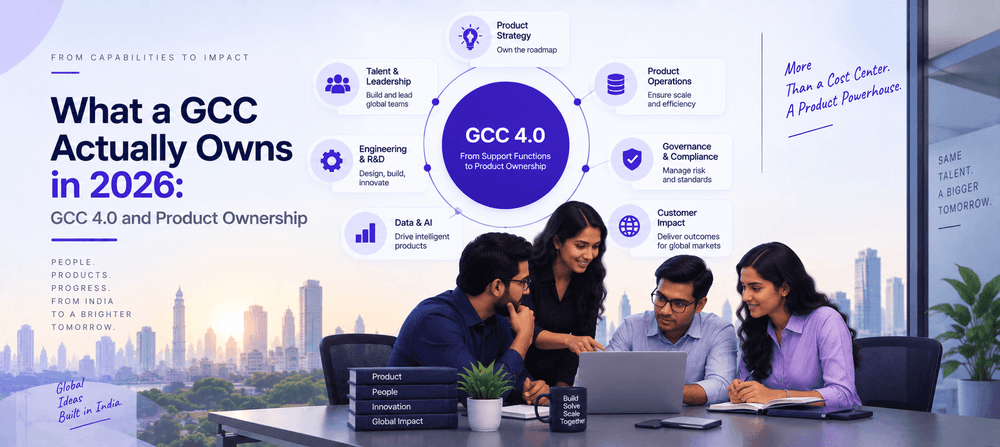
GCC 4.0 isn't an official category, it's a useful shorthand for the next stage of the journey. GCC 1.0 was cost arbitrage, controlling execution. GCC 2.0 was scale, controlling delivery capability. GCC 3.0 was a specialised capability, controlling expertise. GCC 4.0 is strategic ownership, controlling products, platforms, and outcomes.
The real change isn't technology. It's decision rights. A delivery center asks "what work should we execute?" An ownership center asks "what should we build, improve, and own?" Those are completely different organisations, and the GCC maturity model is the clearest way to see where you sit on that path.
What can a GCC own?
A modern GCC can own several layers. It can own
- Products, taking the roadmap, engineering, product management, architecture, analytics, customer feedback, release management, and reliability for a product or product area, which means it helps decide what gets built, not just how.
- Platforms, which suit GCCs especially well: developer platforms, data platforms, API platforms, cloud infrastructure, identity, payments, or internal enterprise platforms, each carrying a clear mandate.
- Engineering Domains without owning a whole product, cloud infrastructure, security, data engineering, AI, mobile, developer experience, or site reliability, which is often a smart stepping stone toward broader ownership.
- AI Capabilities: AI platforms, machine learning systems, data pipelines, model operations, AI product features, applied research, and AI governance. PwC flags AI leadership as an increasingly important capability while noting that the most specialised AI skills remain concentrated in limited talent pockets, which is why hiring the right people, as in hiring AI/ML engineers in India, becomes decisive.
- R&D, from prototyping and research to testing and product innovation.
- Business Processes, financial analytics, risk, supply chain, customer operations, procurement, business intelligence, revenue operations. The thread running through all of it is ownership of outcomes rather than execution of tasks.
What a GCC should not own
This matters just as much. A GCC doesn't need to own everything. Headquarters may keep corporate strategy, brand, executive governance, global sales, and certain customer relationships. The goal was never to relocate the whole company to India. It's to work out which capabilities India can own better, faster, or more efficiently.
The difference between responsibility and ownership
This gets misunderstood constantly. A team can be responsible for delivery without owning the capability. If headquarters decides the roadmap and India builds the features, that's delivery responsibility. If India owns the roadmap for a defined product area, its engineering organisation, and the customer outcome, that's ownership. The words look similar; the operating models are worlds apart.
Ownership requires authority
You can't ask a GCC to own a product while keeping every meaningful decision at headquarters. Real ownership needs decision rights, budget authority, product access, customer context, leadership, accountability, and technical autonomy. Redrawing the org chart doesn't create GCC 4.0. Handing over authority does.
The role of founding leadership
Leadership is the foundation of ownership. A strong GCC leader has to recruit, build culture, manage stakeholders, set technical standards, design the organisation, negotiate ownership, and develop senior talent. SquadXP's GCC Building model puts founding leadership first for exactly this reason, and the case for hiring a site leader before a wave of engineers is really the case for ownership in disguise.
Product ownership changes hiring and cost
A delivery center hires software engineers, QA, and DevOps. A product-owning GCC also needs product managers, architects, engineering managers, UX, data, security, and domain experts. That raises the complexity of the hiring strategy and changes compensation: a product leader with global responsibility isn't comparable to a delivery manager, and a principal engineer designing a globally critical platform isn't comparable to a generic senior developer, which is why benchmarking pay properly matters so much at this stage.
On cost, the metric shifts. Cost still counts, but it's no longer the headline. A better scorecard is cost plus productivity plus innovation plus IP plus product ownership plus revenue impact. PwC found Indian GCCs generated value for their headquarters at a weighted average CAGR of 10 to 11% during FY20 to FY24, with 11 to 12% projected for FY25 to FY29, which says the case is increasingly about value creation, not labour savings.
GCC 4.0 requires deeper talent
Ownership needs a stronger seniority pyramid: leadership, then staff and principal engineers, then engineering managers, then senior engineers, then engineers. A center with 100 engineers but only one senior technical leader will struggle to create genuine ownership. Location follows the ownership model too, Bengaluru for product, AI, and senior leadership; Hyderabad for enterprise engineering, cloud, and data; Pune for engineering and enterprise products; Tier-2 cities for scalable engineering where specialist leadership needs are lower, as covered in choosing the right GCC city.
Global P&L responsibility and how to measure it
The most advanced form of ownership is financial accountability. PwC notes roughly one in five GCCs is targeting global P&L responsibility by 2030, at which point the center owns revenue, margin, product growth, customer outcomes, and business performance, and "offshore center" stops being an adequate description.
To track the shift, stop measuring only headcount, cost per employee, and utilisation. Add product metrics (products owned, features shipped, adoption, customer outcomes), engineering metrics (reliability, deployment frequency, cycle time), innovation metrics (patents, AI adoption, new products), business metrics (revenue influenced, margin, retention, P&L), and talent metrics (leadership depth, internal promotions, attrition, critical-skill coverage).
The danger of "innovation theater"
Plenty of GCCs launch innovation labs, AI centers, digital hubs, and centers of excellence while the team still waits for headquarters to decide everything. That isn't ownership, it's set dressing. A real AI center owns AI outcomes. A real platform center owns the platform. A real product engineering organisation influences product decisions. If the label promises ownership the authority doesn't back it, it's theater.
Conclusion
The defining GCC question in 2026 isn't "how many people should we hire?" It's "what should this organisation own?" Answer that, and hiring, location, compensation, and org design all get easier. The strongest GCCs are becoming global capability owners, building products, owning platforms, leading AI, developing IP, shaping product strategy, and eventually owning business outcomes. That's the real meaning of GCC 4.0.