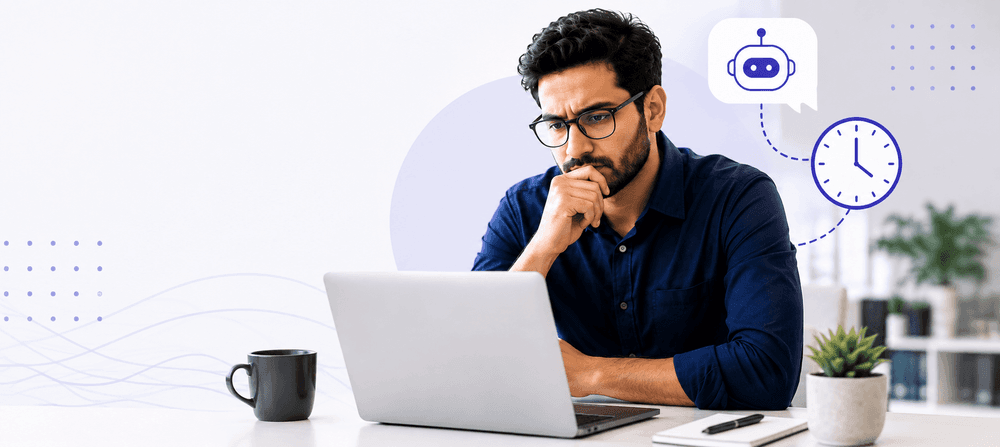
**Chatbot adoption is moving fast, but hiring the talent to build them isn’t.
Companies want to launch faster, automate interactions, and scale AI-driven experiences. But finding the right chatbot developers often takes months, slowing down innovation and creating unnecessary bottlenecks.
For startups trying to ship quickly and enterprises scaling customer support, hiring delays don’t just waste time - they impact growth, cost, and competitive advantage.
In this article, we break down why hiring chatbot talent takes so long - and what companies can do to fix it. **
The Growing Demand for Chatbot Talent
Chatbots today are no longer optional.
They handle customer support, drive lead generation, enable 24/7 interactions, and reduce operational load across industries.
Modern chatbot systems combine NLP, machine learning, and real-time integrations, making them far more powerful, but also harder to build.
As a result, companies are actively looking for professionals who can work across:
-
NLP frameworks
-
Conversational design
-
AI model integration
-
API development
-
Chatbot deployment
The challenge? Talent with this combination of skills is limited.
Why Hiring Chatbot Talent Takes Too Long
The problem isn’t just a talent shortage; it’s also how companies approach hiring. In many cases, the hiring process itself becomes a bottleneck.
Here’s where things slow down:
1. Limited Supply of Skilled Professionals
Chatbot development isn’t a single-skill role.
It requires a mix of AI knowledge, NLP expertise, backend development, integrations, and conversational UX thinking.
Very few professionals bring all of this together.
Most companies struggle to find candidates who can both build chatbot systems and design meaningful user interactions.
2. High Global Competition for AI Talent
AI talent is in demand everywhere.
Startups, enterprises, and tech giants are all competing for the same pool of developers.
Larger organizations often move faster or offer stronger compensation, making it harder for others to secure top candidates quickly.
The result? Longer hiring cycles and missed opportunities.
3. Lengthy Hiring Processes
Traditional hiring is slow by design.
Resume screening, multiple interview rounds, technical tests, and internal approvals can stretch the process over weeks, or even months.
In fast-moving domains like AI, that delay directly impacts product timelines.
4. Complex Skill Evaluation
Assessing chatbot expertise isn’t straightforward.
It’s not just about coding - it involves evaluating understanding of NLP frameworks, conversation flows, integrations, and real-world use cases.
This level of evaluation takes time and often requires experienced interviewers.
5. Rapidly Evolving Technology
The chatbot ecosystem is constantly evolving.
New tools, frameworks, and AI models are introduced regularly.
Companies often struggle to assess whether candidates are up to date, which adds more layers to screening and slows the process further.
The Impact of Slow Hiring
**Hiring delays don’t just affect recruitment; they impact the entire business. **
Delayed Product Launches
For teams building AI-powered products, slow hiring directly delays go-to-market timelines.
Increased Costs
Longer hiring cycles increase recruitment spending, delay ROI, and add hidden opportunity costs.
Overloaded Internal Teams
When hiring takes too long, existing teams take additional work.
This leads to burnout, slower development, and reduced quality.
Missed Opportunities
Companies that can’t deploy chatbot solutions quickly risk falling behind competitors who already offer automated experiences.
Here's the refined section rewritten to sound more human, no dashes:
How to Fix the Chatbot Hiring Challenge
The difference isn't small. It fundamentally changes how fast you can build.
Here's how companies are solving this through staff augmentation:
1. Replace Traditional Hiring with Staff Augmentation
Full-time hiring was not built for the speed of AI development demands.
Staff augmentation gives companies direct access to experienced chatbot developers and conversational AI specialists, without the months-long recruitment cycle.
You define the skill set. The augmented team member integrates into your existing workflow, your tools, and your delivery process, ready to contribute from day one.
No lengthy onboarding. No hiring overhead. No long-term commitment before you are sure of the fit.
2. Scale Your Chatbot Team On-Demand
One of the biggest advantages of staff augmentation is flexibility.
Building an MVP chatbot? Augment with one or two specialists. Scaling a full conversational AI platform? Expand the team without rebuilding your hiring process from scratch.
Staff augmentation lets you match team size to project stage, so you are never overstaffed between milestones or under-resourced during critical sprints.
3. Access Specialized Chatbot Talent Immediately
Chatbot development requires a specific combination of skills including NLP, AI integration, API development, and conversational UX design.
Finding all of that in a single full-time hire is slow and often unrealistic in today's market.
Through staff augmentation, companies like SquadXP maintain a bench of pre-vetted chatbot developers who are already skilled, already tested, and ready to join your project. This brings hiring timelines down from months to days, keeping your project on track.
4. Reduce Risk Before Making Long-Term Commitments
One of the hidden costs of traditional hiring is commitment risk. Bringing someone full-time before you truly know if the role, the tech stack, or the project scope will hold is a gamble most teams cannot afford.
Staff augmentation removes that pressure.
You work with the specialist, see how they perform in your environment, and scale out the engagement based on real outcomes rather than assumptions made during an interview.
5. Keep Internal Teams Focused
When chatbot projects fall entirely on internal teams that are already stretched, quality drops and timelines slip.
Bringing in augmented chatbot specialists means your core engineering team stays focused on what they do best, while the augmented layer handles the specialized work.
It reduces burnout, removes bottlenecks, and stops your best engineers from constantly switching context between their primary work and the chatbot build.
Traditional Hiring vs Faster Talent Acquisition
The following table highlights the difference between traditional hiring methods and more agile talent acquisition strategies.
| Hiring Factor | Traditional Hiring | Agile Talent Approach |
|---|---|---|
| Recruitment Time | 2–4 months | 1–3 weeks |
| Access to Talent | Limited to local market | Global talent pool |
| Hiring Cost | High recruitment overhead | Flexible cost structure |
| Team Scalability | Slow expansion | Rapid scaling |
| Project Speed | Delayed project start | Immediate development |
| Risk Level | Long-term employment commitment | Flexible engagement |
This comparison shows how modern hiring strategies can significantly improve speed and efficiency when building chatbot teams.
The Future of Chatbot Talent Acquisition
As conversational AI continues to evolve, the demand for chatbot specialists will only increase.
Organizations will need professionals who can work with advanced technologies such as:
-
Generative AI models
-
Multilingual conversational systems
-
Voice-enabled assistants
-
AI-driven personalization engines
Because these technologies require highly specialized expertise, traditional hiring models may struggle to keep pace with demand.
Companies that adopt flexible workforce strategies and global talent sourcing will be better positioned to innovate and scale.
Conclusion
Hiring chatbot talent isn’t just slow - it’s a bottleneck for innovation.
Companies that rethink how they access talent through global networks, flexible hiring models, and specialized partners will move faster, build better, and stay ahead.
In a space where speed and execution matter, solving the hiring challenge is no longer optional - it’s a competitive advantage.