
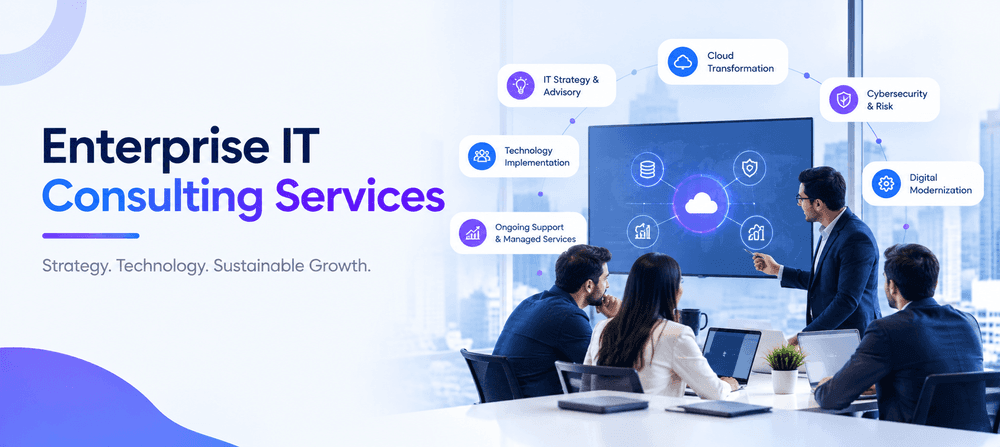
Most enterprise IT consulting engagements don't fail because the consultants were bad. They fail because nobody agreed, in writing, on what the engagement actually was. Six weeks in, the client thinks they're getting an implementation; the firm thinks they're delivering a strategy deck. Both are frustrated, the budget is half gone, and the real work hasn't started.
That gap almost always traces back to two things the buyer never pinned down: what "IT consulting services" actually includes, and how the scope was defined before anyone signed. Get those two right and the rest of the engagement tends to run itself. Get them wrong and no amount of talent on the consulting side will save it.
This guide is about getting them right. We'll walk through what enterprise IT consulting services genuinely cover, the deliverables you should expect from each, and the part most buyers skip how to scope an engagement so you get outcomes instead of slide decks.
What "Enterprise IT Consulting Services" Actually Means
The phrase is doing a lot of work, and that's part of the problem. "IT consulting" gets used for everything from a one-day architecture review to a two-year transformation program, and buyers who don't separate those end up comparing proposals that aren't remotely the same thing.
At enterprise scale, it helps to think of IT consulting as spanning three levels, because the level you're buying changes everything about price, timeline, and who you need in the room.
Advisory is thinking work: strategy, architecture, assessment, a roadmap. The deliverable is a decision or a plan, not a running system. It's the cheapest level and the fastest, and it's where a lot of engagements should start.
Implementation is building work: actually delivering the system, the migration, or the platform the advisory stage recommended. This is where most of the budget and most of the risk live, and where the "strategy deck vs working software" misunderstanding does its damage.
Managed and ongoing is running work: operating, supporting, and optimising what's been built, usually against agreed service levels. It's a different commercial model again ongoing, not project-based.
The single most useful question you can ask a prospective partner is which of these three they're proposing, because a firm that's brilliant at advisory may have no implementation muscle at all. If you want to see how the whole field sorts out before you shortlist, our guide to the top IT consulting services companies breaks down who tends to specialise where.
The Core Services, and What Each Should Deliver
Under those three levels sits a set of concrete services. Here's what each typically includes and, more importantly, the deliverable you should hold them to.
Technology strategy and advisory: Aligning your technology with business goals platform decisions, build-versus-buy calls, a prioritised roadmap. The deliverable is a documented strategy with clear recommendations and a sequence, not a vague "digital vision." If you can't act on it the week it lands, it wasn't scoped tightly enough.
Architecture and systems design: Designing how systems fit together the target architecture, integration patterns, data flows, security model. The deliverable is a design concrete enough to build from. This is the bridge between advisory and implementation, and skipping it is how expensive builds go sideways.
Implementation and systems integration: The actual delivery: building the platform, integrating systems, migrating data, standing up infrastructure. The deliverable is working, tested, documented software or infrastructure in your environment. This is the heaviest service and the one to scope most carefully.
Legacy modernisation: Moving off aging systems re-platforming, breaking up monoliths, migrating to cloud-native infrastructure. It carries real operational risk, so the deliverable should include a migration plan with rollback, not just the new system. The discipline this takes is worth understanding up front, which is why technology modernisation consulting deserves its own scoping conversation rather than being folded into a general build.
Cloud and infrastructure consulting: Cloud strategy, migration, cost optimisation, DevOps maturity. The deliverable ranges from an assessment to a fully migrated, optimised environment, depending on the level you bought — so be explicit about which.
Security and compliance advisory: Posture assessment, architecture review, regulatory readiness. The deliverable is a prioritised risk register and remediation plan, and at enterprise scale this often has to run through the whole engagement rather than sit in a box at the end.
Data and AI consulting: Data strategy, platform design, and increasingly the integration of machine learning into products. The deliverable depends heavily on depth of need and this is one area where generalist consulting and genuine specialism diverge sharply, so scope it with that in mind.
The pattern across all of these: a well-scoped service names its deliverable in terms you can verify. "Advisory on cloud" is not a deliverable. "A cloud migration plan covering these twelve workloads, with cost estimates and a phased sequence" is.
How to Scope an Enterprise IT Consulting Engagement
This is the part that separates engagements that deliver from engagements that drift. Scoping isn't paperwork you do after choosing a firm done well, it's most of the decision.
Start with the outcome, not the activity: The strongest scopes begin from the business result you need — "cut infrastructure cost 30%," "migrate off the mainframe by Q3," "ship the new platform to pilot customers" — and work backwards to the activity. A scope written as a list of activities ("advise on architecture, review code, support the team") with no outcome attached is how you end up paying for effort instead of results. This is the same principle as insisting on teams measured by outcomes, not just headcount: define what done looks like before you count hours.
Name the deliverables precisely: For each service, write down exactly what you'll receive and in what form a document, a working system, a trained team, a signed-off migration. Precision here is what prevents the strategy-deck-versus-software misunderstanding, because both sides can point to the same sentence.
Agree who owns what: Spell out the split of responsibility between the consulting firm and your internal team. Who makes architectural decisions? Who owns the code after handover? Who runs it in production? Ambiguity here is where blame lives when something slips.
Set phase gates, not one big bang: Break the engagement into phases with a decision point at the end of each assess, then design, then build, then run so you can course-correct or stop before the whole budget is committed. A good partner welcomes this; a firm that only sells the entire program as one indivisible block is a flag.
Define success and how it's measured: Write down the acceptance criteria before work starts: what has to be true for a phase to count as done. Vague success criteria are how engagements end in dispute rather than sign-off.
Protect your IP and knowledge: At enterprise scale, make the contract explicit that your code, designs, and data are yours, and that knowledge transfers to your team rather than walking out the door when the consultants leave. The goal is capability that stays, not dependency that deepens.
Much of this logic overlaps with running a proper procurement process the IT consulting RFP is where these scope questions become the questions you actually put to bidders, so the two work hand in hand.
The Scoping Mistakes That Cost the Most
A few errors recur often enough across enterprise engagements to be worth naming directly.
Scope creep with no change process: Requirements will change that's normal. What hurts is having no agreed mechanism for how changes get priced and approved. Without one, either the firm absorbs cost and cuts corners, or you get surprise invoices. Agree the change process in the contract, not mid-crisis.
Buying implementation when you needed advisory first: Rushing into a big build before the strategy and architecture are settled is how enterprises spend heavily building the wrong thing. If the direction isn't clear, scope a smaller advisory phase first and decide from there.
No knowledge transfer clause: The engagement ends, the consultants leave, and your team can't maintain what was built. Dependency by accident. Bake knowledge transfer into the scope as a deliverable, not a hope.
Confusing consulting with staffing: These are different engagements with different economics, and conflating them muddies the scope badly. If what you actually need is extra hands under your own direction rather than outside expertise owning a problem, that's a different model the distinction between IT consulting and staff augmentation is worth settling before you write a single line of scope.
Underestimating the cost of getting it wrong: The fee is the visible number; the cost of a poorly scoped engagement rework, delay, a half-built system nobody owns is the one that hurts. Going in with a realistic view of what IT consulting actually costs helps you judge whether a cheap proposal is a saving or a warning.
Consulting, In-House, or a Blend?
Scoping also means being honest about what should be consulted out at all. Not every problem needs an external firm.
Consulting earns its keep when you need expertise you don't have and don't need permanently a one-time migration, a specialised architecture decision, a capability your team hasn't built before. It's the wrong tool for ongoing work that your own people should own, where building internal capability beats renting it indefinitely. The trade-offs here are real enough that they deserve their own look: the comparison of an IT consulting firm versus an in-house technology team lays out when each wins.
The most effective enterprise pattern is usually a blend: consultants for the strategy and the hard, one-time build, and a strong internal team or a dedicated partner team to own and run it afterward. Scoped well, the consulting engagement is explicitly designed to hand capability over, not to create a permanent dependency. And when the talent itself is the constraint, knowing where the deep engineering and consulting talent actually sits shapes whether you consult, hire, or build a dedicated team.
A Practical Scoping Checklist
Before you sign any enterprise IT consulting engagement, confirm each of these is written down and agreed.
- Which level am I buying? Advisory, implementation, or managed named explicitly, not assumed.
- What exactly will I receive? Every deliverable defined in verifiable terms, not activities.
- What's the business outcome? The result the engagement is accountable to, written at the top.
- How is it phased? Decision gates between phases so you can adjust or stop.
- Who owns what? Responsibility, decision rights, and post-handover ownership spelled out.
- How do changes get handled? A change-and-pricing process agreed before work starts.
- What transfers to my team? Knowledge transfer and IP ownership written as deliverables.
- How is success measured? Acceptance criteria defined before the first phase begins.
If a prospective partner resists making any of these concrete, that resistance is itself information. A firm confident in its delivery is happy to be held to a precise scope; it's the one planning to bill for effort that prefers the scope vague. The fuller evaluation of a consulting partner builds on exactly this instinct.
Where SquadXP Fits
We'll be clear about our angle. We are not a traditional strategy-deck consultancy our strength is the part of enterprise technology work where the right people are the deliverable. When an engagement needs specialist expertise, a capable build team, or leadership that can own a technology problem end to end, we assemble it: pre-vetted specialists and dedicated teams scoped around your actual outcome, not a generic statement of work.
That matters most at the implementation and modernisation end, where scopes drift and dependency creeps in. Because we build teams designed to integrate with your people and transfer capability rather than hoard it, the engagement is scoped from the start around leaving you stronger the principle of teams built for outcomes, not just headcount applied to enterprise delivery. Whether you need a specialist for one hard decision or a team to carry a build, the aim is a scope that delivers capability you keep.
Build Your Next Initiative With Confidence
Enterprise IT consulting services aren't one thing, and the engagements that deliver are the ones where the buyer refused to pretend they were. Know which level you're buying, hold each service to a verifiable deliverable, scope from the outcome backward, phase the work so you can steer, and write knowledge transfer in so capability stays with you. That discipline, more than the logo on the proposal, is what separates value from a wasted budget.
If you want help scoping an engagement or building the specialist team to deliver it we would be glad to talk it through. Reach out about specialist hiring or a dedicated team for your next technology initiative.ay for.